Expense Recognition Principle: Definition, Methods and Examples

Imagine selling 1,000 products in March but waiting until April to account for the production costs. March shows enormous profit. April shows an unexplained loss. Neither number is accurate, and neither is useful for planning. This is how the expense recognition principle creates confusion when it is misapplied.
The expense recognition principle, also known as the matching principle, requires that expenses are recorded in the same accounting period as the revenues they help generate. It is one of the foundational principles of accrual accounting and a requirement under both GAAP and IFRS. This guide covers the definition, the three methods of expense recognition, the period vs product cost distinction, worked journal entries, and the FP&A implications for budgeting and forecasting.
Read more: Strategic Financial Planning That Actually Drives Results
What Is the Expense Recognition Principle?
The expense recognition principle is all about timing. It ensures that costs are recorded in the same period as the revenue those costs contributed to generating. It is a key component of accrual accounting, which records financial events when they occur rather than when cash changes hands.
Going back to the March example: the cost of producing those 1,000 products, including materials, labour, and packaging, should be recorded in March alongside the March sales revenue, even if suppliers are not paid until April. Those costs are part of the story behind the March sales. Recording them in April would make both months’ financial statements misleading.
The expense recognition principle is closely related to the revenue recognition principle. Both ensure that the income statement reflects the true economic activity of a period rather than its cash flow. Under cash-basis accounting, expenses are recorded only when cash is paid. Under accrual accounting, expenses are recorded when they are incurred. The expense recognition principle is the mechanism that ensures accrual-basis expenses align with the revenue they support.
Read: EBITDA vs Cash Flow: Why Profitable Companies Still Run Out of Cash

Accrual Accounting vs Cash Accounting
The distinction between the two accounting methods defines when the expense recognition principle applies.
| Dimension | Accrual Accounting | Cash Accounting |
| When expenses are recorded | When incurred (regardless of payment) | When cash is paid |
| When revenue is recorded | When earned (regardless of cash receipt) | When cash is received |
| Expense recognition principle | Applies: expenses matched to related revenue | Does not apply: timing is cash-driven |
| Financial statement accuracy | More accurate picture of profitability | Can distort profitability with timing differences |
| Required for | All companies above certain size; public companies; IFRS reporters | Small businesses; some private companies |
| Example | Commission earned in December, paid in January: recorded in December | Commission earned in December, paid in January: recorded in January |
Accrual accounting is required under GAAP and IFRS for most businesses. Cash accounting is permitted for small private companies in many jurisdictions but produces financial statements that are less useful for trend analysis, budgeting, and stakeholder reporting.
The Three Expense Recognition Methods
Not all expenses are matched to revenue in the same way. The matching principle applies through three distinct methods depending on the relationship between the expense and the revenue it supports.
Method 1: Direct Matching (Cause-and-Effect)
When a clear, direct link exists between an expense and the specific revenue it generates, the expense is recognised in the same period as that revenue.
This applies to: Cost of goods sold (recognised when the goods are sold, not when manufactured or purchased); sales commissions (recognised in the period the sale occurs, not when the commission is paid); warranty costs (recognised in the period of sale, because the warranty relates to the sold product).
Direct matching is the most precise application of the principle. The cause (the expense) and the effect (the revenue) are identifiable and recorded together.
Method 2: Systematic and Rational Allocation
When an expense cannot be linked to specific revenue but provides benefits across multiple periods, it is spread systematically across those periods. The allocation method should be rational and applied consistently.
This applies to: Depreciation of fixed assets (cost spread over the asset’s useful life); amortisation of intangibles (cost spread over the benefit period); prepaid expenses (such as annual insurance premiums allocated monthly). The allocation does not require matching to specific revenue. It requires a rational basis for spreading the cost across the periods it benefits.
Method 3: Immediate Recognition (Period Costs)
When no future economic benefit can be identified and no direct link to revenue exists, the cost is expensed in full in the period it is incurred. These are called period costs.
This applies to: Rent for the current month; administrative and executive salaries; utility bills; general marketing expenditure not linked to specific future revenue. Period costs are recognised regardless of whether the business generates revenue in that period. They are the cost of being in operation, not the cost of generating a specific sale.
Read: Revenue vs Gross Profit: Understanding the Difference to Avoid Planning Errors
Period Costs vs Product Costs
The distinction between period costs and product costs determines which recognition method applies and how costs flow through the financial statements.
| Product Costs | Period Costs | |
| Definition | Directly tied to producing goods or delivering services | Support the business broadly; not tied to a specific product |
| Examples | Raw materials, direct labour, manufacturing overhead | Rent, admin salaries, utilities, general marketing |
| Balance sheet treatment | Held as inventory until goods are sold | Expensed immediately; never capitalised as inventory |
| P&L recognition | Recognised as COGS when goods are sold (Method 1) | Recognised in the period incurred (Method 3) |
| Risk of misclassification | If expensed too early: understated inventory, understated profit | If capitalised incorrectly: overstated assets, inflated profit |
Misclassifying a period cost as a product cost defers expense recognition and inflates short-term profitability. A company that capitalises administrative salaries as part of inventory cost is distorting both the income statement and the balance sheet. This is one of the most common financial statement manipulation techniques and one of the things auditors check for specifically.
Read: Balance Sheet vs Income Statement: Key Differences and Why You Need Both for Financial Planning
How the Expense Recognition Principle Works in Practice
The best way to understand the three methods is through worked examples with journal entries.
Example 1: COGS Matching (Method 1)
A manufacturer purchases $40,000 of raw materials in April. The finished goods are sold in June for $100,000.
In April, at purchase:
| April: Raw Material Purchase | Debit | Credit |
| Inventory (Asset) | $40,000 | |
| Cash / Accounts Payable | $40,000 | |
| Cost held as inventory; not yet expensed. No revenue has been earned from these materials yet. |
In June, when the goods are sold:
| June: Sale and COGS Recognition | Debit | Credit |
| Accounts Receivable | $100,000 | |
| Revenue | $100,000 | |
| Cost of Goods Sold (Expense) | $40,000 | |
| Inventory | $40,000 | |
| The $40,000 cost is recognised in June, matched to the $100,000 revenue it generated. Not in April when cash was paid. |
Example 2: Long-Term Equipment (Method 2)
An energy company installs $24,000 of specialised equipment at the start of a 24-month contract. The equipment serves only this contract and has no residual value.
| Month 1-24: Monthly Depreciation / Allocation | Debit | Credit |
| Depreciation / Allocation Expense (P&L) | $1,000 | |
| Accumulated Depreciation / Equipment (Balance Sheet) | $1,000 | |
| The $24,000 cost is spread evenly across 24 months ($1,000 per month), matching the expense to the monthly revenue it supports. The full cost is never expensed at once. |
Example 3: Depreciation on Fixed Assets (Method 2)
A company purchases machinery for $60,000. Useful life is 5 years, straight-line, no residual value. Annual depreciation is $12,000 ($60,000 / 5 years).
| Year-End: Annual Depreciation Entry | Debit | Credit |
| Depreciation Expense | $12,000 | |
| Accumulated Depreciation | $12,000 | |
| The $60,000 capital expenditure never appears on the income statement in full. $12,000 per year is allocated for 5 years, matching the asset cost to the periods it generates economic benefit. |
Example 4: Sales Commission Accrual (Method 1)
A salesperson earns $5,000 in commissions on December sales. The commission is paid in January.
| December 31: Commission Accrual | Debit | Credit |
| Commission Expense | $5,000 | |
| Accrued Commissions (Liability) | $5,000 | |
| Recognised in December because that is when the revenue it supported was earned. Cash payment in January does not affect the period of recognition. |
| January: Commission Payment | Debit | Credit |
| Accrued Commissions (Liability) | $5,000 | |
| Cash | $5,000 | |
| The liability is cleared when cash is paid. No new expense is recognised; the expense was already recorded in December. |
Common Challenges and Mistakes
- Timing errors. Recording expenses when cash is paid rather than when incurred is the most common violation of the matching principle. It is also the most common difference between cash-basis and accrual-basis accounting. Costs related to long-term contracts are sometimes recorded in full at project start rather than allocated over the performance period.
- Misclassification of expense type. Classifying a period cost as a capital expenditure (capitalising costs that should be expensed) inflates assets and defers expense recognition. The reverse, expensing capital costs immediately, reduces assets and overstates current-period costs. Both distort profitability and require correction.
- Multi-jurisdiction inconsistency. Companies operating across regions may face different local accounting rules. IFRS refers to a ‘matching concept’ rather than a formal ‘matching principle’ and applies it with somewhat different guidance to certain transactions. Ensuring consistency across jurisdictions requires documented policies and periodic audit of regional accounting treatments.
- Manual process errors. Manual accrual journal entries at period-end create significant risk: missed entries, incorrect amounts, entries posted to the wrong period, and reversals applied in the wrong direction. The volume of accruals required at month-end in a large organisation makes manual processes inherently error-prone.
- Non-compliance with standards. Misunderstanding when to capitalise versus expense costs, how to determine depreciation periods, or how to allocate prepaid costs across periods can all result in non-compliance with GAAP or IFRS. Compliance violations create audit risk and may require restatement of prior-period financial statements.
Read: Accounts Payable Turnover Ratio: Formula, Benchmarks and How to Optimise It
FP&A Implications of the Expense Recognition Principle
The matching principle is not just an accounting requirement. For FP&A teams, it shapes how costs should be budgeted, forecast, and analysed.
Accrual-based budgeting. A budget built on cash flows rather than accrued costs will misrepresent profitability. If a sales team budget is built around when commissions are paid rather than when sales occur, the P&L will show depressed margins in high-sales months (when commissions are accrued) and inflated margins in lower-sales months (when prior accruals clear). Budgets must follow the matching principle: costs are planned in the period the related revenue is earned, not when cash changes hands.
Rolling forecast accuracy. A rolling forecast that does not properly accrue costs for work already performed will overstate forward profitability. FP&A teams building 12-month rolling forecasts need to ensure that accrued costs, including commissions earned but unpaid, services delivered but not yet invoiced, and depreciation on newly capitalised assets, are included in the forecast periods they belong to, not deferred to the period of cash payment.
Variance analysis and timing. When P&L shows higher expenses than expected, the first diagnostic question is whether the variance is a timing difference (an accrual hitting in the wrong period) or a genuine cost overrun. A commission expense appearing in the wrong month is an accrual error, not a business performance problem. Understanding the matching principle makes this diagnostic faster and prevents finance teams from investigating operational causes for what is actually a period allocation error.
The Role of FP&A Software in Expense Recognition
Proper expense recognition requires knowing when revenue is recognised, which costs are directly linked to that revenue, and that all accruals and allocations are processed before the period closes. Each of these requires data from across the organisation, processed consistently at every reporting cycle.
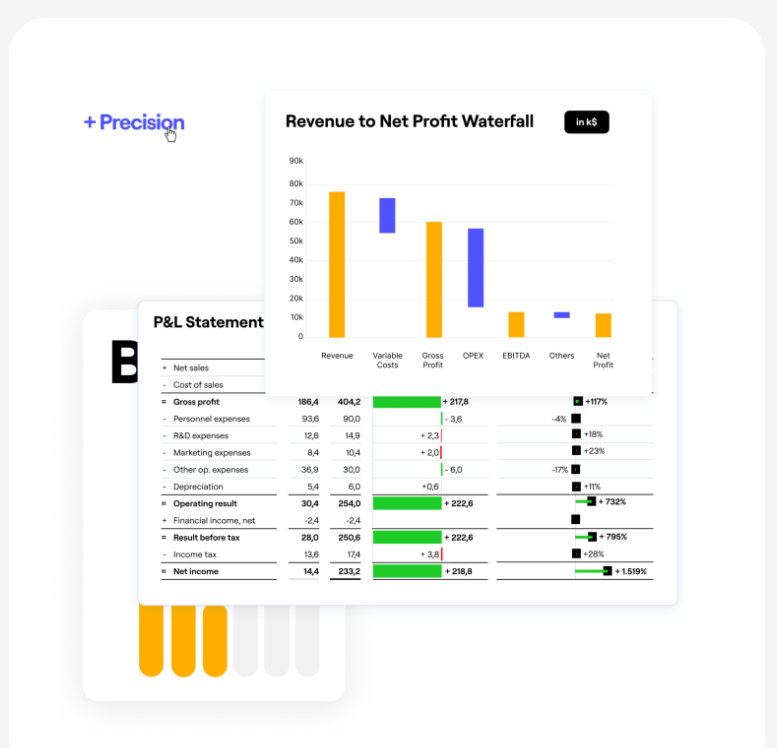
Farseer: The matching principle requires three things to work correctly in practice: knowing when revenue is recognised, knowing what costs are linked to that revenue, and ensuring the accruals and allocations are processed before the period closes. In Excel, this is a manual rebuild every month. Each new revenue line requires identifying the matching costs, calculating the allocation period, and posting the accrual entries. Farseer’s connected planning platform maintains the linkage between cost assumptions and revenue drivers throughout the planning cycle. When a driver changes, associated cost allocations update automatically. Depreciation schedules connect to the capital expenditure plan. Commission accruals update when the revenue forecast changes. Month-end accruals flow from the planning model rather than being rebuilt from scratch at every close. This turns the matching principle from a period-end accounting task into a continuous planning discipline. Explore Farseer’s three-statement planning capabilities at farseer.com/solutions/three-statements/.
Key features that support expense recognition in FP&A platforms include: automation that matches expenses with revenues without manual intervention; real-time tracking that provides up-to-date visibility into expense and revenue patterns as they occur; and compliance support that ensures treatment is consistent with GAAP or IFRS standards across all entities and periods.
For multinational teams, centralised FP&A platforms provide a single source of truth for expense allocation policies across jurisdictions, reducing the inconsistency that arises when each regional finance team applies the matching principle differently under local interpretations.
Conclusion
The expense recognition principle is the mechanism that makes financial statements reliable. By matching costs to the periods they belong to rather than the periods cash changes hands, the income statement tells the true story of how the business is performing rather than a story distorted by payment timing.
The three methods, direct matching for directly linked costs, systematic allocation for multi-period costs, and immediate recognition for period costs, cover every expense a business will encounter. Understanding which method applies to which cost, and why, is what separates finance professionals who interpret business performance from those who simply report the numbers.
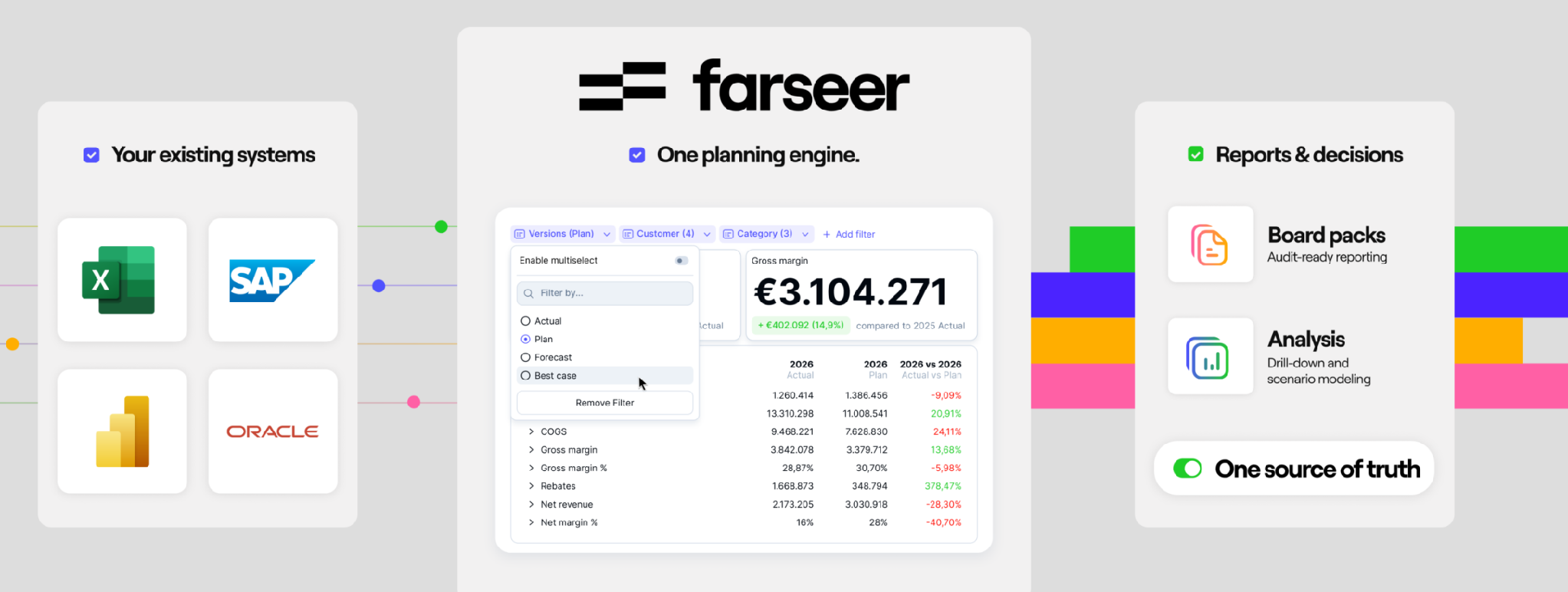
Farseer: The expense recognition principle is only as useful as the planning infrastructure behind it. Matching costs to revenue in the accounting records is one step. Ensuring the forward model reflects those same matching relationships (that next quarter’s commission budget moves when the revenue forecast changes, and that depreciation feeds the P&L automatically as new assets are capitalised) is where most Excel-based finance teams lose the benefit the principle is supposed to provide. Farseer keeps the matching relationships intact through the entire planning cycle, from budget to rolling forecast to month-end close, without requiring finance teams to manually rebuild allocations at each planning cycle. Explore the platform at farseer.com.

FAQ
What is the expense recognition principle?
The expense recognition principle requires that expenses are recorded in the same accounting period as the revenues they help generate. It is a core part of accrual accounting and a requirement under both GAAP and IFRS. Also called the matching principle, it ensures that the income statement reflects the true economic activity of each period rather than the timing of cash payments.
What are the three methods of expense recognition?
The three methods are: (1) Direct matching, where expenses with a clear cause-and-effect relationship to revenue are recognised in the same period as that revenue, applied to COGS, commissions, and warranties; (2) Systematic and rational allocation, where expenses benefiting multiple periods are spread across those periods, applied to depreciation, amortisation, and prepaid expenses; (3) Immediate recognition, where expenses with no identifiable future benefit are recognised immediately, applied to rent, administrative salaries, and utilities.
What is the difference between period costs and product costs?
Product costs are directly tied to producing goods or delivering services: raw materials, direct labour, manufacturing overhead. They are held as inventory and recognised as COGS when goods are sold. Period costs support the business broadly: rent, admin salaries, utilities. They are expensed immediately in the period incurred. Misclassifying period costs as product costs inflates assets and defers expense recognition, distorting profitability.
How does the expense recognition principle relate to accrual accounting?
Accrual accounting is the broader framework that records financial events when they occur rather than when cash changes hands. The expense recognition principle is one of the key principles within that framework, specifically governing how and when costs are matched to the revenue they help generate. Accrual accounting without the matching principle would result in expenses and revenues that are recorded accurately in isolation but not aligned with each other.
What are the most common expense recognition mistakes?
The five most common mistakes are: recording expenses when cash is paid rather than when incurred; misclassifying period costs as capital expenditures; failing to allocate long-term contract costs across the periods they benefit; inconsistent application of the matching principle across departments or jurisdictions; and relying on manual accrual journal entries that introduce timing errors and missed entries at period-end.
What are some examples of the expense recognition principle in practice?
Four common examples: COGS recognised when goods are sold, not when manufactured; straight-line depreciation spreading a $60,000 asset cost over 5 years at $12,000 per year; commission accruals recorded in the month of the sale even when payment follows in the next month; prepaid insurance allocated monthly across the 12-month policy period rather than expensed in full when the premium is paid.
How does FP&A software help with expense recognition?
FP&A platforms automate the linkage between revenue recognition and related cost accruals, so when the revenue model changes, the associated expense accruals update automatically. They maintain depreciation schedules connected to the capital expenditure plan, track commission accruals linked to the sales forecast, and ensure period-end accruals flow from the planning model rather than requiring manual journal entries at every close.

Financial Statement Analysis: The Complete Guide (With Step-by-Step Process)
Read more
Best Financial Analysis Tools in 2026: Compare Features & Pricing
Read more