

80%
Faster cost allocation process
"Farseer has significantly enhanced the speed, quality and reliability of our insights."

Enterprise companies choose Farseer because finance teams own the platform from day one, without the cube learning curve, the dedicated admin, or the paid connectors.

Trusted by enterprise finance teams

"Farseer turned our dreams into reality. The tool is so intuitively easy to use that whoever logged in continued to use it. Farseer is a refreshment in terms of the ease of planning and reporting."Read case study





"Feature-wise, Farseer was on par with the big players, but the difference was in the approach. The Farseer team was honest, hands-on, and they truly understood our needs. That's what sealed the deal for us."Read case study


“We tested other solutions, but in the end we chose Farseer because it was very similar to Excel; intuitive, you can copy and paste, and it’s visually familiar. That made it easy for planners to transition. But underneath, it’s a properly structured model with fact tables, dimension tables, and variables everything we couldn’t have in Excel.”Read case study




"From our SAP ERP, Farseer pulls all the historical data, prices, and rebates automatically. We can now create a preliminary sales plan in about ten minutes, apply growth targets, and get margin-level results immediately, something that used to take days."Read case study

"Manual work is cut by more than 50%. And I know exactly where every number came from."Read case study

"Farseer has significantly enhanced the speed of our processes, as well as the quality, level of detail, and reliability of the information we prepare and analyze, bringing notable improvements to our controlling operations."Read case study

"With Farseer, we're seeing results we can act on. Reporting is 30% faster, planning cycles are shorter, and we now have real-time insights at our fingertips. It's been transformative for how we operate."Read case study
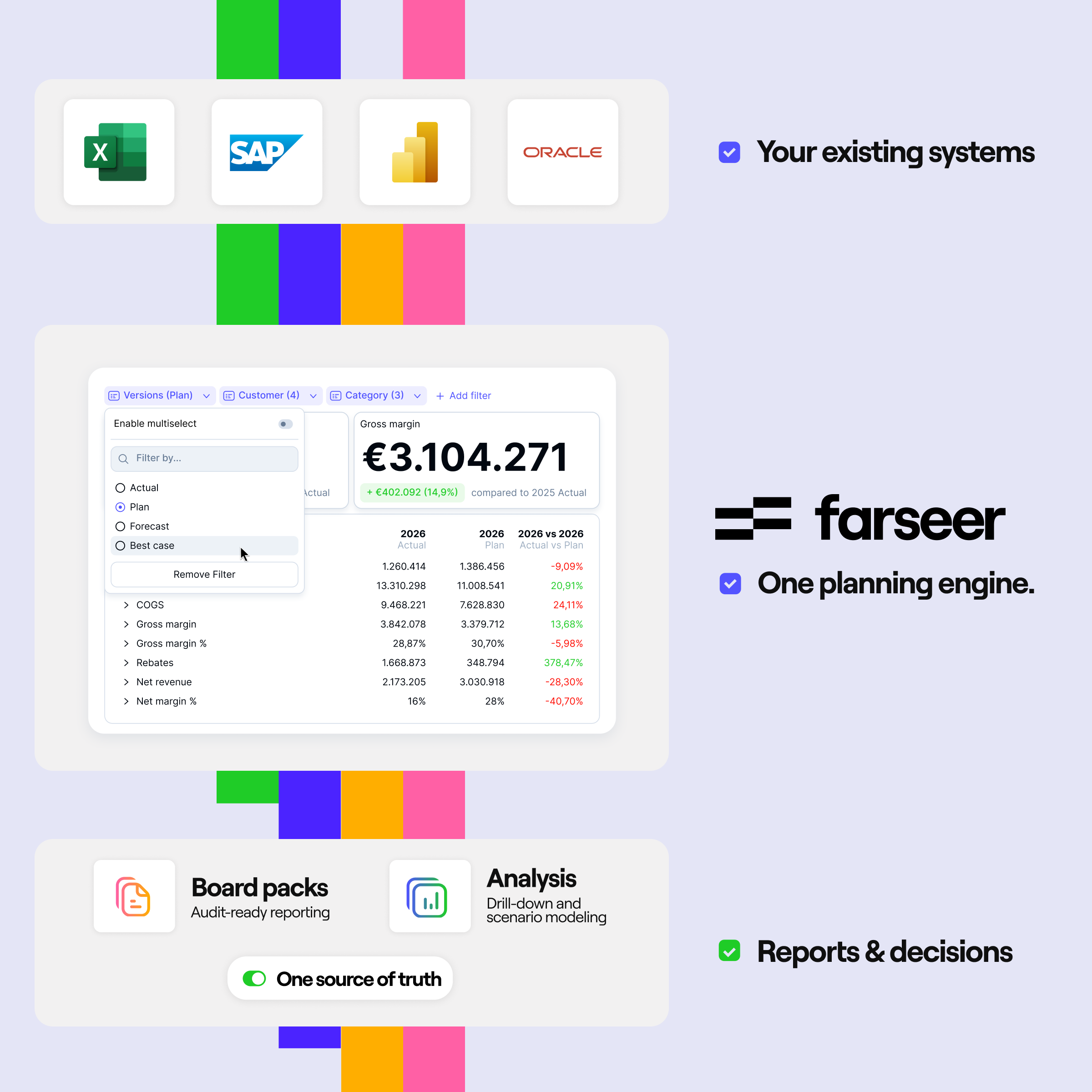
Jedox is powerful, but flexibility costs time and per-connector add-ons.
Jedox implementations average five months, with services that often match the software cost and most native connectors priced as add-ons. Farseer is vendor-delivered inside a single budget cycle, with integrations included.
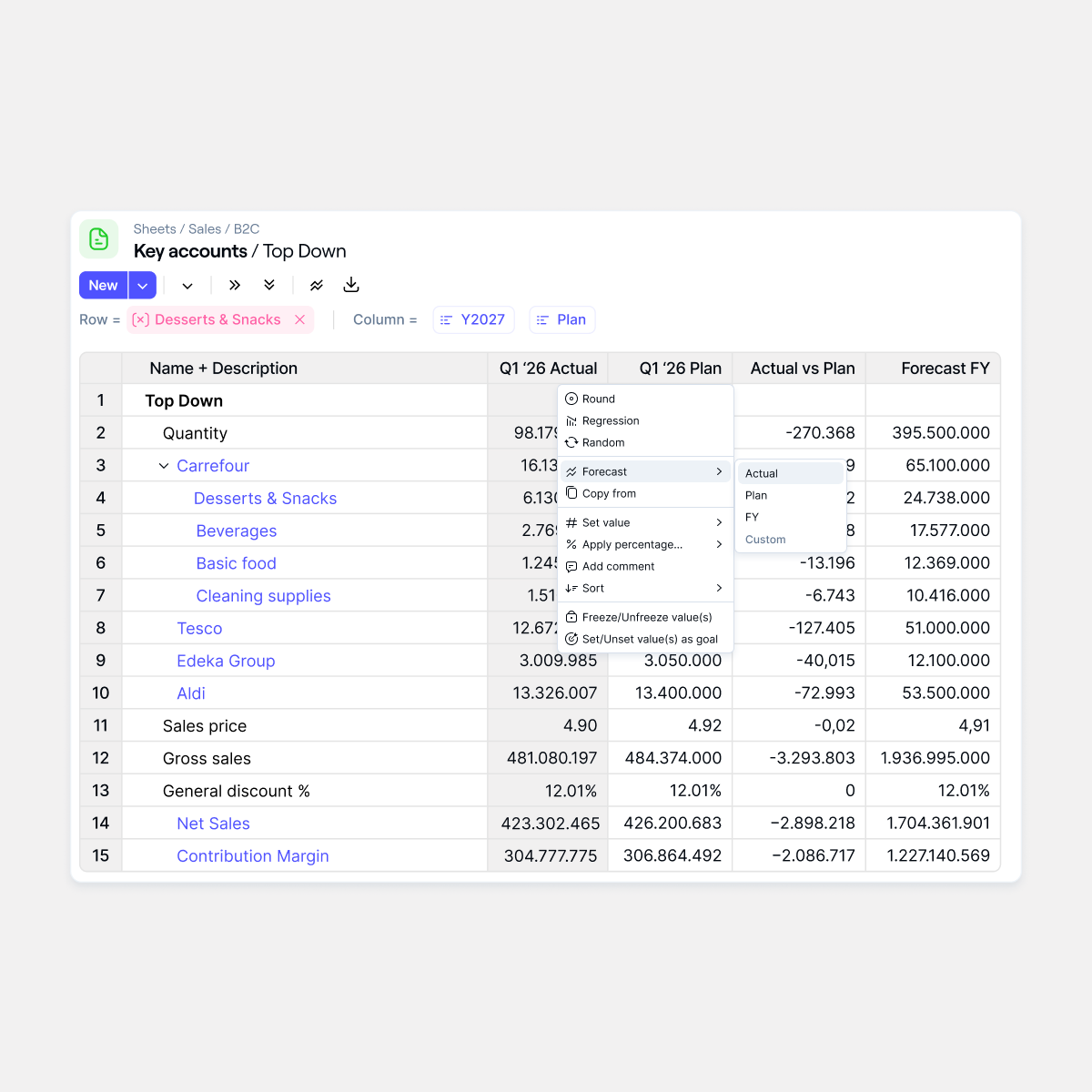
If your team can use Excel, they can use Farseer on day one.
Jedox is flexible, but that flexibility runs through PALO functions, cube logic, and dimension references – powerful but slow to grasp, and most deployments need a dedicated administrator.
Farseer keeps the spreadsheet model finance already thinks in, with formulas that read like plain English.
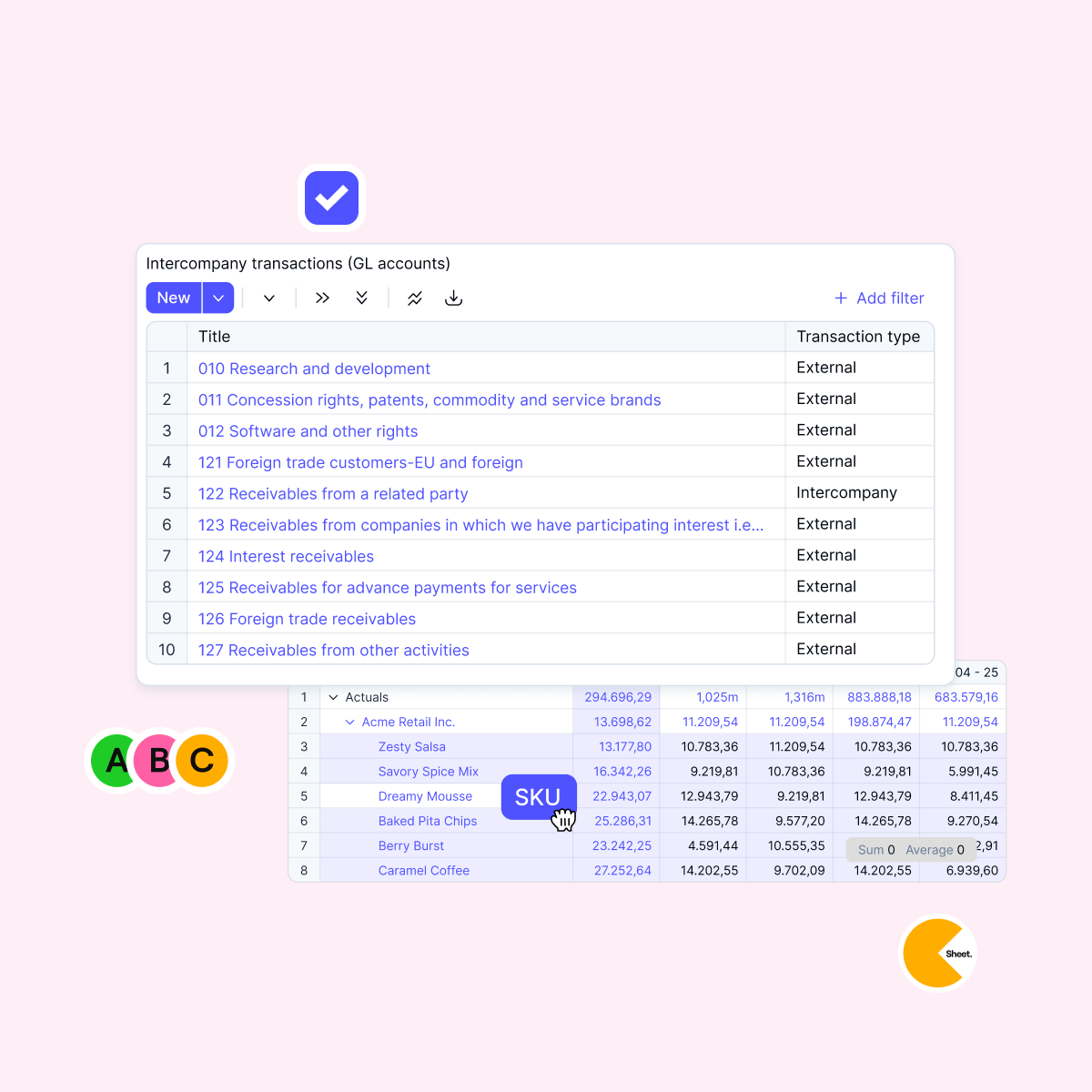
OLAP is fast on aggregates, until your dataset stops being aggregated.
Jedox’s in-memory OLAP engine is fast on summarized planning, but reviewers report performance degradation as datasets and models grow.
Farseer is architected for transaction-level granularity from the start, so the number you present at the board is the one you can defend in audit.
80%
Faster cost allocation process
"Farseer has significantly enhanced the speed, quality and reliability of our insights."
50%+
Reduction in manual work
"Farseer is so intuitively easy to use that whoever logged in continued to use it."

70%
Fewer planning cycle steps
"Farseer's driver-based planning gave us a reliable structure and streamlined our entire process."

Yes. Farseer is a modern enterprise planning platform built for finance teams that want the modeling depth of Jedox without the multi-month implementation, the proprietary formula syntax, or the dedicated admin role. Both platforms cover budgeting, forecasting, consolidation, and reporting, but Farseer is delivered directly by the vendor and designed for finance teams to own end-to-end after onboarding, rather than through a network of certified implementation partners.
Jedox implementations average around five months on G2, with multi-entity rollouts often stretching to six or eight months and services that frequently cost as much as the annual software license. Farseer customers — including Hrvatski Telekom, Delta DMD, and Croatia Airlines — are typically live within three months, working with the vendor directly rather than through a partner network. The shorter timeline comes from a single accountable team, a spreadsheet-native modeling interface, and no cube architecture to design upfront.
Jedox uses a proprietary modeling language built on PALO functions, dimension element references, and cube logic. Reviewers consistently describe it as powerful but slow to learn, and most Jedox deployments depend on a dedicated administrator to maintain models. Farseer formulas read like plain English and follow Excel conventions, so finance teams familiar with spreadsheets are productive on day one without specialist training or scripting.
Yes. Multi-dimensional modeling is a flagship Jedox strength, and Farseer supports the same modeling depth — activity-based costing, inter-entity allocations, complex driver hierarchies — through a different underlying architecture. The key difference is that Farseer doesn’t require users to think in cubes, dimensions, and elements as a separate mental model on top of the spreadsheet. The modeling power is the same; the learning curve is not.
Both platforms are European-founded and EU-hosted, so both offer strong data residency and GDPR alignment. Jedox is German, hosted on Azure Europe; Farseer is Croatian, also EU-hosted. The differentiator for European buyers tends to be vertical fit and time to value — Farseer has deep references in European telco (Hrvatski Telekom), pharma and FMCG (Delta DMD), and aviation (Croatia Airlines), and typically delivers a faster go-live than the Jedox partner-led model.