80%
Faster cost allocation process
"Farseer has significantly enhanced the speed, quality and reliability of our insights."

Both put finance in control – but where Vena stitches Excel, Power BI and a cube together, Farseer runs it all as one model on one engine.

Trusted by enterprise finance teams











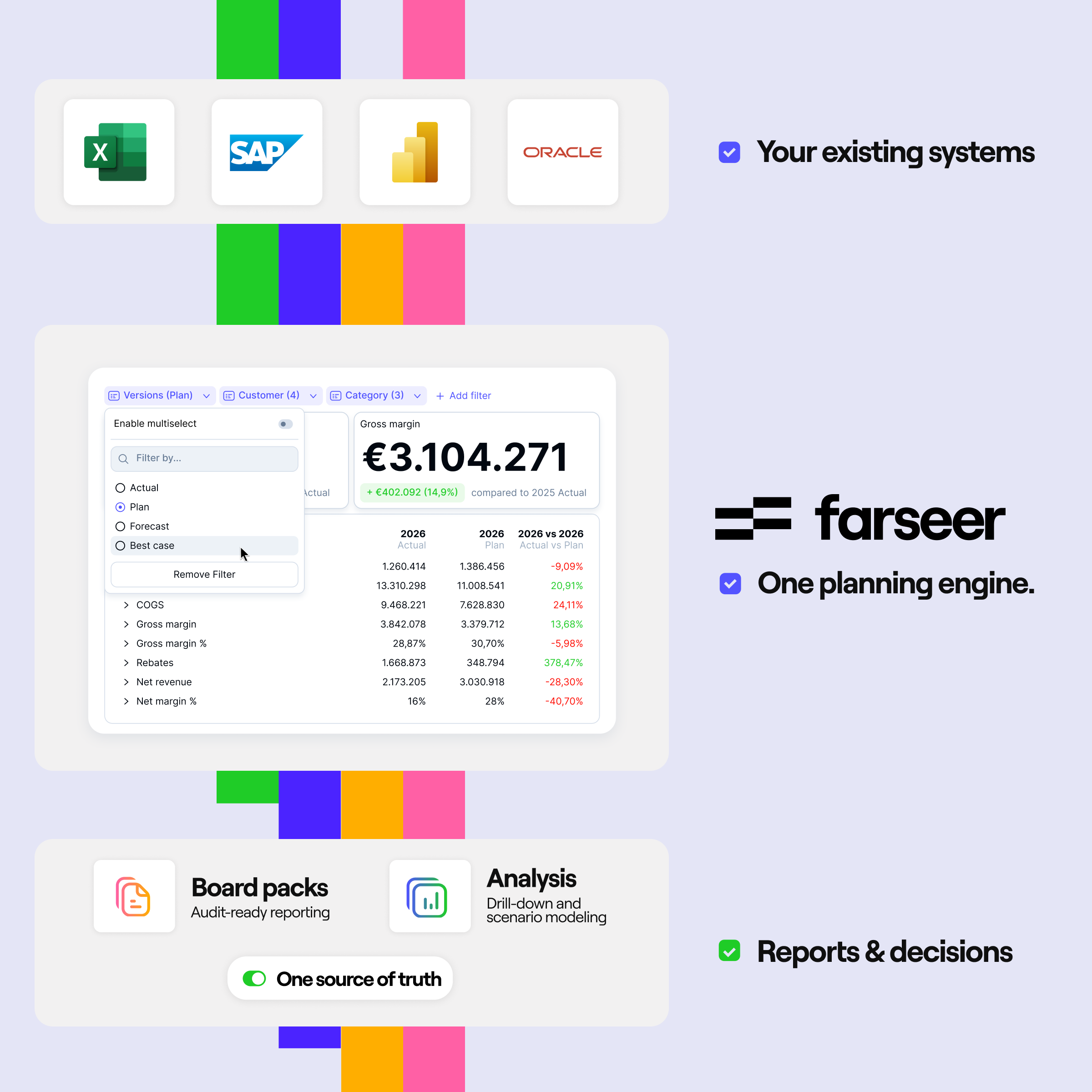
Vena’s platform now spans four connected parts – Excel as the front end, the CubeFLEX OLAP cube underneath, Acterys and Power BI for operational planning, and a separate consolidation product on top.
Each piece is valid, but every seam is a place where data has to sync and reconcile. Farseer runs operational and financial planning in a single unified model on one calculation engine. The same model that plans headcount and drivers produces your consolidated, multi-GAAP statements – fewer seams, fewer places for the numbers to drift.
Vena has its own modeling language, a certification program, and a consultant ecosystem. That’s not a feature.
The most consistent complaint across Vena’s reviews isn’t the interface or the support; it’s speed on large, complex models — templates that take minutes to load and calculations that lag as data volumes and entity counts grow. It’s the structural cost of running an enterprise workload on a spreadsheet grid and an OLAP cube.
Farseer’s calculation engine is built for large data volumes from the ground up, keeping planning, what-if simulations, and ML forecasting responsive at scale.

Vena is easy to use but slow to set up; Farseer gets finance running on its own faster and for less.
Reviewers say that Vena implementations run long, carry undisclosed fees on top of the subscription, and tend to need premium support and a dedicated power user to sustain.
Farseer is built for finance to own their models without IT or consultant dependency, with typical go-live under 90 days – which is where its roughly 4-5x lower TCO comes from.
80%
Faster cost allocation process
"Farseer has significantly enhanced the speed, quality and reliability of our insights."
50%+
Reduction in manual work
"Farseer is so intuitively easy to use that whoever logged in continued to use it."

70%
Fewer planning cycle steps
"Farseer's driver-based planning gave us a reliable structure and streamlined our entire process."

Not anymore. Vena started as a deep Excel integration over an OLAP cube, and Excel remains its front end and biggest selling point. But in 2026 Vena acquired Acterys to add Power BI–based operational planning and write-back, launched a dedicated financial consolidation product, and expanded its AI agent suite. The trade-off is that capability now spans several connected components rather than a single model.
Farseer has its own full spreadsheet interface, so finance users get familiar spreadsheet logic without being bound to Microsoft Excel’s grid, its calculation rules, or the risk of Microsoft changing them. Vena’s advantage is that it is Excel; Farseer’s is that it gives you spreadsheet flexibility on a calculation engine designed for planning at scale.
This is Farseer’s clearest edge. Across G2, Capterra, TrustRadius and BARC, Vena’s most frequent criticism is performance on large datasets and complex models — lag in calculations and multi-minute load times. Farseer’s calculation engine is purpose-built for large data volumes, which is what keeps what-if simulation and ML forecasting responsive as models grow.
Yes. Vena launched Vena Financial Consolidation in May 2026 and is a Niche Player in the 2026 Gartner Magic Quadrant for Financial Close and Consolidation. Farseer offers full consolidation parity — multi-entity, multi-currency, intercompany eliminations and multi-GAAP statutory reporting — as part of the same unified model rather than a separate product to reconcile.
Vena reviewers report implementations that run longer than expected, implementation fees of roughly $10,000–$30,000 often not disclosed upfront, and a general recommendation to invest in premium support and a dedicated power user. Farseer targets go-live in under 90 days with predictable, transparent cost scaling and positions its total cost of ownership at roughly 4–5x lower than Vena’s.