AI in CAPEX Management: From Project Requests to Capital Allocation

AI is transforming how companies manage their operations, especially in CAPEX management. By organizing project data, financial assumptions, forecasts, and actual spending, it helps businesses make faster and smarter investment decisions.
As a result, finance teams can review investment requests more efficiently, compare projects using the same standards, and update CAPEX forecasts as needed.
Read: Finance Automation in 2026: Tools, Use Cases, and Real-World Strategy
AI also makes CAPEX data more accessible. Teams can spend less time on reports and more time addressing important questions, like which projects deserve funding, which investments might exceed their budgets, how delays could affect cash flow, and where to invest next.
This article explains how AI fits into CAPEX planning, highlights where it adds the most value, and what companies need to use it effectively.
6 Ways AI Can Improve CAPEX Planning, Control, and Capital Allocation
AI is most valuable in CAPEX management when it helps improve the quality, speed, and consistency of investment decisions.
This can lead to clearer project requests, stronger assumptions, better project prioritization, more accurate forecasts, earlier warnings about cost overruns, and a better understanding of the entire investment portfolio.
The following six use cases show where AI can make the biggest difference in CAPEX planning, control, and capital allocation.
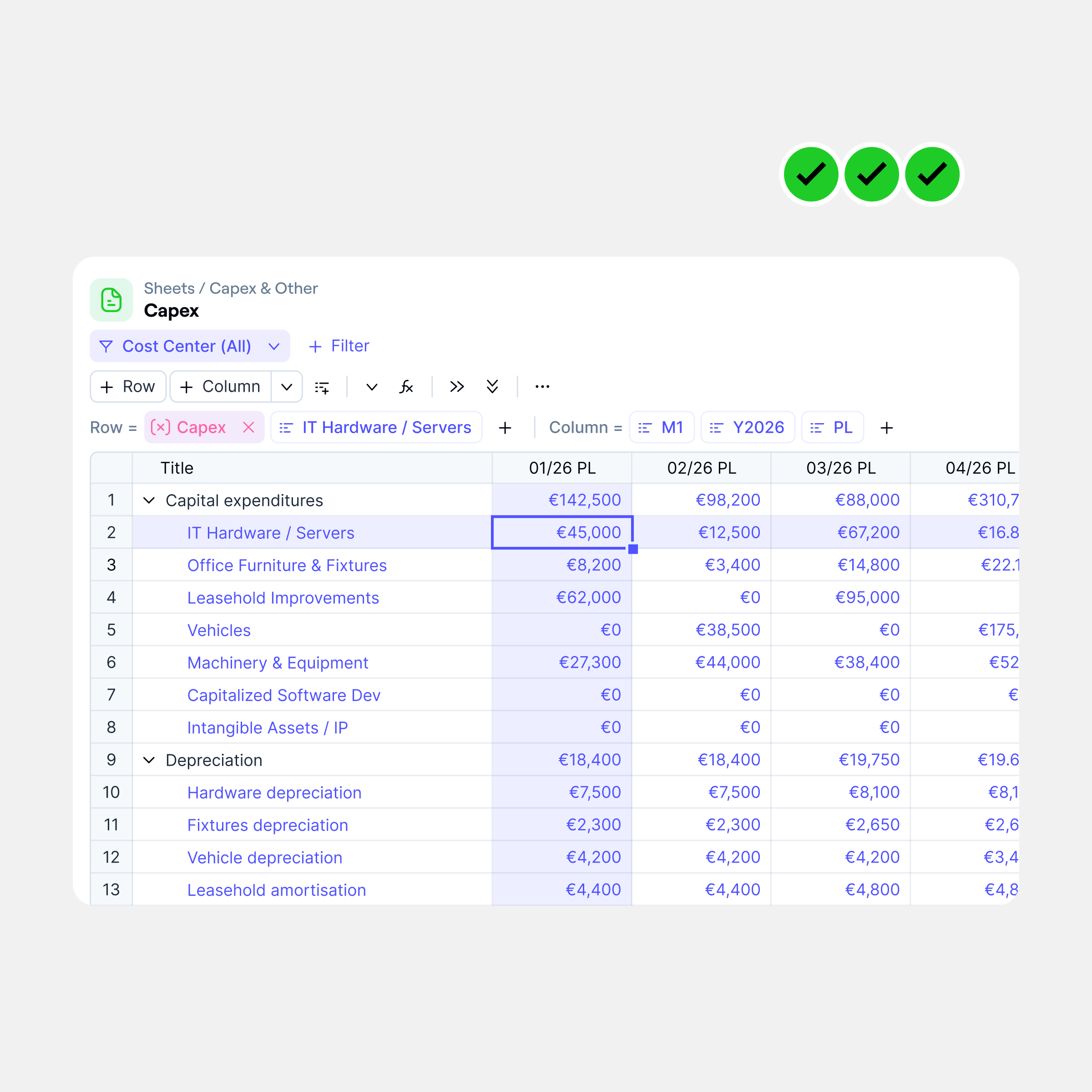
Standardize CAPEX requests before evaluation
CAPEX requests often come from different departments, plants, or business units. Each may use a different format and include different levels of detail.
AI can extract and organize information such as:
- project value
- expected timing
- project owner
- NPV
- IRR
- payback period
- strategic objective
AI can also sort projects into categories like maintenance, replacement, compliance, capacity expansion, or growth.
For example, imagine a manufacturing group with five plants and 90 CAPEX requests each year. If every plant uses a different spreadsheet, the finance team spends extra time preparing requests before they can even start evaluating them. AI can standardize these requests and highlight missing information before the approval process begins.
What to track: percentage of complete requests and average preparation time per request.
Challenge assumptions with historical data
A strong CAPEX business case relies on good assumptions. AI can compare new proposals to past projects and point out any unusual assumptions about cost, timing, savings, production impact, or payback.
Suppose a €4 million packaging line assumes installation costs of €250,000 and a four-month implementation period. Similar past projects averaged €420,000 and six months. That does not mean the proposal is wrong. It tells the review team exactly where to investigate.
Over time, this process creates a stronger feedback loop between what was planned and how projects actually perform.
What to track: variance between approved and actual project cost, implementation time, and expected versus realized return.
Prioritize projects using a transparent scoring model
When there are more proposed investments than available capital, choosing projects becomes a portfolio decision.
AI can help score projects using criteria such as:
- NPV
- IRR
- payback period
- strategic relevance
- compliance requirements
- operational risk
- capacity impact
- cash requirements
Assume a company has €55 million in proposed investments but only €35 million available. A compliance project may have a weak direct return but high regulatory importance. A capacity project may offer a strong IRR but require most of its cash in Q1.
Having a single scoring framework makes it easier to compare these trade-offs. Finance teams should still set the criteria and their importance. AI helps process the data and shows how different priorities change project rankings.
What to track: capital allocated by strategic category and expected return of the approved portfolio.
Reforecast CAPEX based on project progress
The annual CAPEX budget is just the beginning.
Consider a company with a €40 million CAPEX plan and 70 active projects.
By September:
- €21 million has been invoiced
- €6 million is committed but not yet invoiced
- three major projects have moved into Q1
If €5 million expected to be spent in Q4 moves to the next year, the effects go beyond just CAPEX. It can affect year-end cash, liquidity needs, when depreciation starts, and financing needs.
AI can combine project status, purchase orders, committed spending, and invoices to help keep CAPEX forecasts current.
That’s why CAPEX planning should connect directly with cash flow forecasting and the overall financial plan.
What to track: monthly CAPEX forecast accuracy and value of spend shifted between periods.

Detect project overruns earlier
A project might look like it’s within budget, even if committed spending already suggests it will go over.
Suppose a project has an approved budget of €8 million.
The company has:
- invoiced €5.1 million
- committed €2.4 million through purchase orders
- received a revised €900,000 estimate for remaining work
Looking only at invoices, it seems there is €2.9 million left in the budget. But the total expected cost is already €8.4 million.
AI can gather invoices, purchase orders, updated estimates, and project progress to spot this risk before it becomes an actual overspend.
This gives teams more time to update forecasts, review the project scope, or request extra approval if needed.
What to track: value of potential overruns identified early and time between warning and corrective action.
Manage CAPEX as a portfolio
Looking at individual projects helps decide if a single investment makes sense.
Portfolio analysis helps determine if the company is putting its capital in the right places.
Assume a group has a €60 million CAPEX plan:
- €24 million for maintenance and replacement
- €18 million for capacity expansion
- €8 million for compliance
- €10 million for growth
Management can then ask:
- How much capital is already committed?
- Which projects drive most of next quarter’s cash requirements?
- How much CAPEX protects current capacity versus adding new capacity?
- What happens to liquidity if major projects move by one quarter?
For teams that want to connect this type of analysis with budgets, forecasts, and actuals, tools such as Farseer AI can support that work within the broader planning process.
The main advantage is managing CAPEX as one investment portfolio, rather than as separate project files.
What to track: committed versus available budget and capital allocation by category.
What You Need Before Using AI in CAPEX Management
Before bringing in AI, companies should focus on getting three key things right.
Get the CAPEX data model right
Every project should follow a common structure.
That usually includes:
- approved budget
- project owner
- business unit or cost center
- project category
- planned start and completion date
- planned spend by period
- actual spend
- committed spend
- project status
- NPV, IRR, or payback assumptions
Whenever possible, historical project data should follow the same structure. This helps AI compare projects, spot patterns, and make better forecasts.
Define approval and decision rules
AI works best when approval rules are clear.
Companies should define:
- approval thresholds
- required financial metrics
- mandatory project information
- scoring criteria
- approval responsibilities
For example, projects above €5 million may require group-level approval, while projects with long payback periods may require additional strategic justification.
Connect CAPEX with the wider financial plan
CAPEX decisions affect more than the investment budget.
A change in project value or timing can affect:
- cash flow
- depreciation
- financing needs
- operating costs
- liquidity
If a €10 million warehouse project moves from December to March, teams should see the effect on cash flow and depreciation without rebuilding the model.
Connecting these areas makes CAPEX planning a true part of the broader financial planning process.
How to Start Using AI in CAPEX Management
You don’t need to change your entire CAPEX process at once to start using AI.
A simple five-step approach can help demonstrate the value of AI before applying it to more complex decisions.
Pick one use case
Choose one task with clear inputs and measurable output.
Good starting points include:
- CAPEX request review
- project classification
- checking missing inputs
- variance commentary
- project cost monitoring
- CAPEX reforecasting
The first use case should be significant enough to make an impact and have a clear way to measure results.

Define the baseline
Measure the current process before introducing AI.
For example:
- reviewing one project takes 45 minutes
- monthly CAPEX forecast accuracy is 82%
- 18% of requests return to project owners because information is missing
- monthly CAPEX reporting takes three working days
- 12% of active projects exceed their initial approved budget
These numbers provide a starting point for tracking progress. Without this baseline, teams might use AI but not know if the process actually improved.
Run a controlled test
Apply AI to a limited set of projects.
For example, a manufacturing group could test it on maintenance CAPEX at one plant before applying it to every investment across the group.
Where possible, run the current process alongside the AI test. This allows the team to compare results and see differences in accuracy, speed, and usefulness.
Compare the KPIs
Measure the same indicators again.
If project review falls from 45 to 20 minutes while review quality stays consistent, the time benefit is clear.
If forecast accuracy moves from 82% to 88%, teams can examine why.
Maybe committed purchase orders improved the forecast. Maybe AI spotted project delays earlier. Or maybe better input discipline during the test made the difference.
It’s just as important to understand why things improved as it is to measure the improvement.

Extend the use case based on results
Once one use case produces consistent results, the company can apply the same approach to another part of CAPEX management.
A good approach is to begin with reviewing requests, then move on to project evaluation, and later add forecasting, variance monitoring, and portfolio analysis.
At each stage, keep checking if AI is making decisions better, faster, or more consistent.
This step-by-step method also helps build trust in AI. Users can see how the system works on a small scale before relying on it for larger investment decisions.
Making AI Useful in CAPEX Management
The main benefit of AI in CAPEX management is that it gives teams a clearer picture of how capital allocation decisions are made.
When teams can compare requests consistently, check assumptions against past results, spot cost issues early, and see how project changes affect the broader financial plan, they can make better investment decisions.
The real test isn’t how much analysis AI can produce, but whether it helps improve capital allocation decisions and supports investing in the right projects at the right time.
FAQ
How is AI used in CapEx management?
AI helps standardize investment requests, check assumptions against historical project data, score and prioritize projects, keep CapEx forecasts current, detect potential cost overruns early, and analyze the investment portfolio as a whole. Its main value is improving the speed, quality, and consistency of capital allocation decisions rather than replacing the approval process.
Can AI replace human judgment in capital allocation?
No. AI processes project data, flags unusual assumptions, and shows how different priorities change project rankings, but finance teams still set the scoring criteria, define approval rules, and make the final investment decisions. AI works best as support for a well-defined CapEx process, not as a substitute for accountability.
How does AI help detect CapEx project overruns?
AI combines invoices, purchase orders, committed spending, and updated cost estimates to project a total expected cost — not just what’s been invoiced so far. This reveals projects heading over budget while there’s still time to update forecasts, review scope, or request additional approval, instead of discovering the overspend after it happens.
What data do you need before using AI in CapEx management?
Every project should follow a common structure: approved budget, owner, category, planned and actual spend by period, committed spend, status, and financial assumptions like NPV, IRR, or payback. Historical projects should use the same structure where possible, so AI can compare proposals against past performance and spot patterns.
How should companies start using AI in CapEx planning?
Start small: pick one use case with clear inputs and measurable outputs, such as request review or project classification. Measure the current process first, run a controlled test on a limited set of projects, compare the KPIs, and only then extend AI to evaluation, forecasting, and portfolio analysis.