AI Agents in FP&A: Beyond Dashboards and Reports

Picture your month-end close routine. Actuals land. You refresh the dashboard. You export the variance report. You spend two days figuring out why marketing overspent and which region drove the revenue miss. Then you write it all up, present it, and start preparing for next month.
Now notice something about that routine. Every single step starts with you. The dashboard sits there until you look at it. The report says nothing until you read it. The variance explains itself only after you dig.
That is the quiet limitation of the BI era. AI agents change that. Agents are systems that can answer a complex business question in seconds, simulate a pricing decision before it hits the P&L, and even build the planning model you describe in plain English.
Read: Finance Automation in 2026: Tools, Use Cases, and Real-World Strategy
For FP&A, this is the biggest shift since planning moved from paper to spreadsheets. FP&A has always owned planning, forecasting, budgeting, and performance analysis. What changes is how much of that work waits for a human to press a button.
This article walks through what AI agents are, what they can do inside FP&A workflows, where they break, and how to start. Along the way I will show how this looks inside Farseer, a planning platform that has built its AI around three distinct agents. That way you see the concept and the practice side by side.
The Problem with Dashboards Nobody Talks About
The Dashboard is a rearview mirror with great graphics. Dashboards and reports share four structural weaknesses.
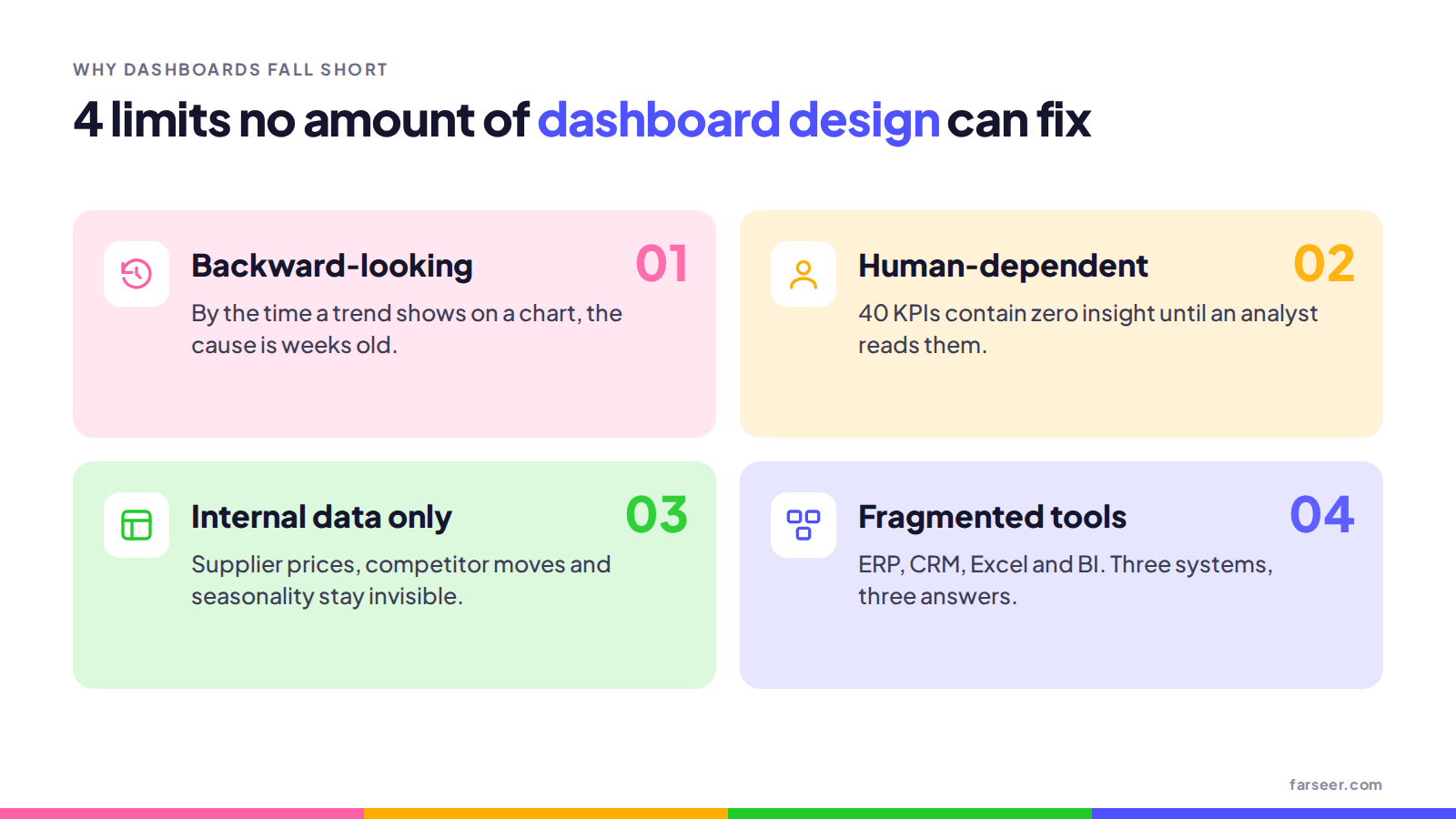
First, they look backward. A dashboard shows what already happened. Even a “real-time” dashboard shows the present, not the future. By the time a trend is visible on a chart, the cause is weeks old. Month-end variance analysis is the classic case. It explains “what happened” in exhaustive detail. It says nothing about “what should we do next.”
Second, they depend on human interpretation. A dashboard with 40 KPIs contains zero insights until an analyst looks at it and works out what it means. That analyst is the bottleneck. Your reporting can scale forever. Your team’s attention cannot. Every new dashboard is one more thing someone has to remember to check.
Third, they only see structured internal data. Revenue, costs, headcount. Fine. But the drivers of your next quarter often live outside the cube. Supplier price announcements. A competitor’s discounting. Weather, if you sell anything seasonal. Traditional reporting is blind to all of it until someone manually brings it in.
Fourth, the tools are fragmented. Actuals live in the ERP. Pipeline lives in the CRM. The model lives in Excel. The charts live in a BI tool. Every handoff between them is manual, and every handoff is a place where insight dies. Ask three systems the same question and you get three answers.
Add these up and you get the familiar rhythm of finance in a fast-moving business. Something changes on the 3rd of the month. Finance explains it on the 12th of the following month. The explanation is accurate, well formatted, and 40 days too late.
Dashboards are not useless. They answer known questions well. The problem is everything they cannot do. They cannot investigate. They cannot simulate. They cannot build. That gap is exactly where agents live.
What Is an AI Agent?
The word “agent” is used very loosely, so let’s pin it down.
An AI agent is software that pursues a goal with some autonomy. You give it a task. It works out the steps, runs the analysis, and comes back with an answer, a recommendation, or a finished piece of work. You do not operate an agent the way you operate a dashboard. You delegate to it.
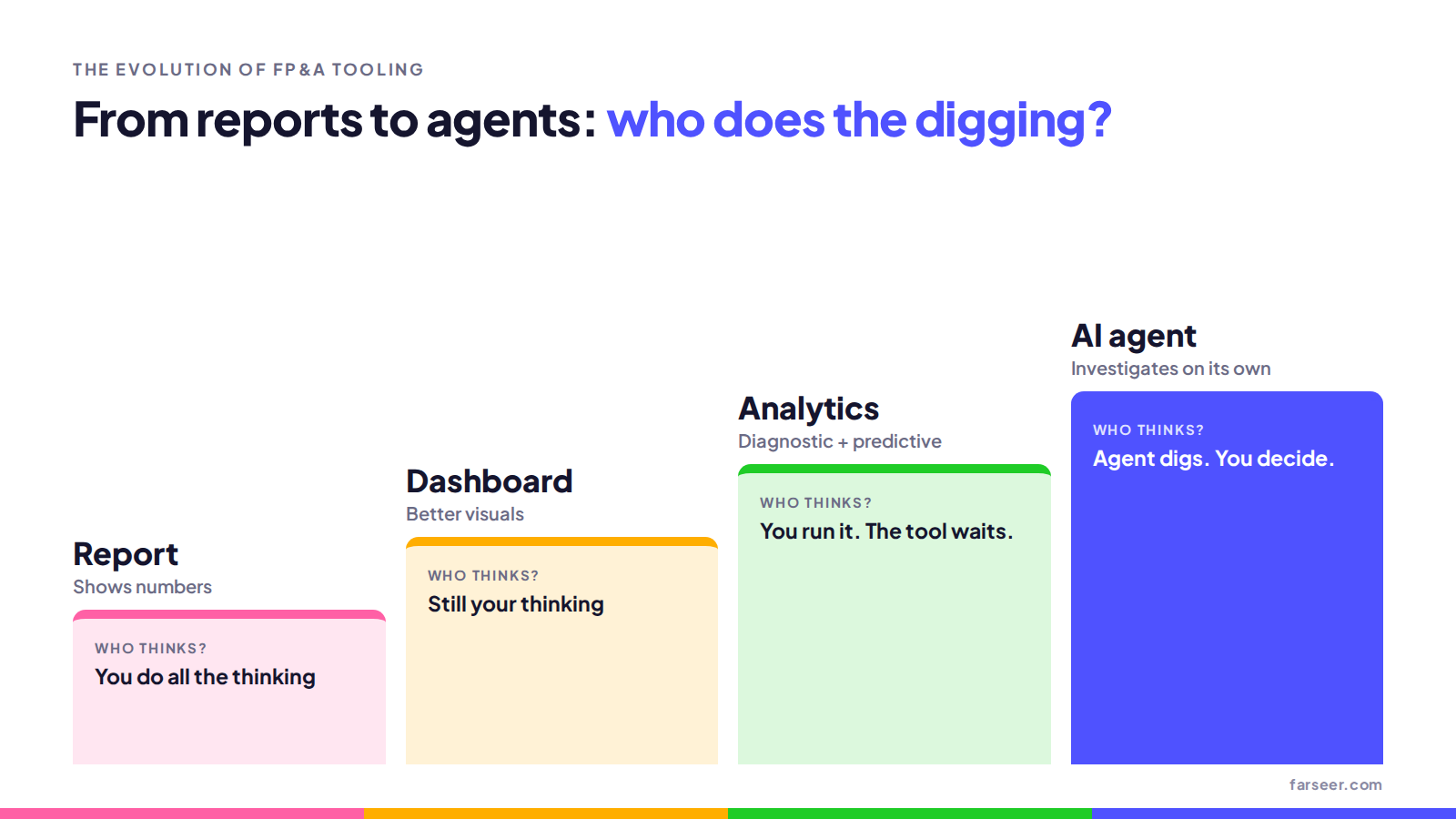
The easiest way to see the difference is to line up the generations of finance tooling.
A report is descriptive. It shows numbers. You do all the thinking.
A dashboard is descriptive with better visuals. Still you’re thinking.
Traditional analytics adds diagnostic and predictive power. But a human has to run the analysis, frame the question, and interpret the output. The tool waits.
An agent changes that. You ask, “Why did gross margin drop in DACH this quarter?” and it does the digging. It traces the drop through region, product, and customer until it lands on the cause. “Freight costs from your second-largest carrier rose 14%. Here is the margin impact by product line.”
You can think of an AI agent like an always-on analyst. A team member who never sleeps, knows every driver in your model, and can turn a one-line question into a full analysis in seconds.
This also moves the centre of gravity of the function. For twenty years FP&A has been tool-centric. We organized work around reports, cubes, and refresh schedules. Agent-driven FP&A is organized around questions, decisions, and actions. The conversation shifts from “is the report ready?” to “what does the analysis tell us to do?”
The catch: most AI guesses
Here is the distinction that matters most for finance, and it is where a lot of AI hype falls apart.
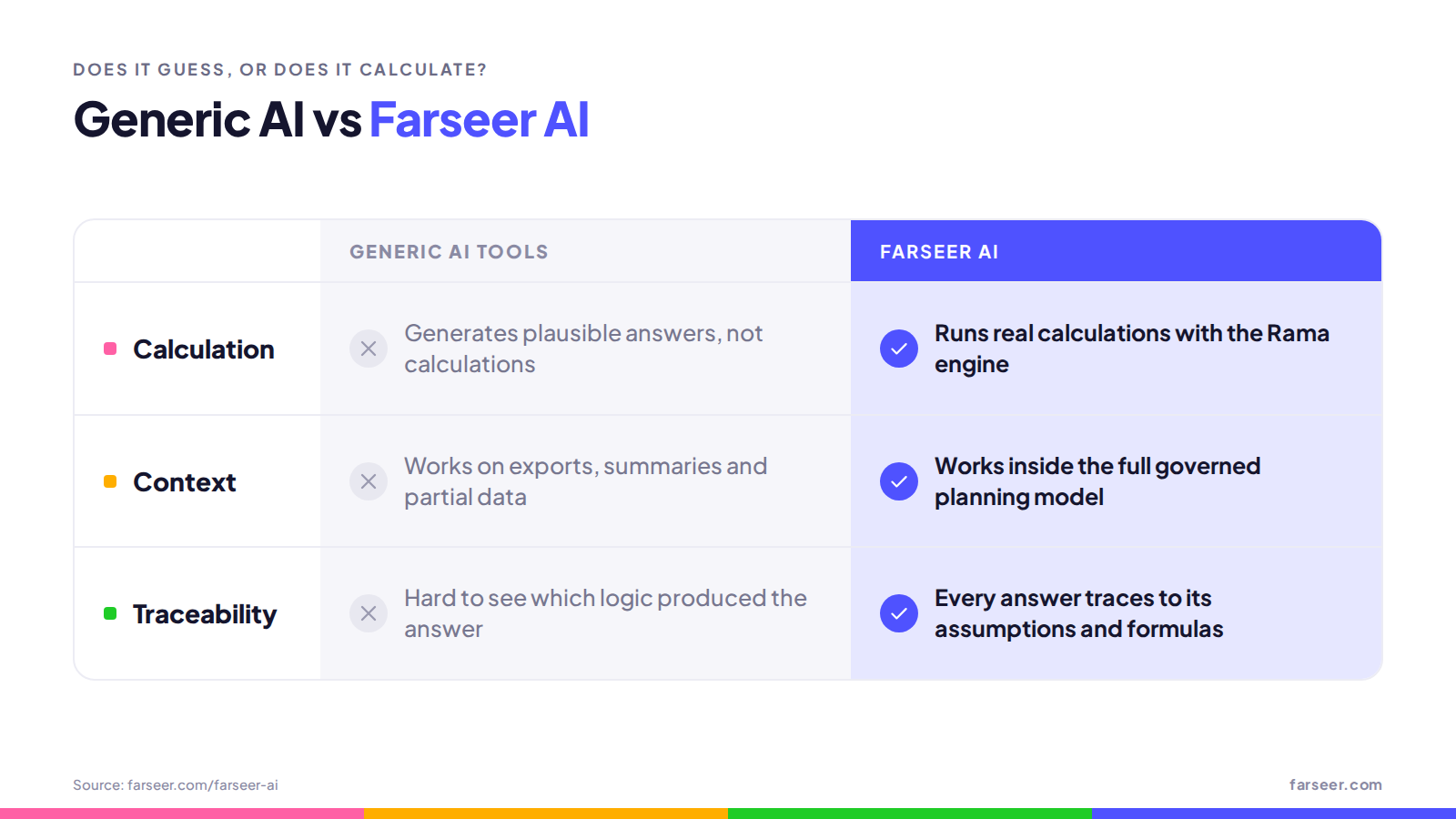
Generic AI tools generate answers. They do not run calculations. Paste a P&L into a general-purpose chatbot and ask why EBITDA fell. You will get a fluent, confident paragraph. It might even be right. But the model produced text that sounds like financial analysis. It did not follow your financial logic. It worked from an export, not your actual model. And you cannot see which assumptions produced the answer.
In marketing, a plausible answer is often good enough. In finance, plausible is dangerous. A CFO cannot take “sounds right” to the board.
So, the real question for any FP&A agent is simple. Does it guess, or does it calculate?
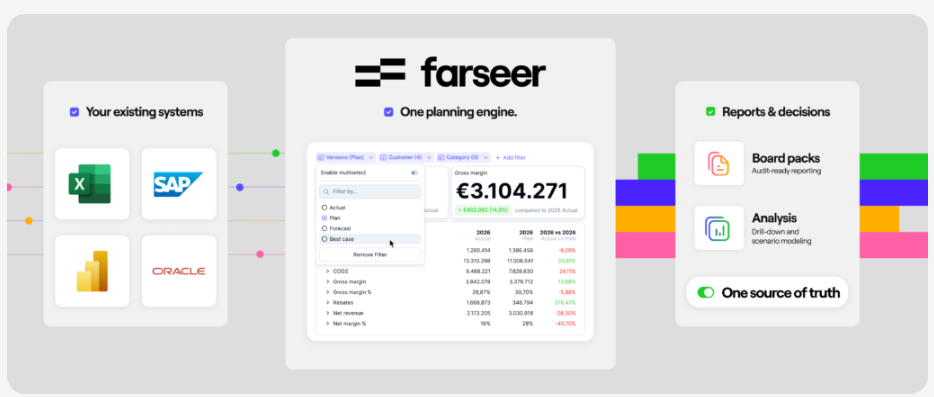
This is the design choice at the heart of Farseer AI. Every answer is calculated by Rama, Farseer’s calculation engine, directly on your governed financial model. It uses the same formulas, drivers, and assumptions your team built. The AI works inside the planning system rather than on exports or summaries, so it sees the full model. And every answer traces back to its source, down to the assumption, calculation, and formula that produced it. The language model handles the conversation. The planning engine handles the math. That split is what makes AI output something finance can put its name on.
What AI Agents Can Actually Do in FP&A?
Here are the 5 capabilities that matter.
- Continuous monitoring and anomaly detection. An agent can watch financial and operational data all the time, not just at month-end. It learns what normal looks like for each line and flags what moves outside the pattern. A revenue dip in one product line on a Tuesday. A cost spike in a single cost centre. You find out the day it happens, not three weeks later during close. Most month-end fire drills are small anomalies that had four weeks to compound in the dark.
- Predictive and prescriptive analytics. Rolling forecasts that update when new actuals land. Scenario simulations that come with quantified options attached. If demand keeps softening at this rate, here is the margin impact by quarter, and here are the two cost levers that close the gap.
- Automated insights and narrative. Somebody has to explain the variances. In most teams that means days of pivot tables and an evening writing commentary. An agent traces a variance across region, product, and customer until it isolates the driver, then explains it in plain language.
- Workflow automation. Alerts when a threshold breaks. Budgets routed back when a submission lands 15% over target. Data prep, reconciliations, and commentary for immaterial lines running on autopilot.
- Natural language interaction. Finance users, and eventually business users, query the model conversationally instead of building reports.
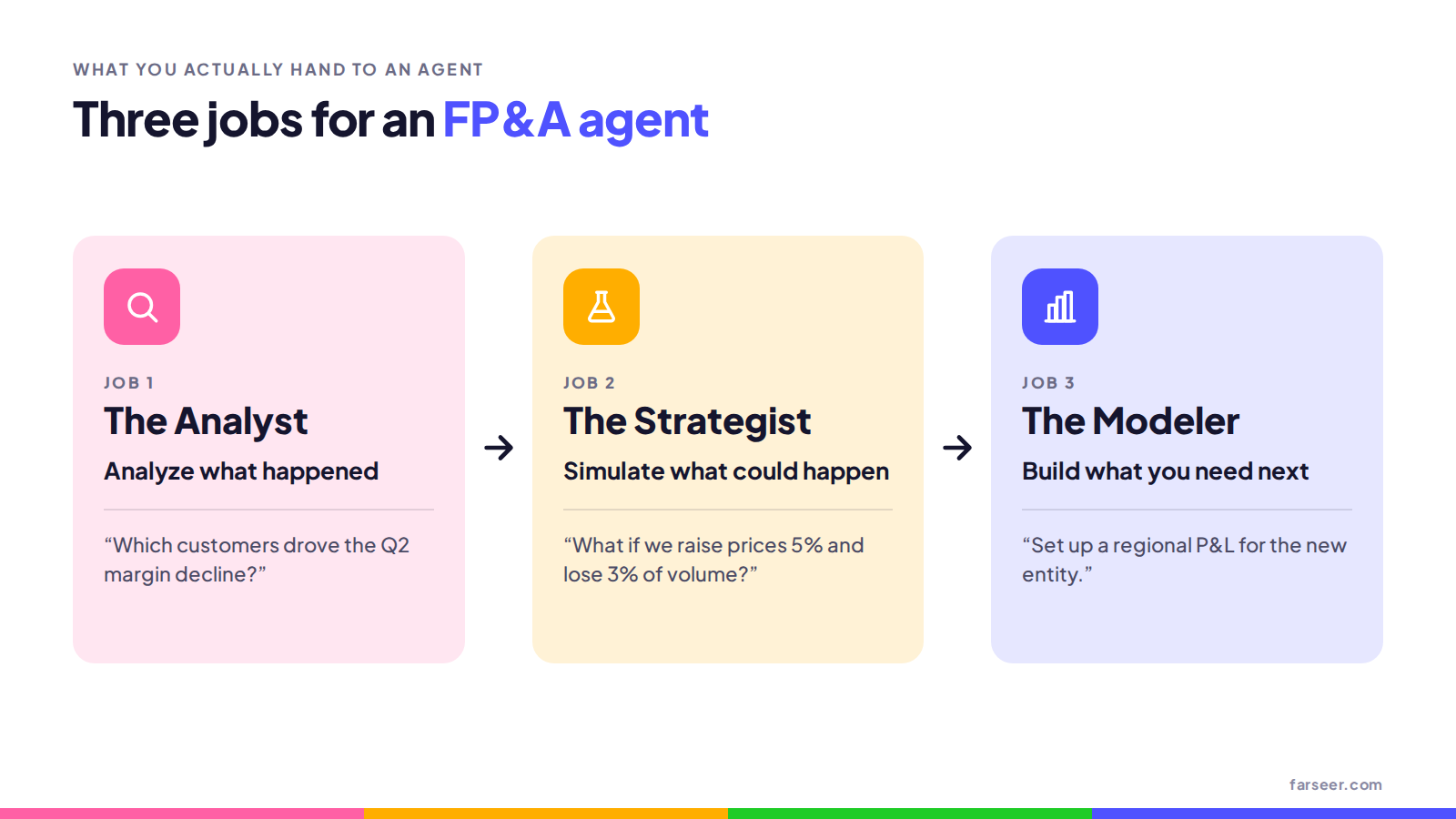
That is the capability list. But capabilities are abstract. It helps more to think about the jobs you would actually hand to an agent. In FP&A, they fall into three.
Job1: The Analyst
The analyst answers questions. “Which customers drove the margin decline in Q2?” “How is EMEA tracking against the forecast?” “What explains the gap between actuals and budget in OpEx?” Today these questions go into an analyst’s inbox. With an analyst agent, they get answered in the moment, by whoever asks them.
Job 2: The Strategist
The strategist tests decisions before you make them. What if we raise prices 5% and lose 3% of volume? What if raw material costs climb 10% next quarter? The value is not one number. It is seeing how multiple drivers interact across revenue, margin, and cash flow at the same time, so the trade-offs show up before the commitment does.
Job 3: The Modeler
The modeler builds. Every FP&A team has a backlog of models nobody has time to set up. A new product line. A regional P&L. A headcount plan for the new entity. A modeler agent takes a plain-English description of the business logic and turns it into structure, formulas, and dashboards.
What this looks like in Farseer
Farseer has built its AI around exactly these three jobs, as three named agents.
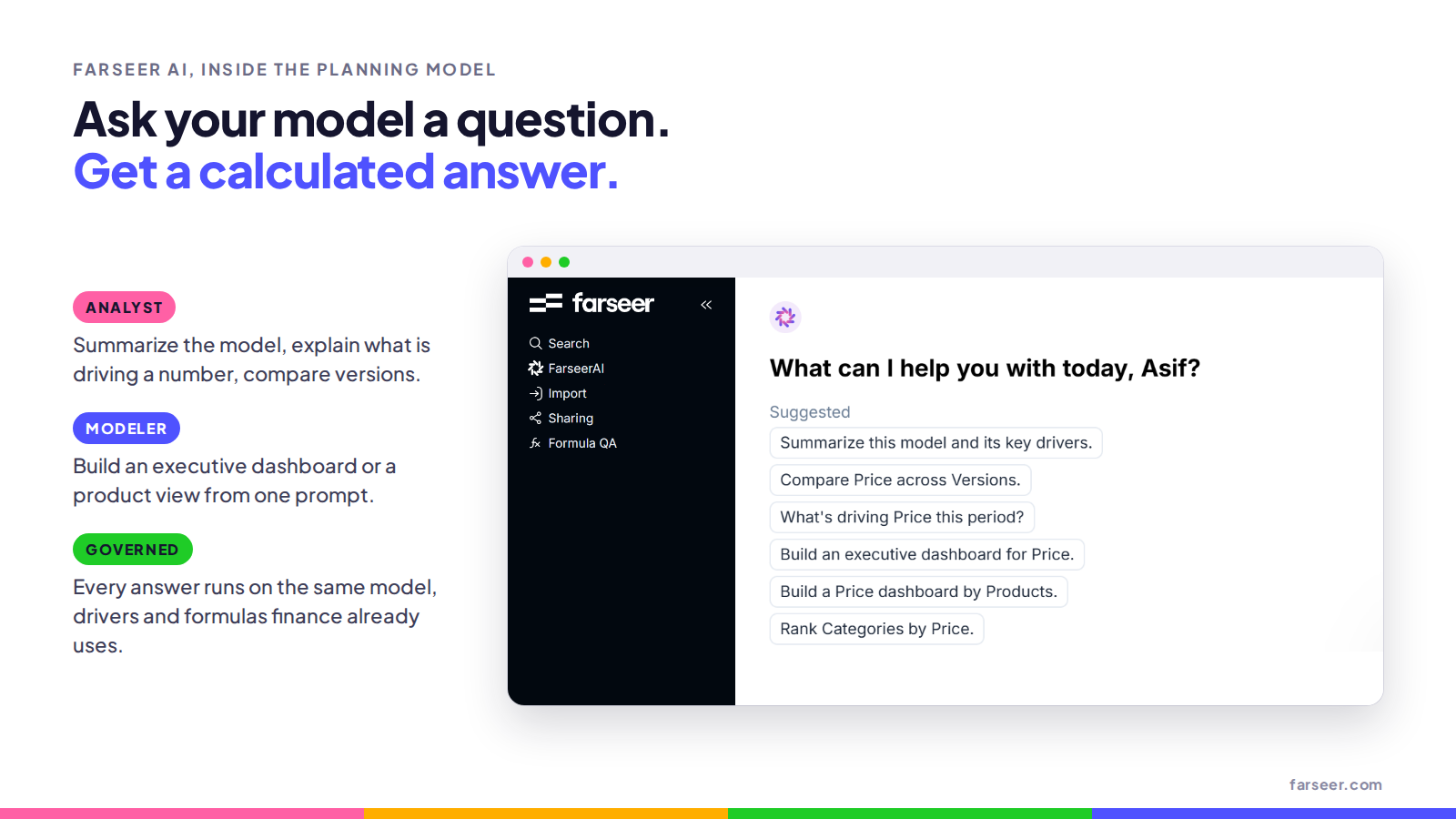
The Farseer AI Analyst takes complex financial questions and turns them into real calculations on the planning model. It analyses performance across entities, products, customers, or regions. It explains variances between actuals, budget, forecast, and prior periods, and it tells you which drivers moved.
The Farseer AI Strategist simulates pricing changes, cost increases, demand shifts, and operational decisions directly on the model. We call it “simulate the decision before it hits the P&L.” Because it runs on the same model finance uses for the plan, the scenario is not a separate spreadsheet.
The Farseer AI Modeler turns a plain-English description of business logic into planning models, formulas, and dashboards. That is the job most analysts would happily hand over to AI.
Put the three together and you get the full FP&A lifecycle covered. Analyse what happened. Simulate what could happen. Build what you need next.
What This Looks Like in the Real World
Many planning platforms now offer some form of AI. The approaches differ. Some bolt a copilot onto reporting. Some build AI into the calculation layer. AI in planning tools has quickly moved from a nice-to-have demo feature to a serious consideration when companies evaluate FP&A platforms.
This is what early-adopting teams consistently report. Three patterns keep repeating.
- Reporting cycles compress. When variance investigation and first-draft commentary happen in seconds instead of days, the gap between “actuals available” and “insight delivered” collapses.
- Forecasts can improve when they are updated more frequently and incorporate new actuals. A rolling forecast that updates with new actuals can give the business more frequent visibility than a forecast rebuilt once a quarter.
- Workload shifts rather than disappears. Hours come out of data prep and explanation. They go into scenario work and business partnering.
The Hard Parts Nobody Puts in the Demo
The gap between the demo and the deployment is where these projects live or die.
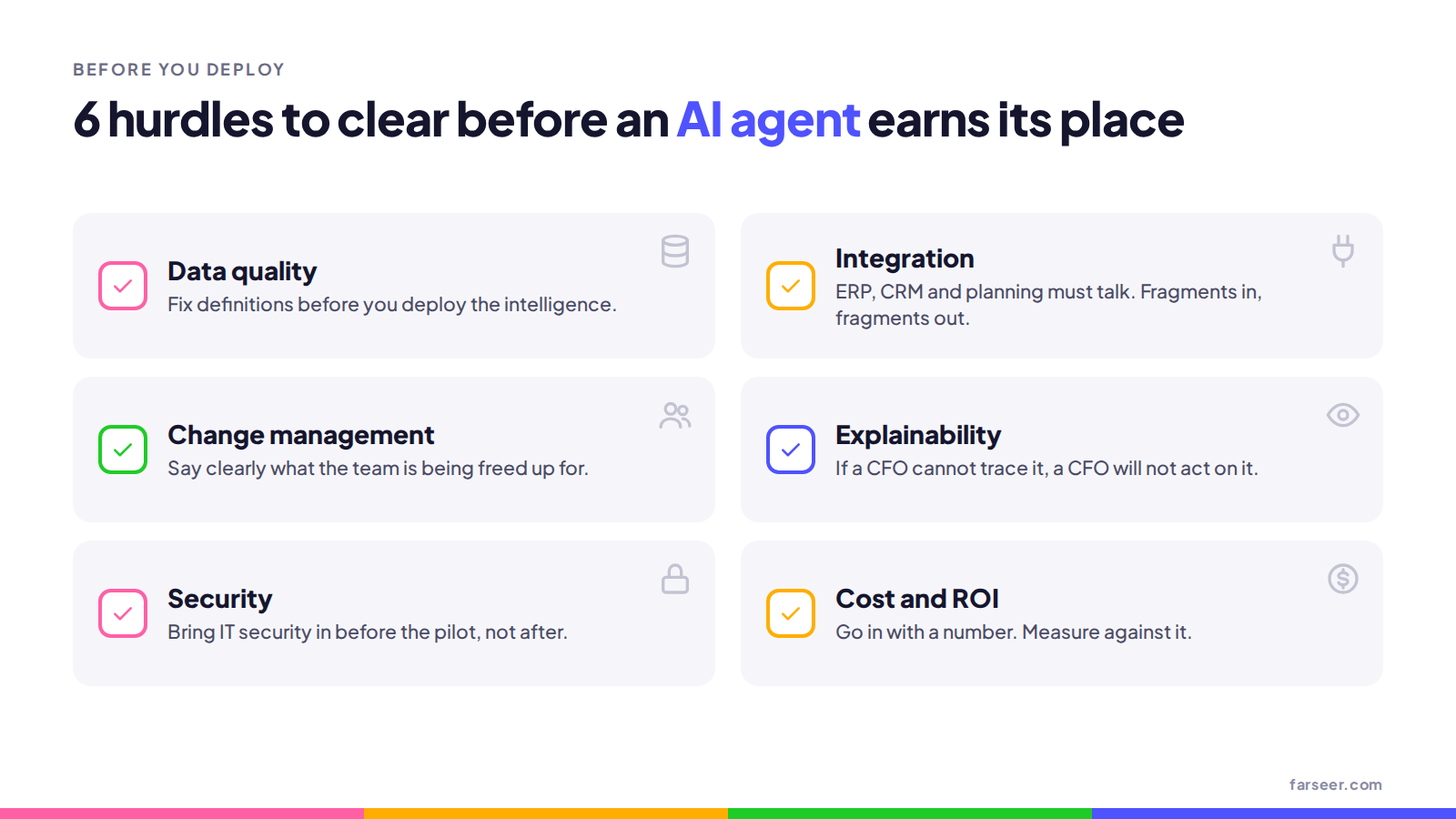
- Data quality comes first. An agent’s output is exactly as reliable as the data underneath it. If your product hierarchy is inconsistent across systems, if “revenue” means three different things in three reports, an agent will confidently analyse garbage. A human reading a dashboard applies scepticism. An agent working at scale spreads the error faster. Fix the definitions before you deploy the intelligence.
- Integration is the real project. The agent needs to see across ERP, CRM, the data warehouse, and the planning tool. In most companies those systems were never designed to talk. An agent that sees fragments produces fragments.
- People will resist. Some will hear “agent” and worry about their jobs. Some have watched past automation projects overpromise. The honest answer is that agents absorb the mechanical layer of the work. The analysts who thrive will move up into judgment and partnering. That takes upskilling and leaders who say clearly what the team is being freed up for. Skip the change management and you get quiet sabotage. An agent nobody trusts, and a process that routes around it.
- Trust requires explainability. This is the big one for finance. A recommendation you cannot trace is one a CFO will not act on. Nor should they. Any AI output that touches a decision needs to show its work: which drivers moved, which data it used, which assumptions sit underneath. That is why the “guess or calculate” question from earlier matters so much. An AI that runs on the governed model can link every answer back to the assumptions, drivers, and formulas behind it. Then your controllers can audit an AI answer the same way they audit a formula. An AI that works from exports cannot offer that, no matter how fluent it sounds.
- Security is not a footnote. You are wiring AI into the most sensitive data in the company. Where do prompts go? Is your data training someone else’s model? Who can ask the agent what? Involve IT security before the pilot, not after.
- And yes, cost. The business case has to stand on recovered hours, faster decisions, and better forecasts. Go in with a number in mind and measure against it.
None of these is a reason to wait. Each is a reason to start deliberately.
Where This Is Heading
Zoom out five years and the direction is fairly clear, even if the timeline is not.
Planning stops being a calendar event. The annual budget and quarterly re-forecast exist because human-powered planning is expensive, so we ration it. When agents keep the forecast current, the cycle becomes a continuous flow. You will still set annual targets. You will stop rebuilding the model to do it.
Agents start working across departments. A demand agent in operations feeds a revenue agent in finance, which feeds a workforce agent in HR. Integrated business planning has been a slideware promise for a decade. Agents talking to agents might be what finally delivers it.
BI-centric architecture gives way to what analysts call decision intelligence platforms. Less “here are your dashboards.” More “here are your decisions, with the options quantified.” The dashboard does not disappear. It becomes where you verify the answer, not where insight begins.
Further out sits the digital twin. A full simulation of the business where agents test decisions before you make them for real. Early days, but the pieces are assembling.
Through all of it, the human role concentrates. Strategy, judgment, persuasion, accountability. The FP&A professional of 2030 spends very little time producing information. They spend most of their time deciding what to do with it and convincing others to act. That was always the interesting part of the job.
How to Start Without Betting the Function
You do not need a transformation program. You need a sequence.
Start by fixing one data problem. Pick the definitional mess that causes the most arguments and resolve it. Every agent you ever deploy will depend on it.
Then pick one painful, repetitive workflow. Variance explanation is usually the best first candidate. It is high effort, low judgment, and easy to check. Run the agent’s answer next to the human version for two or three cycles and compare.
Keep a human in the loop where it matters, and write down where the loop sits. Agents analyse, simulate, and draft. Humans decide.
Invest in your team’s AI literacy now. Not everyone needs to build models. Everyone needs to know what an agent can be trusted with and how to interrogate its output.
And when you evaluate tools, ask the three questions that separate real finance AI from a chatbot. Does it calculate or guess? Does it work inside the model or on exports? Can I trace every answer to its source?
If you want to see how one platform answers those questions, Farseer’s rollout follows a simple three-step path.
- Assess, where you map your model, data sources, and the questions you want answered.
- Connect, where the AI is anchored to your governed data from ERP, CRM, and the planning model.
- Activate, where your team starts asking, simulating, and modelling in plain English. It all runs on ISO 27001 certified security with audit trails and granular permissions.
And Farseer offers to show it on your own data, which is the best test of any AI claim.
Here is the closing thought. Dashboards made FP&A better at showing what happened. Agents make FP&A better at understanding it, testing what comes next, and acting on it. The teams that adopt early will not just close faster or forecast better. They will change what the business expects finance to be. Less scorekeeper, more copilot.
The dashboard era gave you a better mirror. The agent era hands you a headlight. Time to look forward.
You don’t need an agent to start working this way. You need better questions. So we put together 50 copy-ready AI prompts for FP&A, grouped into the same jobs covered above: analyze, simulate, build and communicate. They cover variance commentary, rolling forecasts, price and volume scenarios,cash flow and board summaries. Each prompt is built so you can drop in your own numbers and use it today. Try a few this month. Then notice where you still have to export, paste and check the answer by hand. That’s exactly the gap a governed model like Farseer closes.
Download the 50 AI prompts for FP&A:
FAQ
What are AI agents in FP&A?
AI agents in FP&A are software systems that can perform financial analysis, scenario simulation, planning tasks or model-building activities with some degree of autonomy. Instead of waiting for a user to manually run a report, an agent can take a finance question or task, perform the required analysis and return an answer or completed work.
How can AI agents be used in FP&A?
AI agents can support FP&A with variance analysis, financial forecasting, scenario planning, management reporting, anomaly detection, narrative commentary, workflow automation and financial model creation. The specific capabilities depend on the underlying planning platform and data.
What is the difference between AI agents and dashboards in FP&A?
Dashboards primarily present information for a user to interpret. AI agents can go further by answering questions, investigating drivers, simulating scenarios and performing defined planning tasks. A dashboard might show that gross margin declined; an AI agent can help investigate the drivers and model potential responses.
Can AI agents replace FP&A analysts?
AI agents are more likely to automate parts of an FP&A analyst’s workflow than replace the entire role. Repetitive analysis, data preparation, variance commentary and scenario setup can be automated, while judgment, business partnering, decision-making and communication still require human involvement.
How does AI improve financial forecasting?
AI can help finance teams analyse historical and current data, identify patterns, update forecasts and simulate different assumptions. The value depends heavily on data quality, financial model design and the ability to connect AI to the underlying planning data.
What is an AI-powered FP&A platform?
An AI-powered FP&A platform combines financial planning, budgeting, forecasting, reporting and modelling capabilities with AI-driven analysis or automation. More advanced platforms connect AI directly to a governed financial model so that AI-supported analysis uses the same assumptions, drivers and calculations as the planning process.
What is the difference between generative AI and an AI agent in finance?
Generative AI primarily produces content such as text or summaries in response to prompts. An AI agent can pursue a defined task, determine the steps required, use connected tools or data, perform analysis and return a result. In finance, the distinction is particularly important when an agent needs to perform calculations against a governed financial model.
How can AI agents perform financial analysis without hallucinating?
No AI system should be treated as automatically error-free. A stronger approach is to ground financial analysis in governed data and a controlled calculation engine, make assumptions and formulas traceable, and keep humans involved in material decisions. Farseer states that its AI calculations run on its governed financial model through the Rama calculation engine.
What are the risks of using AI agents in FP&A?
Key risks include poor data quality, inconsistent definitions, incorrect model logic, lack of explainability, security and access-control issues, inappropriate automation and insufficient human oversight. Finance teams should validate outputs and establish clear controls before allowing AI to influence material decisions.
How should FP&A teams start using AI agents?
Start with one repetitive, measurable workflow such as variance analysis or management commentary. Establish clean data definitions, run the agent alongside the existing human process for several cycles, compare results, define where human review is required and expand only after the workflow is trusted.