The Real Cost of Tariffs for CPG: What CFOs Need to Model Before Prices Hit the Shelf

Does the US President have the power to regulate foreign commerce and impose sanctions during a declared national emergency? What defines a national emergency? These and many other questions are still being debated. Last year these questions came relevant and pressing for CPG Finance teams as they struggled to keep up with the rapid-fire changes that underlie these questions.
Under the assumption that the International Emergency Economic Powers Act (IEEPA) a 1977 U.S. statute granted the President broad powers to regulate foreign commerce and impose sanctions during a declared national emergency the US tariff regime changed five times in fourteen months. The result, a slew of missed earnings, rapid vendor and client negotiations (who takes what hit) and forecast that went from murky to amorphous.
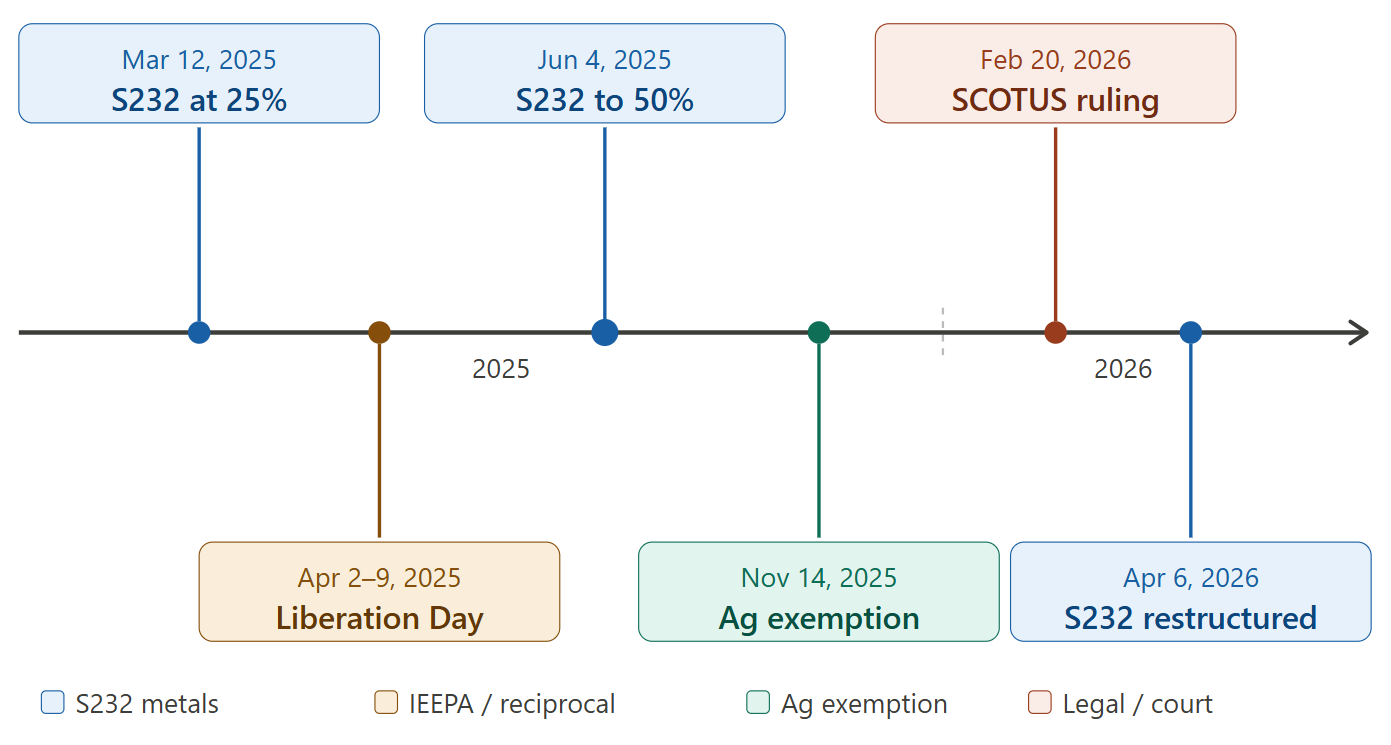
- March 12, 2025: Section 232 metals reinstated at 25 percent, eliminating all prior country exemptions and product exclusions. This affected tinplate steel (food cans) and aluminum (beverage cans, closures, foil) across the entire supply chain immediately.
- April 2: Liberation Day imposed a universal 10 percent baseline and country-specific reciprocal rates on more than 90 nations. A 90-day pause followed on April 9, excluding China. China’s cumulative rate peaked near 145 percent.
- April 9, 2025: A 90-day pause followed on Liberation Day tariffs, excluding China. China’s cumulative rate peaked near 145 percent.
- June 4, 2025: Section 232 metals doubled from 25 to 50 percent. Possibly the most consequential CPG date in the cycle, because it survived the February 2026 Supreme Court ruling and remains structurally in force as of this writing.
- November 14, 2025: An executive order exempted coffee, cocoa, beef, tropical fruits, vanilla, and most spices from the reciprocal tariff list, partially unwinding ingredient exposure for packaged food companies. Palm oil was not included.
- February 20, 2026: The Supreme Court struck down all IEEPA-based tariffs in Learning Resources v. Trump, terminating the reciprocal and fentanyl tariff structures in a 6-3 ruling.
- February 24, 2026: A Section 122 replacement tariff at 10 percent began with a 150-day clock and authority to rise to 15 percent. Section 232 metals and Section 301 China tariffs remained in force.
Numbers are still being calculated, but it is estimated that up to $175 billion in potential refunds on IEEPA duties collected between February 2025 and February 2026 are due. Whom those refunds flow to, importer-of-record or downstream parties that absorbed tariff surcharges, is yet to be determined.
US tariff changes do not stay within US borders. When the US imposed tariffs on Canadian goods, Canada retaliated with tariffs on US-shipped exports. For CPG companies with cross-border manufacturing networks, particularly those shipping finished goods from the US into Canada, Mexico, or the EU, the retaliation leg of the trade equation can be as large as the direct import leg and is entirely absent from most annual budget models.
Below is an example:
Where Tariffs Hit the COGS Line
Tariff exposure is not uniform across CPG. The three-story framework from our prior margin analysis holds here: household and personal care, beverages, and packaged food each carry a structurally different risk profile.
Read: Record Revenue. Record Load Factors. But Negative Returns
Aluminum and Beverage Cans
The United States imports approximately 47 percent of the aluminum it consumes, with Canada supplying roughly 56 percent of US aluminum imports. The US does not currently have sufficient domestic aluminum production that can ramp quickly, making the Section 232, 50 percent tariff nearly impossible to avoid.
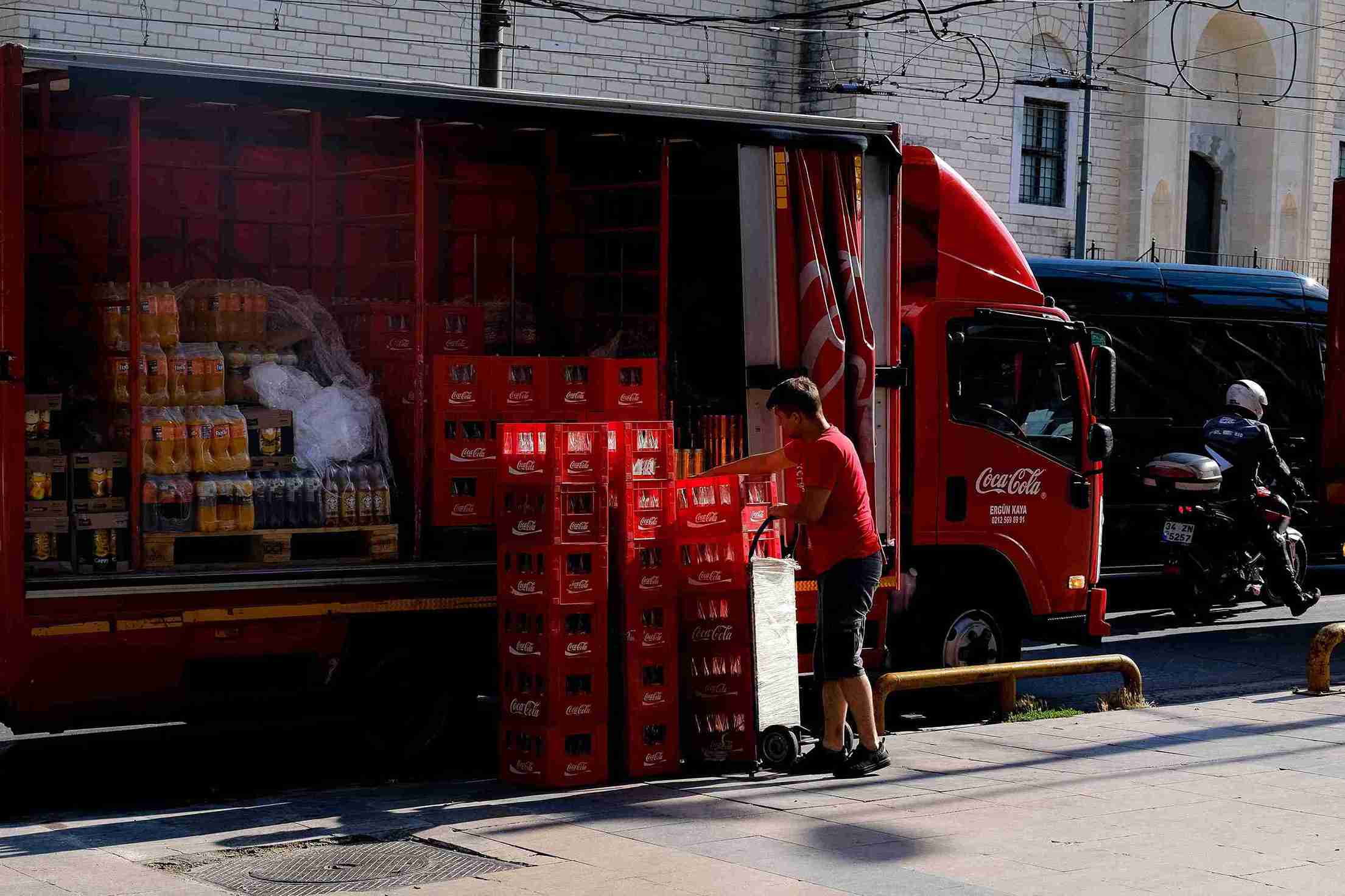
For the “The Big Three” beverage giants – Coca-Cola, PepsiCo, and Keurig Dr Pepper, aluminum and steel cost make up a large portion of packaging mix. Cans make up over a quarter of Coca-Cola’s packaging mix. A shift to PET bottles as a substitute to reduce aluminum exposure introduces its own formulation, consumer preference, and shelf-life variables that have varying effects on the P&L.
Tinplate Steel and Food Cans
The harder problem for packaged food companies is tinplate, the tin-coated steel used for soup cans, canned tomatoes, fruit, and shelf-stable products. Campbell’s CEO Mick Beekhuizen said: “There’s not enough capacity available in the United States or supply available in the United States.” It is a structural cost event that will pass through to either price, margin, or product mix, and the speed at which it moves through those alternatives determines the gross margin outcome for the quarter.
Coffee and Cocoa: Mostly Resolved, Still Relevant for Scenario Modeling
Brazil supplies roughly a third of US green coffee imports and was hit with a cumulative 50 percent tariff effective July 30, 2025. The November 14, 2025 agricultural exemption removed coffee and cocoa from the tariff list but companies had already had to raise prices to compensate. These commodities now sit at the Section 122 universal 10 percent successor rate but rapid fluctuations in the base cost rate support the case for increase scenario modeling.
Finished Goods from China
For household and personal care companies, the peak exposure was finished goods manufactured in China at the 145 percent peak rate. Procter and Gamble’s breakdown of its $1 billion FY26 tariff headwind attributed approximately $200 million to China-sourced finished goods. Church and Dwight disclosed a $190 million gross run-rate exposure, elected to exit three of product lines rather than absorb the cost on goods that could not support a compensating price increase. These are portfolio decision, not pricing decisions, and it illustrates how tariff exposure at the SKU level can force strategic actions that a gross company-level headwind number obscures.
Palm Oil: Still Exposed
Companies in the baked goods, snack foods, margarine, and personal care formulations rely heavily on Palm oil, of which 80 percent of global production is sourced from Indonesia and Malaysia. Both countries currently face the Section 122 universal 10 percent rate. should treat this as an unresolved driver with no current legislative path to exemption and should model it explicitly rather than absorbing it into a generic commodity line.
The Tariff Modeling Architecture CFOs Need To Know
This is where the annual budget dies and the rolling forecast earns its keep. The following will help CPG finance team develop defensible margin math before prices are committed to customers.
1. Build a Tariff Exposure Map by HTS Code
Build the finance model at the Harmonized Tariff Schedule (HTS) level. For every significant input, packaging component, and finished-goods import, identify the 10-digit HTS code, the current applicable tariff rate and its legal authority (Section 232, Section 301, Section 122, or bilateral framework), the sourcing country, and the annual purchase volume in dollars. Map each HTS code to a cost line in the P&L. This is a one-time buildout that procurement and supply chain can maintain, and it is the only way to run meaningful scenario analysis when a single executive order changes rates.
2. Calculate the Inventory Blend Rate Per Period
Build a quarterly inventory blend model for each major tariff-exposed input category. The inputs may include:
- On-hand inventory in units or pounds at the start of the period
- Average cost basis of the inventory (pre- or post-tariff)
- Planned replenishment volume for the period
- Applicable tariff rate at the time of replenishment
The output should be an effective landed-cost rate for the period that feeds directly into the COGS model.
3. Model Pass-Through Elasticity by SKU
Premium and innovation-tier SKUs carry higher consumer price tolerance than standard SKUs. Recent history has shown the companies are able to pass through some, but not all, tariff increases to end consumers. The financial model should be built based on price pass-through assumption by SKU tier (premium, mid-tier, opening price point) rather than a single company-wide pass-through rate. A 70 percent pass-through assumption that is accurate on average may mask a 95 percent pass-through on premium and a 30 percent pass-through on opening price point, which produces a materially different gross margin mix.
4. Add A Tariff Line Item To The Realization Waterfall
The standard net realization waterfall runs:
- List price LESS
- Trade allowances LESS
- Volume rebates LESS
- Deductions and chargebacks EQUALS
- Net revenue
Most finance teams stop there and treat everything below net revenue as a single blended cost of goods sold number. In a frequently changing tariff environment, COGS contains two very different cost layers mixed: inventory bought before the tariff hit and inventory bought after, at the tariffed price. If you lump those together, you cannot tell how much of margin compression is coming from the tariff versus anything else.
Pull the tariff cost out as its own visible line in the P&L, sitting just below gross margin. This makes the tariff impact visible at the gross margin line rather than buried in a blended COGS variance, and it lets finance teams track whether a price increase is actually recovering the tariff cost or whether trade deductions are absorbing the recovery before it reaches net margin.
5. Treat the IEEPA Refund as a Concrete FP&A Action Item
The February 20, 2026 Supreme Court ruling invalidated IEEPA-based tariffs retroactively to the date they were imposed. For CPG companies that imported impacted goods the refund could be substantial. Go get it.
Pull every entry filed between February 4, 2025 (the date of the first IEEPA fentanyl tariff) and February 24, 2026 (the date US Customs and Border Protection (“CBP”) ceased IEEPA collection) for any HTS code that carried an IEEPA-based rate.
Calculate the total IEEPA duties paid across those entries as a contingent asset on your balance sheet. The refund amount is the gross IEEPA-component duty paid, less any portion that has been passed through to customers in a documented, recoverable pricing surcharge.
CBP is developing a refund process. As of mid-2026 that process is still being established. Prepare supporting documentation now so that when the mechanics are clear, you are in the first wave of claimants rather than the last.
6. Build a Scenario Library, Not a Point Forecast
Build three scenarios minimum:
- A base case forecast reflecting current in-force rates (Section 232 at 50 percent for steel/aluminum articles, 25 percent for derivatives, Section 122 at 10 percent, Section 301 China rates intact).
- Stress case reflecting Section 122 step-up to 15 percent plus Section 301 escalation and Canada retaliation continuation.
- Relief case reflecting broader agricultural exemption extension, Section 122 expiration without replacement, and partial IEEPA refund recovery
Model the gross margin impact of each scenario by quarter for the next four quarters. Do not model annual impacts only as tariff rate changes hit landed cost within one to three weeks of taking effect, and a quarterly model catches the asymmetry between the cost impact (immediate) and the pricing response (lagged by a full promotional cycle).
Bottom Line
This is the environment h was built for. The platform connects live tariff rate assumptions to your COGS drivers, runs pass-through scenarios by SKU/HTS tier, and updates the full P&L in real time, so if Section 232 doubles on a Thursday, a reforecast is done before the market opens Friday.
Del Monte’s bankruptcy is not an outlier. That is the outcome when a company’s cost structure cannot absorb a policy-driven cost event that its planning system was not built to track. Tariffs are not a one-time event to manage around. Rates changed five times in fourteen months, the Supreme Court invalidated half the regime, and the replacement tariff expires in mid-July 2026. CPG companies that build the modeling infrastructure to track these events in real time to protect their margins. The ones that wait for an annual budget cycle to catch do not.

FAQ
How can CFOs accurately model tariff impacts before committing to price increases?
Finance teams should build tariff exposure models at the HTS-code level, calculate inventory blend rates, and model SKU-level pass-through elasticity to understand how tariff costs flow through margins before making pricing decisions.
Which CPG categories are most exposed to tariff-driven margin pressure?
Beverages face significant aluminum exposure, packaged food companies are vulnerable to tinplate steel costs, household and personal care companies have exposure to China-sourced finished goods, and palm oil remains an unresolved risk for many manufacturers.
Why are annual budgets no longer sufficient for managing tariff volatility?
Tariff rates have changed multiple times within short periods, creating immediate cost impacts that annual planning cycles cannot absorb. Rolling forecasts and scenario modeling are required to keep forecasts aligned with changing trade policies.
What tariff scenarios should finance teams be modeling right now?
At minimum, CFOs should maintain a base case, stress case, and relief case that account for potential tariff increases, retaliatory tariffs, policy reversals, exemptions, and refund recoveries over the next four quarters.
Can companies recover tariff costs already paid under the invalidated IEEPA tariffs?
Potentially yes. Following the February 2026 Supreme Court ruling, companies that paid IEEPA-based tariffs may be eligible for refunds and should begin documenting affected imports and duties now to prepare for the claims process.

Digital Transformation in Finance: How Finance Teams Break Out Of Digital Planning Purgatory With AI
Read more
Farseer raises $7.2M Series A to build the Enterprise Operating System for Finance
Read more