The Finance Weekend Pulse 2026: Would You Let AI Talk to Your Board

The Short Version
Finance professionals have adopted AI everywhere except where the numbers matter, and they don’t trust it in the boardroom. That is the story told by 150 CFOs, FP&A leads and finance managers surveyed at Finance Weekend in September 2026.
- 93% use AI at work, but only 22% on forecasts. AI mainly drafts the emails; humans still build the numbers.
- 69% have caught AI producing a wrong or made-up figure. 64% have caught it more than once. Just 1% say they trust the output.
- 71% would never present an AI-generated number to their board without checking it. A further 21% would, but only from a tool built for finance, not a general chatbot.
- Half of finance teams lose 2–5 working days a month to manual data work. Nearly 3 in 10 lose a week or more.
- 43% plan to evaluate or buy AI tooling within 12 months. Only 7% have implemented anything so far.
The conclusion running through the data: finance isn’t resisting AI, but it’s waiting for AI it can put its name under.
Who We Asked
The survey ran on-site at Finance Weekend in September 2026 and collected 150 responses from finance practitioners: 50% CFOs, 31% Heads of FP&A/Controlling, 11% finance managers and analysts, and the rest in adjacent finance roles.
Respondents span the full size range: 32% work at companies under €10M in revenue, 40% between €10M and €250M, and 28% at €250M+. Services (26%) and FMCG/retail (19%) are the largest named industries, with manufacturing and pharma also represented.
One profile stat deserves headline status on its own: 60% of respondents still run planning on Excel (with or without ERP exports), and among €250M+ companies, that figure is 64%. Dedicated FP&A tools cover just 14% of the room.
*Percentages are rounded; multi-select questions sum to more than 100%.
The Results
Finding 1: Everyone uses AI (almost nowhere it counts)
93% of respondents used AI at work in the last 30 days, but usage collapses the closer it gets to the numbers. AI drafts emails for 69% of the room; only 22% use it to build or check a forecast.
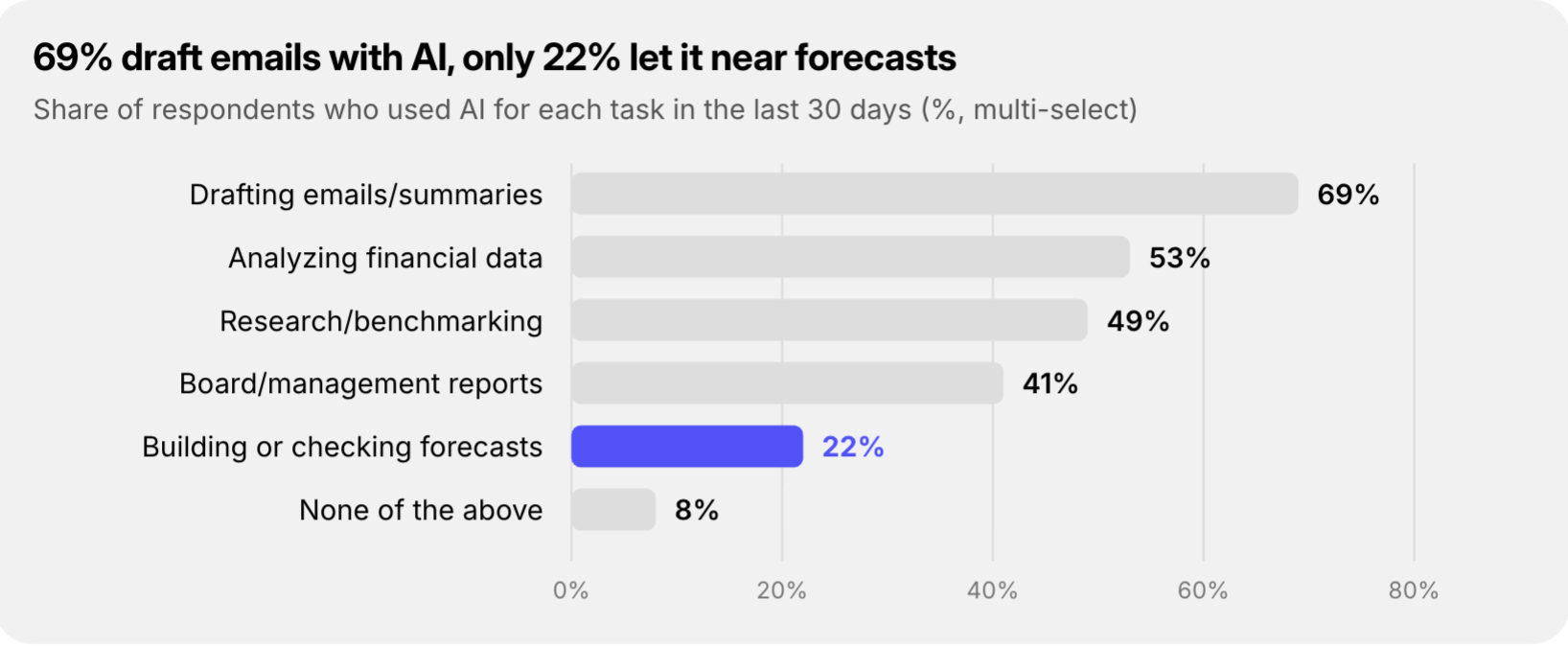
The planning process tells the same story. 58% of teams either keep AI out of planning entirely (21%) or experiment unofficially on the side (37%). 22% let AI assist while humans finalize every number, 14% let it draft forecasts they adjust, and just 6% let it run any part of the process autonomously.
AI has won the inbox. It hasn’t won the model.
Finding 2: The trust deficit is earned, not theoretical
Skepticism about AI in finance comes from experience. 69% of respondents have personally caught an AI tool producing a wrong or made-up figure, and 64% have caught it more than once. Exactly one respondent out of 90 says they trust AI output without checking.
The boardroom question makes the consequence concrete. Asked whether they would present an AI-generated number to their board without manually verifying it:

Among those who have already caught AI inventing numbers, the “never” share rises to 74%. The lesson finance professionals have drawn is not “avoid AI” (93% still use it), but “never let an unverified AI number carry your name.” The one-in-five who would trust a purpose-built finance tool points at where the market is heading: the trust gap is between general-purpose chatbots and systems whose calculations can be traced and audited.
Finding 3: What's really in the way, and what isn't
The blockers are about risk and readiness, not money. Half the room names data security and confidentiality as the biggest thing stopping wider AI use, and 43% name trust in the accuracy of outputs. Budget ranks fourth at 18%.
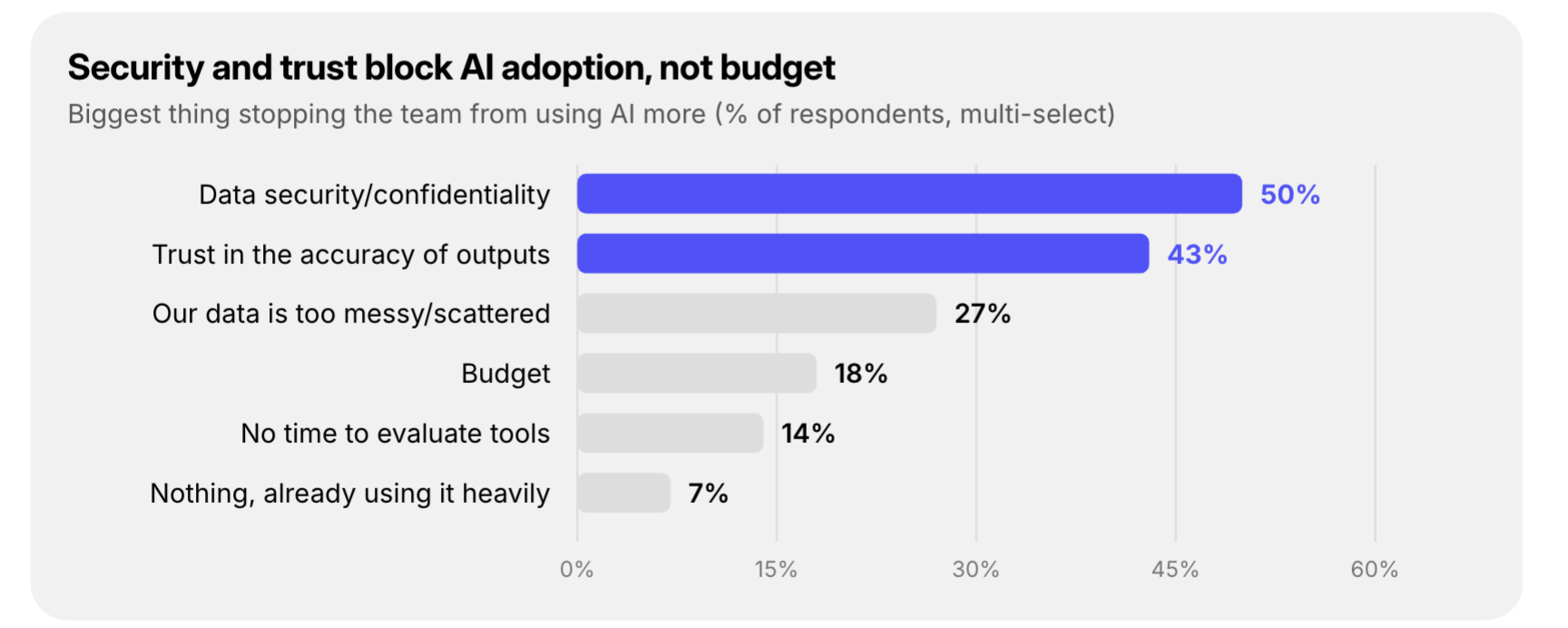
The third blocker deserves attention: 27% say their own data is too messy or scattered to put AI on it. Combined with the manual-work numbers in the next section, it suggests many teams see a data foundation problem standing between them and AI; the model isn’t the bottleneck, the spreadsheet sprawl underneath it is. Notably, the blockers barely change among teams actively shopping for tools: security and trust top the list for buyers too, meaning vendors don’t get past these questions just because a budget exists.
Finding 4: The manual-work tax nobody budgets for
Asked how much time their team spends each month on manual data work (collecting, cleaning, and copy-pasting between systems), half of respondents said 2–5 working days. Another 28% said a week or more, and 10% admitted they have no idea, “which is part of the problem.” Only 12% get away with less than a day.

Put differently: the median finance team loses roughly a full working week per month to work no one would miss. Over a year, that’s more than two months of team capacity spent moving numbers between systems rather than analyzing them, and it maps directly onto the 27% who say their data is too messy for AI.
The manual work and the AI hesitancy are the same problem wearing two costumes.
Finding 5: What finance wants AI to take over
Given one task AI could reliably take over tomorrow, respondents don’t pick the glamorous one. 37% would hand over month-end reporting and 24% data consolidation across entities and systems, together, 61% choose the repetitive mechanics of closing and consolidating. Building forecast scenarios, the most strategic option, comes last at 9%.
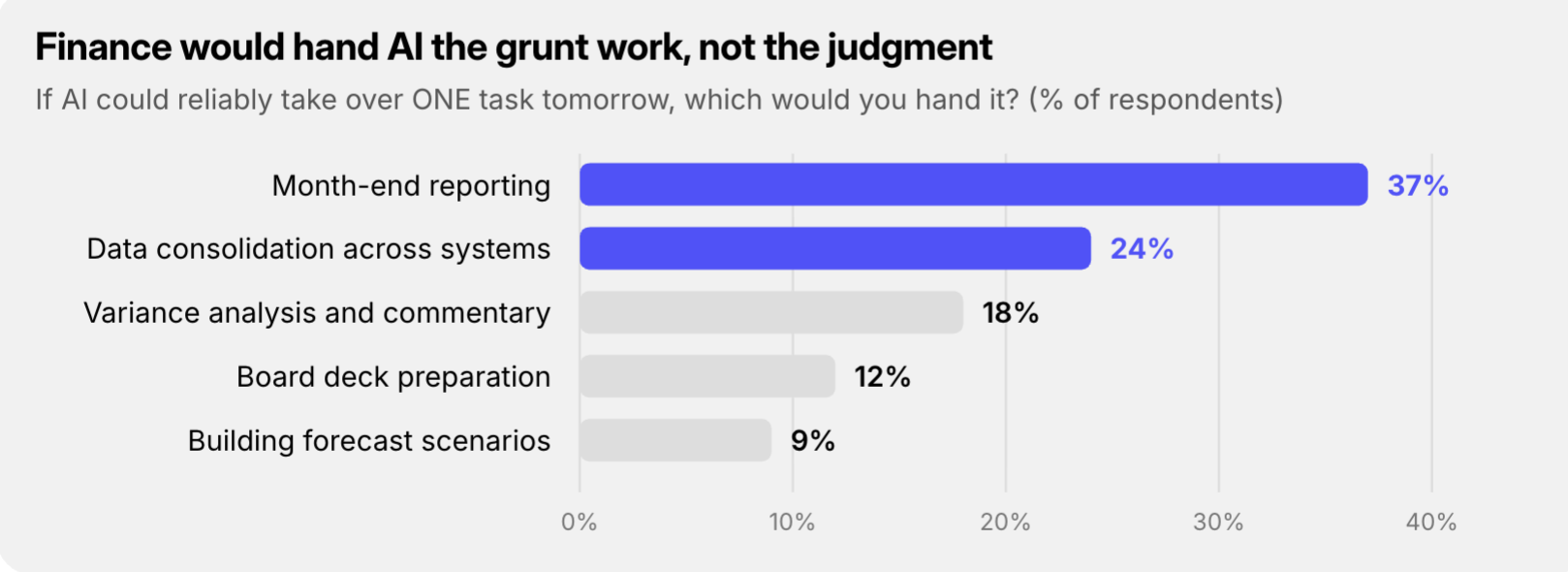
The pattern is consistent with the trust data: finance wants AI to do the work that is verifiable and tedious, and to keep judgment, the scenarios, the story behind the numbers, in human hands. Vendors pitching “AI that does your strategy” are answering a question this room isn’t asking.
Finding 6: The buying window is open right now
For all the caution above, this is not a market that is waiting. 28% are actively evaluating or buying AI tools and a further 16% have budget approved, 43% of the room is in-market within 12 months. Only 7% have already implemented something, and 21% have no plans at all.
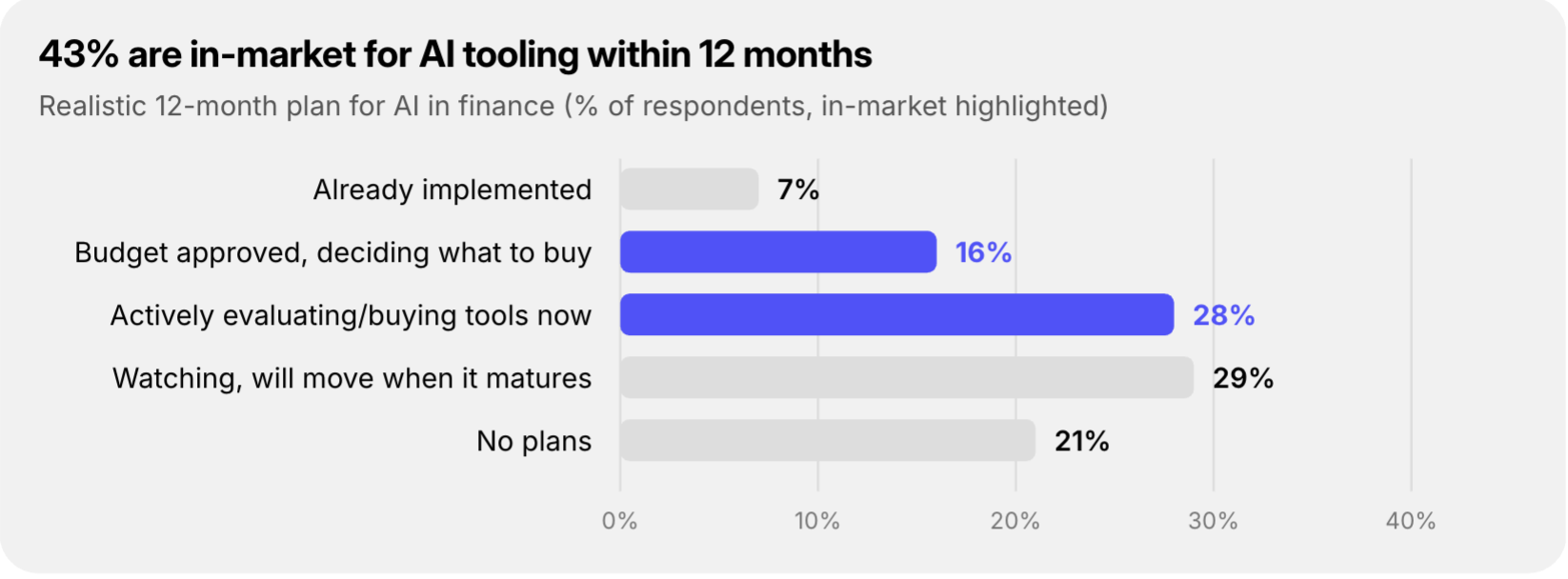
The budget exists; the trust still has to be won.
What This Means For Finance Leaders
- Treat verifiability as the entry requirement. 71% of your peers won’t put an unverified AI number in front of a board, and the 21% who would trust only a purpose-built finance tool show where the bar sits. Whatever AI enters the finance stack must show its work: traceable calculations, auditable outputs, numbers a CFO can sign.
- Fix the data foundation before (or while) adding AI. 27% say their data is too messy for AI, and half of teams lose 2–5 days a month to manual data work. AI layered on scattered spreadsheets automates the chaos; consolidating the data layer is what makes the AI usable.
- Start where your team already voted: the grunt work. Month-end reporting and consolidation are the tasks finance most wants to hand over; they’re repetitive, verifiable, and free up exactly the capacity needed for the judgment work AI won’t be trusted with.
- Don’t mistake caution for a closed market. 43% are in-market within a year while only 7% have implemented. Teams that move now, with tools that clear the trust and security bar, will define what “AI in FP&A” means for everyone still watching.
About this survey
The Finance Weekend Pulse was collected on-site at Finance Weekend in September 2026 from 150 finance professionals: CFOs, Heads of FP&A/Controlling, finance managers and analysts, across services, FMCG/retail, manufacturing, pharma and other industries, at companies ranging from under €10M to over €250M in revenue. Percentages are rounded to whole numbers; multi-select questions sum to more than 100%. Given the sample size, sub-group figures should be read as directional.
The survey was conducted by Farseer, the FP&A platform for planning, forecasting and reporting built for finance teams. For the full dataset or a walkthrough of the results, contact the Farseer team.


Digital Transformation in Finance: How Finance Teams Break Out Of Digital Planning Purgatory With AI
Read more
Farseer raises $7.2M Series A to build the Enterprise Operating System for Finance
Read more