AI Financial Modeling: Improve Your Forecasting, Scenario Planning, and Analysis

AI is already widely used in finance, but most companies still rely on it mainly to speed up routine tasks. Teams use AI to analyze spreadsheets, prepare reports, automate reconciliation, and cut down on manual work. This boosts productivity, but it does not change the way financial decisions are made.
AI financial modeling takes things further by using AI for forecasting, scenario planning, and analysis. The goal is to understand the financial impact of changing assumptions while there is still time to act.
Read: Finance Automation in 2026: Tools, Use Cases, and Real-World Strategy
This shift still relies on having reliable data, clear assumptions, solid financial logic, and good governance.
In this article, we’ll cover how AI improve financial modeling, what its limits are, how it stacks up against traditional methods, and what to consider when choosing AI financial modeling software.
What Is AI Financial Modeling?
AI financial modeling uses various AI technologies to help update and analyze financial models more quickly. Depending on the situation, this might include machine learning, generative AI, or natural language processing (NLP).
Machine learning reviews historical data, finds patterns, and helps generate forecasts. Generative AI explains changes, summarizes results, and helps build or test scenarios. NLP lets users interact with financial data in plain language, such as asking why gross margin dropped or which cost centers had the biggest variance.
These features work on top of the basic structure of financial modeling. The model still needs clear drivers, assumptions, business rules, and connections between operational and financial data.
AI does not replace this structure. It just makes it easier to process data, update forecasts, and understand results.

Where AI Improves Financial Modeling
AI already plays an active role in financial planning. According to the KPMG Global AI in Finance 2026 report, more than three-quarters of organizations use AI in financial planning, reporting, and commercial analysis. KPMG also found that 70% report better decision-making quality, 71% report faster decisions, and 64% report improvements in forecast accuracy.
AI is especially helpful for tasks that involve large data sets, repeated analysis, and frequent changes in assumptions.
Read: Agentic AI in Finance: A Hands-On Guide for Today’s FP&A Teams
Faster forecasting
Machine learning creates forecast baselines from historical data, seasonality, pricing, volume, and other business drivers. That removes a large part of the manual work required to rebuild projections and lets teams focus on the assumptions that need judgment.
This becomes especially important in complex models. In Farseer’s AI Planning demo, predictive planning runs across more than 200,000 time series and selects the most suitable machine learning method for each one.
The practical impact is a shorter forecast cycle, more frequent updates, and more time to challenge the assumptions before they turn into decisions.
Best AI for Financial Advice: 5 Tools for Smarter FP&A Decisionshttps://www.farseer.com/blog/ai-for-financial-advice/
ReadFaster variance analysis
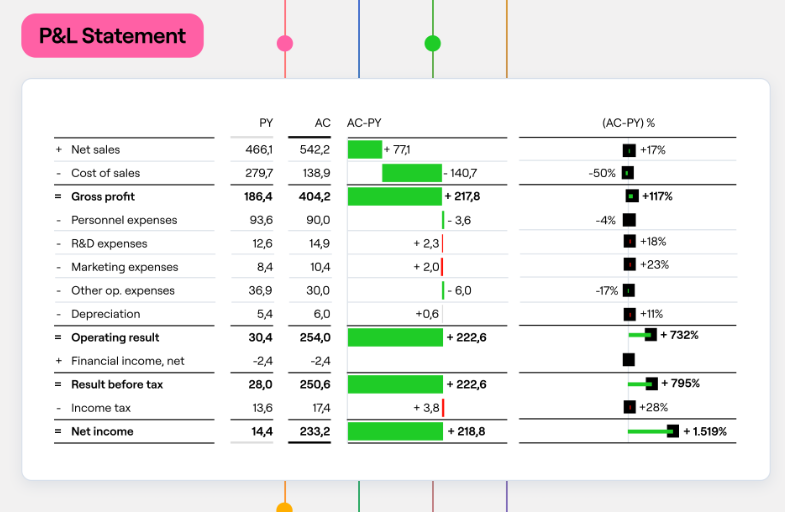
AI changes variance analysis from checking every line to focusing on the exceptions that matter most.
Machine learning finds unusual movements and patterns in large data sets, while generative AI summarizes what changed between actuals, budgets, and forecasts. This lets teams focus on the areas that need attention instead of searching through hundreds of accounts and cost centers.
This change means teams spend less time finding variances and more time understanding what they mean for the business.
More frequent scenario analysis
AI also shortens the time between changing an assumption and seeing how it affects the finances.
Instead of updating inputs in multiple files, teams use a single financial model, update assumptions, and compare results for revenue, margins, costs, EBITDA, and cash flow.
This is especially useful when assumptions change quickly. Now, a change in sales volume, material prices, FX rates, or payment terms does not mean hours of spreadsheet work before the team sees the impact.
Farseer already demonstrates this approach in its AI Planning workflow, where AI works directly with a live planning model to analyze financial data and model scenarios.
Analysis across much larger data sets
Traditional spreadsheet models become harder to manage as the number of dimensions increases. Machine learning can handle large amounts of data much faster than manual review.
Instead of checking every SKU, customer, market, entity, or cost center, teams use AI to find patterns, spot anomalies, and highlight areas that need attention.
This shift matters because AI adoption in finance has already moved well beyond isolated experiments. KPMG reports that three out of four surveyed companies now use AI for planning, forecasting, and analysis.
Faster financial commentary
Generative AI and NLP also help make model outputs easier to explain.
AI summarizes major changes, compares forecast versions, highlights key variances, and prepares an initial explanation of financial performance. The team then reviews this analysis in context before sharing it with management.
Human judgment still matters. The KPMG Global AI in Finance 2026 report found that organizations with stronger governance, controls, and human oversight achieve better results from AI.
The goal is not to have a financial model that runs on its own. Instead, it is to create a process where people spend less time processing data and more time questioning assumptions, assessing risk, and making decisions.
What AI Financial Modeling Does Not Solve
AI improves financial modeling, but it cannot fix a weak planning process. If data is unreliable, business drivers are unclear, or departments do not take ownership of their assumptions, AI will just process these problems faster instead of solving them.
That is already one of the main limits companies face. In the KPMG Global AI in Finance 2026 report, 36% of organizations named data quality, integration, and system interoperability as their biggest opportunity to get more value from AI. KPMG also identifies poor data quality as one of the most common AI vulnerabilities in finance.
Poor data quality
AI depends on the data behind the model. Missing values, inconsistent master data, incorrect mappings, and duplicate records all affect the quality of its output.
If sales data uses different product hierarchies across subsidiaries, AI cannot fix the underlying structure by itself. The company still needs common definitions, clean source data, and clear ownership.

Weak financial logic
A machine learning model can find patterns in past data, but it does not decide which business relationships should drive the financial model.
Teams still need to define how units sold affect revenue, how production volumes affect material use, how headcount affects personnel costs, and how payment terms affect cash flow.
Gartner also stresses that finance teams need to define business drivers and build reliable data processes around AI. Financial accountability cannot simply be handed over to an algorithm.
Disconnected operational and financial planning
AI is less valuable when operational planning and financial planning are kept separate.
If sales uses one forecast, production uses another, procurement keeps separate assumptions, and finance combines everything at the end of the month, AI cannot fix that structural problem.
The model still needs a shared planning logic that links operational assumptions to financial outcomes.
Weak ownership and governance
AI cannot solve unclear accountability.
Someone still needs to take responsibility for sales forecasts, pricing assumptions, production plans, material prices, hiring plans, CAPEX requests, and other business inputs. Teams also need to know where data came from, which assumptions changed, who approved them, and when a human review is needed.
According to KPMG’s 2026 research, organizations with stronger AI governance and assurance processes report better results. Gartner makes the same point: AI in finance requires transparency so responsible people remain informed and accountable for financial outputs.
AI makes a strong financial modeling process better, but it cannot replace it.
AI Financial Modeling vs. Spreadsheet-Based Modeling
Excel is still useful for ad hoc analysis, quick calculations, and smaller models. Problems come up when a financial model needs to support multiple entities, business units, planners, data sources, and forecast cycles.
At that point, the question is not whether Excel can do the calculations – it can. The real issue is how much manual work is needed.
| Area | Traditional Excel Modeling | AI-enabled financial modeling platform |
| Forecast updates | Teams update assumptions and formulas manually | AI processes historical data and business drivers to update forecast baselines |
| Scenario analysis | Users search through reports and accounts to find material changes | AI identifies unusual movements and directs attention to the largest variances |
| Large data sets | Performance and model maintenance become more difficult as dimensions grow | Machine learning analyzes large volumes of granular data at once |
| Commentary | Teams prepare explanations after completing the analysis | Generative AI prepares an initial summary of key changes and variances |
| Variance analysis | Users search through reports and accounts to find material changes | AI identifies unusual movements and directs attention to the largest variances |
| Model maintenance | Knowledge often sits with the person who built the workbook | Business rules, assumptions, and data remain inside a shared planning environment |
| Collaboration | File versions, email exchanges, and separate inputs create more reconciliation | Multiple users work with the same data, assumptions, and model structure |
| Auditability | Teams often need to trace changes across files, tabs, and versions | Centralized models make assumptions, inputs, and changes easier to track |
This does not make Excel irrelevant. It just changes the way it is used.
A team might still use Excel to look into a specific variance or make a quick calculation. But spreadsheets are harder to justify as the main planning tool when many people contribute to the same model and forecasts need frequent updates.
The choice is about deciding whether to rely on manual model maintenance or to use automation and AI, so you can spend more time on analysis and decisions.
How to Evaluate AI Financial Modeling Software
The AI label by itself does not mean much. What matters is how the software works with your financial model, your data, and your planning process.
Start with integration
The software should connect with the systems that already store your financial and operational data, such as ERP, data warehouses, and BI tools.
If teams still need to export data, clean files, and upload spreadsheets before every forecast, AI will not solve the main source of manual work.

Check what the AI actually does
Ask vendors to show which parts of the process use machine learning, generative AI, or NLP.
Does machine learning create forecast baselines? Does generative AI explain variances? Can users ask the model questions in plain language? A generic AI assistant is not the same as AI built into the financial model.
Test explainability
Users need to understand why a forecast changed.
The software should let users trace outputs back to data, assumptions, and business drivers. If the model gives a number but no one can explain how it was calculated, it is hard to defend in a management meeting.
Test scenario modeling
A good AI financial modeling platform should make forecasting faster and scenario analysis easier to run and compare.
Change pricing, volume, material costs, headcount, FX rates, or payment terms and see how quickly the model updates revenue, EBITDA, cash flow, and other related results.
Look at governance and control
AI does not remove the need for ownership. Check permissions, approval workflows, change history, version control, and whether you can override AI-generated outputs.
Teams need to know who changed an assumption and which version of the forecast management approved.
Look beyond the demo to implementation
A polished AI demo is easy to sell. Building a working planning model is much harder.
Ask how long implementation takes, what data needs to be prepared, who builds the model, how existing planning logic is transferred, and how much support your team will get after launch.
The right platform should cut down on manual work, fit into your existing finance stack, and make planning easier to manage.
AI Financial Modeling Is No Longer Optional
AI is already changing how companies forecast, analyze variances, test scenarios, and work with large data sets.
The advantage does not come from adding AI just for the sake of it. It comes from using AI within a structured planning process that has reliable data, clear business drivers, and proper controls.
Companies that do this well spend less time preparing models and more time making decisions. Those that keep AI out of the planning process will find it harder to keep up.
If your main problem is not a lack of AI, but too much manual work, slow forecasting, disconnected planning inputs, or limited scenario analysis, Farseer AI is built to solve those issues. It brings AI into the planning model itself, so teams can work faster without losing the financial logic and control behind the numbers.
FAQ
What is AI financial modeling?
AI financial modeling uses machine learning, generative AI, and natural language processing to update and analyze financial models faster. Machine learning generates forecasts from historical data, generative AI explains changes and summarizes results, and NLP lets users query financial data in plain language. The model’s structure — drivers, assumptions, and business rules — still remains essential.
Can AI replace financial modeling?
No. AI speeds up forecasting, variance analysis, and scenario planning, but it cannot define business drivers, fix poor data quality, or take accountability for assumptions. Finance teams still need to set financial logic, review outputs, and own decisions. AI works best inside a structured planning process, not as a replacement for it.
Is AI financial modeling better than Excel?
It depends on scale. Excel works well for ad hoc analysis and smaller models, but struggles with multiple entities, planners, and frequent forecast updates. AI-enabled platforms automate forecast baselines, run scenarios faster, and keep assumptions in one shared model — reducing the manual maintenance and version control issues that come with spreadsheets.
What are the limitations of AI in financial modeling?
AI cannot fix poor data quality, unclear business drivers, disconnected operational and financial planning, or weak governance. If source data is inconsistent or no one owns the assumptions, AI simply processes those problems faster. Companies still need clean data, defined financial logic, and clear accountability to get real value from AI.
How accurate is AI financial forecasting?
Accuracy depends on data quality and model design, but results are promising: in KPMG’s Global AI in Finance 2026 report, 64% of organizations reported improved forecast accuracy after adopting AI. Organizations with stronger governance, controls, and human oversight consistently achieve better forecasting results than those without.