How to Accelerate Your Month-End Close: From Ten Days to Two Days

Let me ask you a simple question. When does your month-end actually finish?
Not the day finance stops working. The day the business can act on the numbers. The day leadership trusts the actuals. The day your forecast refreshes and your board pack tells a clean story.
For a lot of FP&A teams, that day arrives far too late. The period ends, and then ten or more working days disappear into reconciliations, chasing journal entries, and rebuilding spreadsheets that broke again. By the time the close is done, the month it describes already feels like history.
It does not have to be this way. Some teams close in under two days. They are not smarter than you. They are not working harder. They have simply redesigned the close so most of the work happens before the period even ends.
Read Financial Consolidation: Definition, Challenges & Solutions
That is the whole idea behind this article. We are going to take you from a ten-day grind to a sub-two-day rhythm. We will cover the process, the people, the systems, and the governance. And we will be honest about what it takes.
Here is the secret. The fastest teams do not rush the close. They redesign it. They move work earlier, automate the repetitive parts, and review by risk instead of by habit. Speed is the result, not the goal.
What "Under Two Days" Actually Means
A two-day close does not mean you flip a switch and the books are done. It means something specific and measurable. It means the time from period-end to finalized financials and usable FP&A outputs is under two days. Finalized financials. Not “mostly done.” Not “pending a few adjustments.” It is fully done.
For FP&A, the definition goes a step further. A close is not finished when accounting hits submit. It is finished when actuals are validated, variance commentary is written, and the data is ready to feed forecasting. That is the moment the business can forecast with confidence.
So the clock runs from the last day of the month to the moment your numbers are trusted and your story is ready to tell. That framing matters. It stops you from celebrating a fast accounting close that still leaves FP&A scrambling for three more days.
How realistic is two days? Benchmarking gives us a clear picture. Slower teams routinely take ten or more days to close. Top performers close in roughly one to five days. Sub-two is the elite end of that range. It is achievable, but only if you redesign the close with processes and systems.
Here is the mental shift that makes it work. Stop thinking of the close as a month-end event. Start thinking of it as a month-long operating rhythm. The traditional model crams everything into a frantic sprint after the period ends. The modern model spreads the work across all thirty days. By the time month-end arrives, there is almost nothing left to do.
Read: Consolidated Cash Flow Statement: Definition, Example, and Modern Approach
Why Are Most Month-End Closes Slow?
If you want to go faster, you first need to understand where the days actually go. Most teams treat symptoms. The teams that win diagnose root causes.
Let us name the usual suspects.
Manual reconciliations take enormous time. Someone exports a report, drops it into a spreadsheet, matches it line by line, then chases the differences. Multiply that by dozens of accounts and you have lost days.
Spreadsheet-heavy workflows make everything fragile. A broken link here, a wrong cell reference there, a version that someone saved over. Each error costs hours of detective work, and the errors are almost guaranteed.
Late journal entries and missing accruals create a stop-start pattern. The team thinks it is finished, then a late accrual lands and half the work has to be redone.
Read: Consolidated Statement of Income: Why It’s More Than Just Numbers on a Page
Poor data quality compounds everything. Inconsistent account structures, miscoded transactions, and mappings that nobody fully understands all slow the match and force manual cleanup.
Cross-functional delays are often the biggest hidden cost. Finance cannot close until AP posts the last invoices, payroll confirms its numbers, sales finalizes commissions, and operations reports its accruals. If those teams treat their inputs as low priority, finance waits.
Finally, there are too many review loops with unclear ownership. Work bounces between people. Nobody is quite sure who signs off on what. Reviews happen serially instead of in parallel, and each handoff adds a delay.
Notice the pattern. Almost none of these are accounting problems in the narrow sense. They are design problems. The close is slow because it was never designed to be fast. It grew organically, one workaround at a time, until ten days felt normal.
That is good news. Design problems can be fixed.
The Operating Model For a Two-Day Close
So what does a fast close look like under the hood? It rests on one principle. Close is mostly preparation, not compression.
You cannot squeeze ten days of work into two by working faster. If you do that you will either break your people or sacrifice quality. Instead, you move the work. You shift it earlier, spread it across the month, and arrive at period-end with the heavy lifting already done.
This is the move from a month-end event to a month-long operating rhythm. High-performing teams call it continuous accounting. The work never stops and starts. It flows.
In practice, that means three layers of controls running all month.
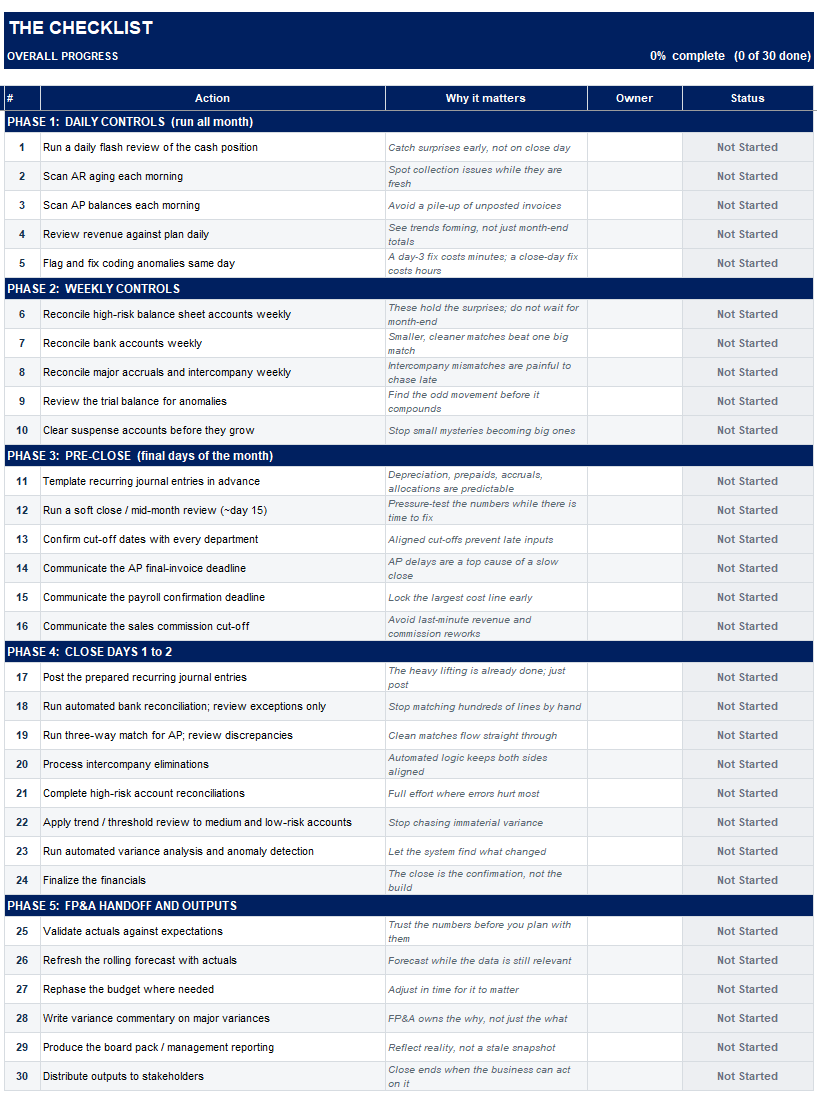
Daily controls catch issues the moment they happen. A quick flash review of cash, receivables, payables, and revenue. Nothing fancy. Just having eyes on the numbers every day so nothing surprises you at month-end.
Weekly controls handle the medium-frequency work. Reconcile the high-risk balance sheet accounts. Review the trial balance for anything odd. Clear suspense accounts before they grow.
Pre-close controls run in the final days of the month. Prepare recurring entries, confirm cut-off dates, and align with other departments. By the time the period closes, you are validating, not building.
When you run all three layers, the month-end stops being a cliff edge. It becomes a gentle finish line. The work was already done. Now you confirm it and publish.
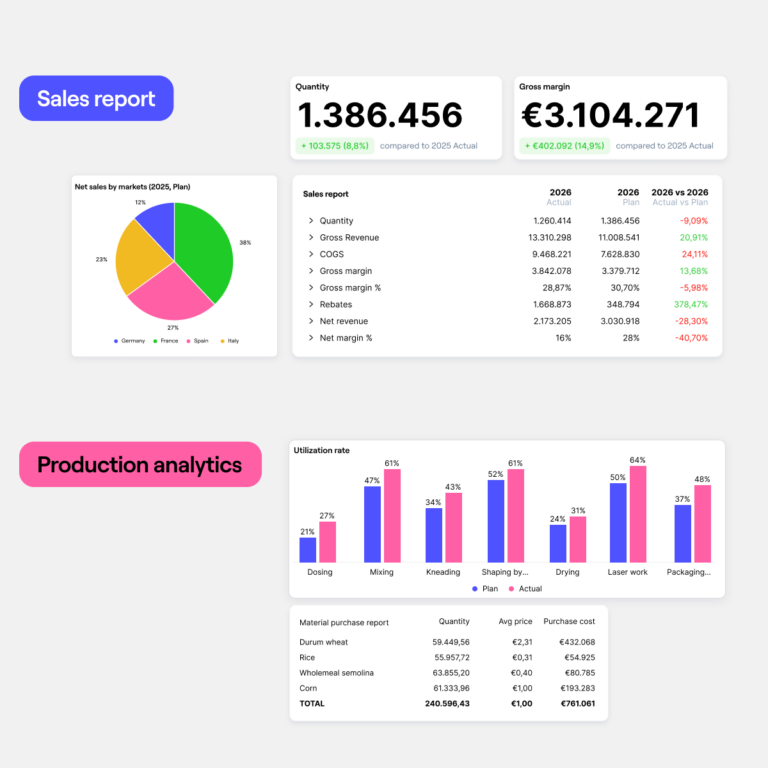
This is also where a modern planning platform starts to earn its place. Continuous accounting needs continuous data. Farseer keeps actuals flowing in real time from your ERP, CRM, and HR systems, so the numbers you review on day twenty are the same trusted numbers you finalize at month-end. Instead of waiting for a month-end data dump, your team works against a live picture all month long. That alone removes one of the biggest sources of close-day chaos.
Build The Pre-Close Machine
This section is where the days are actually saved. If you change nothing else, change this.
The goal is to build a pre-close machine that does most of the work before the period ends.
Here is what goes into it.
Daily flash reporting comes first. Each morning, look at the key movements. Cash position. AR aging. AP balances. Revenue against plan. You are not reconciling. You are scanning for anomalies. Catch a coding error on day three and it costs minutes. Catch it on a close day and it costs hours of unwinding.
Read: Cash Ratio: Formula, Definition & Example
Weekly reconciliations for high-risk accounts come next. Do not wait until month-end to reconcile the accounts most likely to hold surprises. Reconcile them every week. Bank accounts, major accruals, intercompany balances, and anything volatile. By month-end, these are already clean.
Standardized recurring journal entries should be prepared in advance. Most of your monthly entries are predictable. Depreciation, prepaid amortization, standard accruals, allocations. Template them. Prepare them before the period closes. Post them the moment the books are ready.
A soft close or mid-month review catches problems while there is still time to fix them. Run a light close around day fifteen. You are not finalizing anything. You are pressure-testing the numbers, spotting gaps, and giving departments a chance to correct course before the real deadline.
Early cut-off communication ties it together. Tell every department their deadlines well in advance. AP needs its final invoice date. Payroll needs its confirmation date. Sales needs its commission cut-off. When everyone knows the rules early, the inputs arrive on time.
None of it is glamorous. It is disciplined, repeatable work. But this is where ten days becomes two. The teams that win the close are the teams that win the days before the close.
Prioritize By Risk, Not By Habit
Now let us talk about something that quietly wastes enormous effort. Most teams reconcile every account with the same intensity, every single month. That feels responsible. It is actually inefficient.
Not every account deserves the same effort. A dormant account with two transactions a year does not need the scrutiny of your largest revenue line. Yet many teams treat them identically out of habit.
The fix is risk-based close. Sort your accounts into three groups.
High-risk accounts are material, volatile, or complex. Revenue, major accruals, intercompany, anything with judgment involved. Fully reconcile these every month, without exception. This is where errors hurt most, so this is where you spend your attention.
Medium-risk accounts get a lighter touch. Review them using trend analysis. If the balance moves the way you expect, you move on. If it jumps unexpectedly, you dig in.
Low-risk accounts get threshold-based review. Set a materiality rule. If the change falls below the threshold, you accept it and move on. You stop chasing immaterial variance that nobody will ever care about.
This is where FP&A judgment shines. You already know which numbers move the business and which do not. Apply that instinct to the close. Set clear materiality rules. Document them. Then trust them.
The payoff is focus. Your team spends its limited hours on the accounts that matter and stops burning energy on the ones that do not. That focus is what makes a fast close sustainable rather than a one-month miracle.
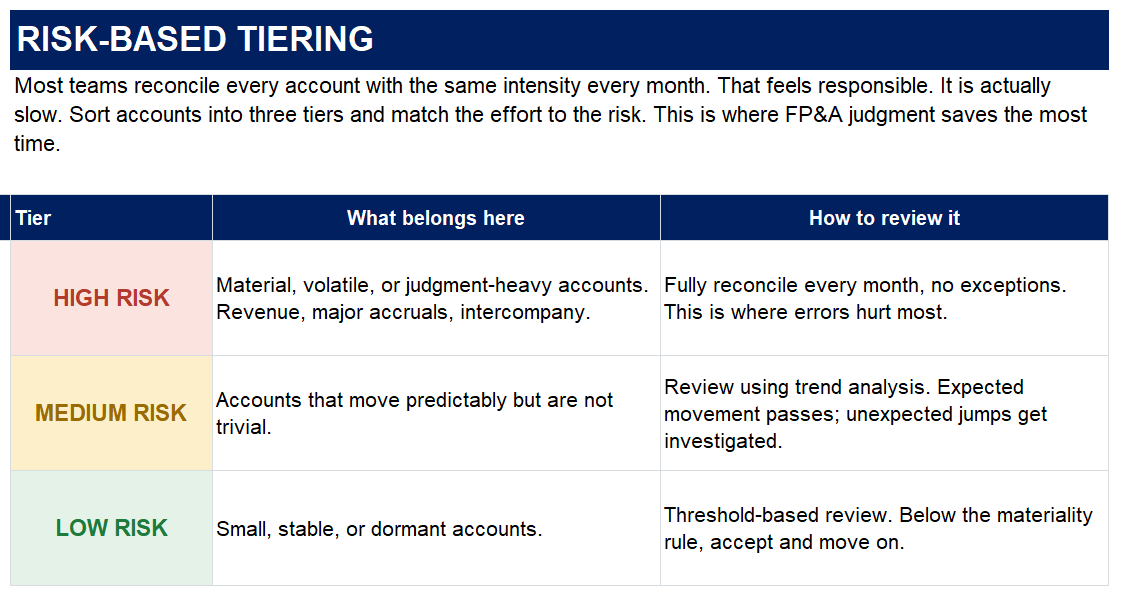
Use this Risk-Based Tiering Framework to focus review effort where it matters most and eliminate unnecessary close activities.
Download the template here:
Automate The Time Killers
You have moved work earlier. You have prioritized by risk. Now remove the manual grind entirely.
Automation is the multiplier. It does not replace judgment. It removes the repetitive work so your analysts can spend their time on exceptions and explanations, which is where they add real value.
Start with the biggest time killers.
Bank reconciliation automation matches transactions automatically and flags only the exceptions. Instead of matching hundreds of lines by hand, your team reviews the handful that did not match.
Recurring journal entry templates post your predictable entries without manual rekeying. Set them once. Let them run.
Three-way match automation for AP compares the purchase order, the receipt, and the invoice automatically. Discrepancies surface on their own. Clean matches flow straight through.
Intercompany elimination support handles one of the most error-prone parts of any close. Automated logic keeps both sides aligned so you are not chasing mismatches at the worst possible moment.
Automated variance analysis and anomaly detection scan the numbers for you. Instead of hunting for what changed, the system tells you. You go straight to explaining why.
Read: Finance Automation in 2026: Tools, Use Cases, and Real-World Strategy
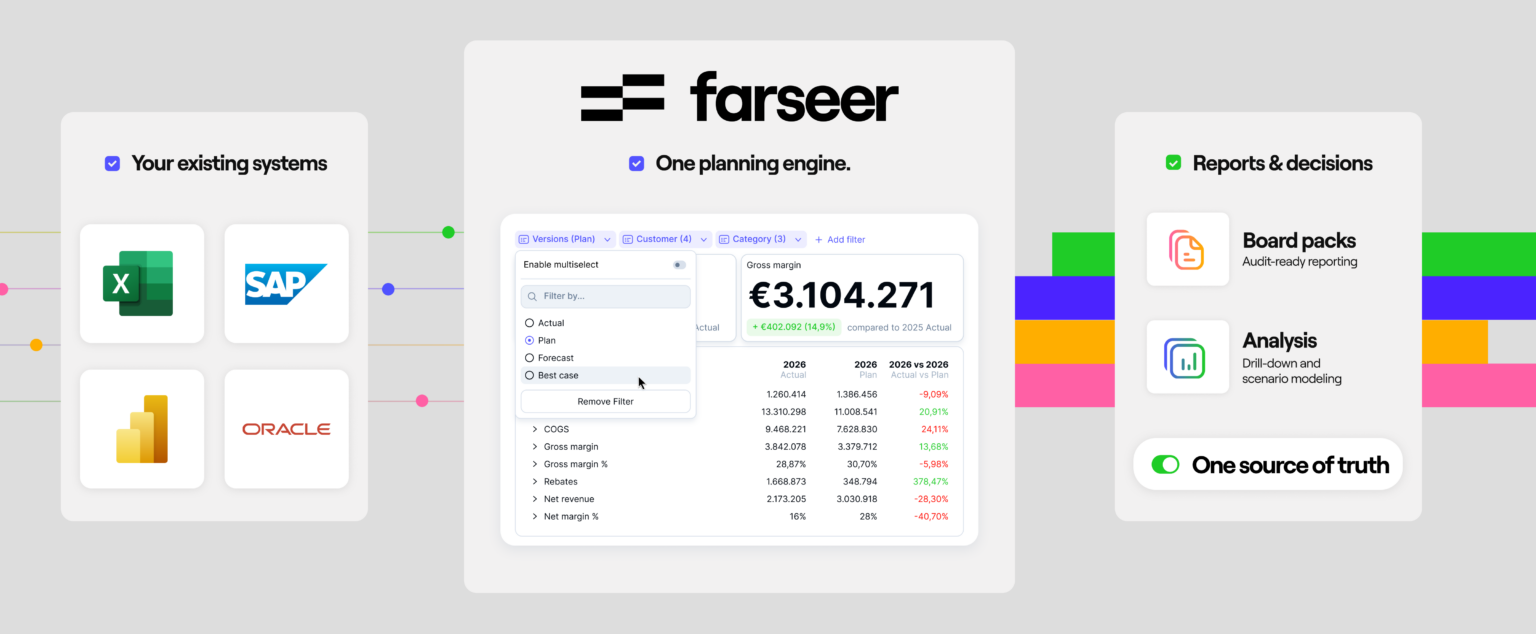
This is exactly where the right FP&A platform changes the math. Farseer replaces fragile spreadsheet workflows with driver-based models that update automatically as actuals flow in from your source systems. When a number moves, the model recalculates instantly, and anomaly detection surfaces the items worth a second look. Your analysts stop rebuilding spreadsheets and start interpreting results. Every assumption and version stays on a full audit trail, so speed never costs you control. That last point matters. The fear with a fast close is that you trade accuracy for speed. Good automation gives you both.
A quick word of caution. Do not automate a broken process. If your account structure is a mess, fix it first. Automation magnifies whatever you point it at. Point it at a clean, well-designed process and it flies.
Make FP&A Part Of The Close, Not The Afterthought
Here is a mistake that quietly costs FP&A its influence. Treating the close as an accounting task that FP&A waits on.
When FP&A sits at the end of the line, the value of a fast close evaporates. Accounting finishes, then FP&A starts a multi-day scramble to validate actuals, refresh forecasts, and build commentary. The fast close becomes a slow handoff.
The better model brings FP&A into the close itself. Tie close speed directly to the things FP&A cares about. Forecast freshness. Board pack readiness. Decision latency.
Think about what faster actuals unlock. When clean actuals land on day two instead of day ten, your rolling forecast refreshes while the data is still relevant. Budget rephasing happens in time to matter. The board pack reflects reality, not a stale snapshot. Your decisions get sharper because they rest on fresher numbers.
FP&A should also own the narrative. Accounting reports what happened. FP&A explains why it happened and what it means. You should own the commentary on major variances. That is your craft.
The deeper benefit is subtle but powerful. When actuals arrive early and clean, your team spends its time analyzing instead of data chasing. The hours you used to lose to validation get redirected to insight. That is how FP&A earns its seat at the strategy table.
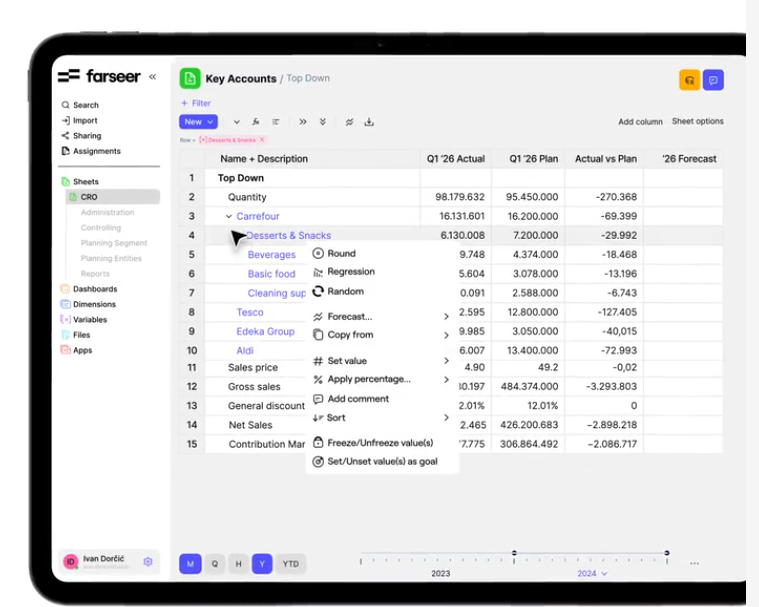
This is the other half of what a connected platform delivers. With Farseer, actuals feed straight into driver-based forecasts, so your rolling forecast updates the moment the close lands rather than days later. Static board decks give way to interactive views that leadership can explore in real time. Your team moves from assembling the report to explaining the story behind it. The faster close stops being an accounting win and becomes an FP&A advantage.
Standardize The Checklist and Ownership Model
Speed without structure is chaos. The thing that makes a fast close repeatable, month after month, is a disciplined operating model. The close checklist is its backbone.
Do not dismiss this close checklist as admin work. It is the control layer that makes speed safe. Without it, a fast close depends on heroics and memory. With it, the close runs the same way every month regardless of who is on holiday.
Build it properly. Every task needs an owner, a due time, and a dependency. Not just “reconcile bank accounts.” Rather, “Maria reconciles bank accounts by 10am on day one, after the bank feed posts.” Specific. Assigned. Sequenced.
Use a close calendar with cut-offs and escalation paths. Everyone can see what is due, when, and what happens if it slips. When a task is late, the escalation path triggers automatically. No one has to chase.
Define the handoffs clearly. Accounting, FP&A, AP, payroll, revenue operations, and the business units all have roles. Map where one team’s output becomes another’s input. Smooth handoffs are where serial delays disappear.
Build contingency paths for the predictable surprises. A missing invoice. A late approval. An unusual transaction. Decide in advance how you handle each so that one hiccup does not stall the whole close.
The point of all this structure is not bureaucracy. It is repeatability. A fast close that only works when your best person is in the office is not a fast close. It is luck. The checklist turns luck into a system.
Metrics That Prove The Transformation
You cannot improve what you do not measure. And you cannot prove a transformation without numbers. So track the right ones.
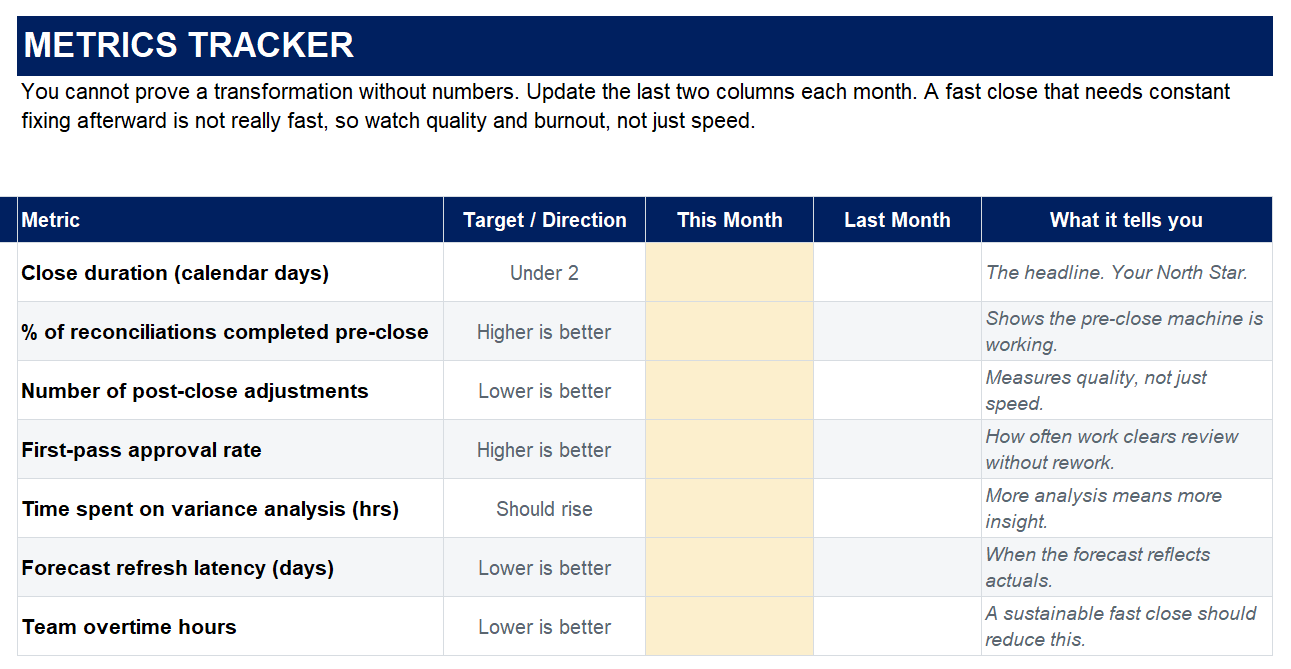
Here are the seven metrics that matter for a close transformation.
- Close duration in calendar days is the headline. This is your North Star. Watch it trend down month over month.
- Percent of reconciliations completed pre-close tells you whether the pre-close machine is working. The higher this number climbs, the faster your close gets.
- Number of post-close adjustments measures quality. A fast close that needs constant fixing afterward is not really fast. Fewer adjustments means a cleaner process.
- First-pass approval rate shows how often work clears review without rework. A high rate means your process and your data are solid.
- Time spent on variance analysis is a value metric. As the close speeds up, this should rise. More time on analysis means more insight for the business.
- Forecast refresh latency captures the FP&A payoff. How long after period-end does your forecast reflect actuals? Shorter is better. This is where close speed turns into planning value.
- Team overtime hours is the human metric. A sustainable fast close should reduce overtime, not hide it. If your close got faster but your team is burning out, you have not actually fixed the process.
Track these consistently. Share them with leadership. Numbers like these turn a vague “we got faster” into a credible story of transformation. They also tell you exactly where the next bottleneck lives.
A 30-60-90 Day Implementation Roadmap
Reading about a faster close is easy. Building one takes a plan. Here is a practical ninety-day roadmap you can start on Monday.
Days one to thirty are about baselining and diagnosis. You cannot fix what you have not measured. Time your current close, step by step. Map every task, owner, and dependency. Find the bottlenecks. Where does the close actually stall? Which handoffs cause the longest waits? Which accounts trigger the most adjustments? Resist the urge to fix things yet. Your job this month is to see the process clearly.
Days thirty-one to sixty are about moving work earlier and automating the worst offenders. Take the recurring tasks you identified and shift them before month-end. Start preparing standard journal entries in advance. Begin weekly reconciliations on your high-risk accounts. Then automate the highest-volume manual steps. Pick the one or two tasks that eat the most hours and tackle those first. Early wins build momentum and buy you credibility for the bigger changes.
Days sixty-one to ninety are about formalizing the new rhythm. Lock in your new close calendar with clear cut-offs. Train every owner on their tasks and deadlines. Document the checklist so it survives staff changes. Set up your metrics dashboard so you can track progress. Then commit to continuous improvement. Each month, review what slowed you down and remove one more obstacle.
Read: Consolidation Entries 101 – A Modern Guide for Finance Teams
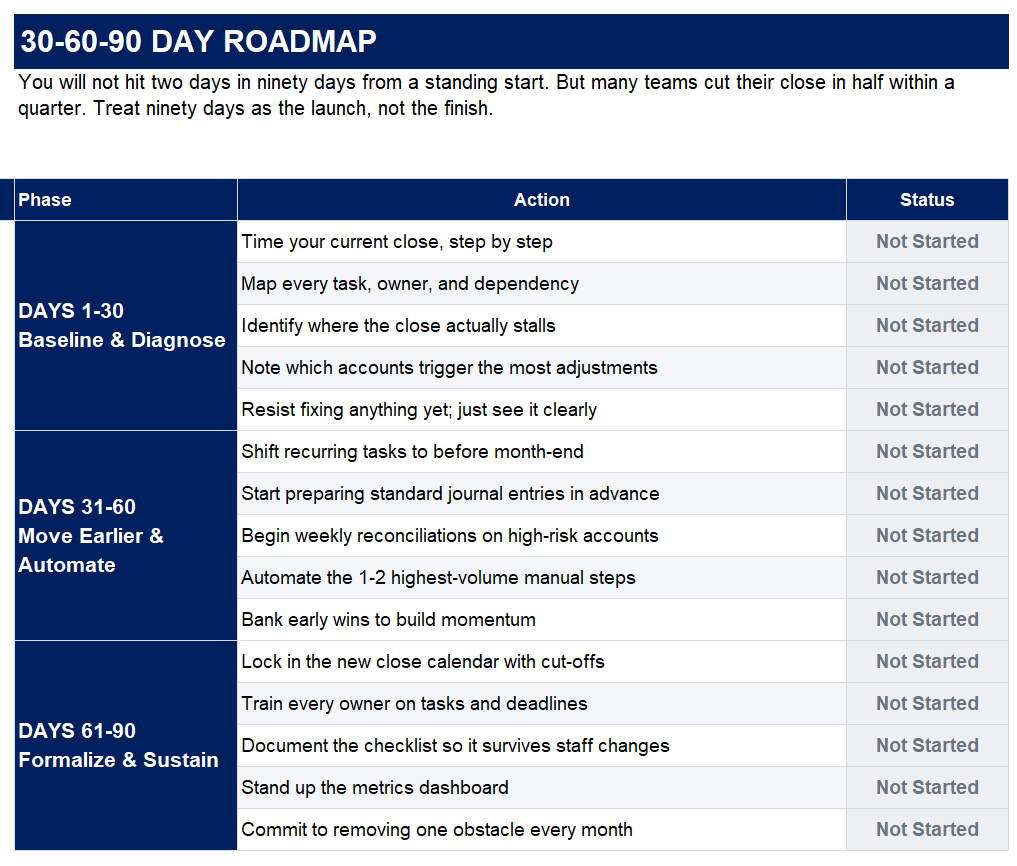
A realistic note on timing. You will not hit two days in ninety days from a standing start. But you will see meaningful progress. Many teams cut their close in half within a quarter. The sub-two-day finish comes as the new rhythm matures and the pre-close machine takes hold. Treat ninety days as the launch, not the finish.
The Real Payoff
Let us step back and remember why any of this matters.
A faster close is not really a finance KPI. It is a leadership capability. When you close in two days instead of ten, you give the whole business something rare. Fresh information. Decisions made on current reality instead of last month’s ghost.
The benefits stack up. Better decisions, because the numbers are current. Less burnout, because the work is spread out instead of crammed into a brutal sprint. Stronger FP&A influence, because your team spends its time on insight instead of data entry.
Here is the idea worth holding onto. The best teams do not close fast by working frantically at month-end. They close continuously, then finalize quickly. The close becomes a quiet confirmation of work already done, not a desperate scramble to assemble it.
That is the transformation. It is within reach, and it starts with a single decision to redesign rather than rush.
If a faster, more reliable close is on your team’s agenda, this is exactly the kind of process Farseer was built to support. It unifies planning, forecasting, and reporting in one connected platform, with real-time data sync, driver-based models, and a full audit trail on every version. The goal is simple. Spend less time assembling the numbers and more time acting on them. You can explore how it works at farseer.com.
Start before next month-end. Move one task earlier. Automate one manual step. Measure one metric. Small changes compound. Ten days really can become two.

FAQ
What is a month-end close?
A month-end close is the process of reviewing, reconciling, and finalizing a company’s financial records at the end of each month. The goal is to produce accurate financial statements, management reports, and FP&A insights that support business decision-making.
How long should a month-end close take?
Top-performing finance teams typically complete the month-end close within one to five days, while the best achieve a two-day close. The exact timeline depends on process maturity, automation, data quality, and organizational complexity.
What causes delays in the month-end close process?
Common causes of month-end close delays include manual reconciliations, spreadsheet-based workflows, late journal entries, poor data quality, missing accruals, cross-functional bottlenecks, and unclear ownership of close activities.
How can finance teams reduce month-end close time?
Finance teams can reduce close time by implementing continuous accounting, automating repetitive tasks, performing reconciliations throughout the month, standardizing close procedures, improving data quality, and using a structured close checklist.
What is continuous accounting?
Continuous accounting is an approach where reconciliation, validation, and review activities occur throughout the month rather than after month-end. This reduces the workload during the close period and helps organizations achieve a faster and more accurate financial close.
What is a two-day close?
A two-day close refers to the ability to finalize financial statements, validate actuals, complete variance analysis, and provide management reporting within two days of period-end. It represents a best-in-class financial close process.
How does automation improve the month-end close process?
Automation improves the month-end close process by reducing manual work, accelerating reconciliations, automating journal entries, identifying anomalies, improving data accuracy, and enabling finance teams to focus on analysis instead of administrative tasks.
What metrics should finance teams track to improve the financial close?
Key month-end close metrics include close duration, percentage of reconciliations completed before close, post-close adjustments, first-pass approval rate, forecast refresh latency, analyst time spent on analysis, and team overtime hours.
How does a faster month-end close benefit FP&A teams?
A faster month-end close gives FP&A teams earlier access to validated actuals, allowing them to refresh forecasts sooner, accelerate variance analysis, improve board reporting, support decision-making, and spend more time on business partnering.
What software helps accelerate the month-end close?
Many organizations use ERP systems combined with FP&A platforms such as Farseer, Anaplan, Jedox, Pigment, and Adaptive Planning to automate workflows, improve data integration, support continuous accounting, accelerate reporting, and reduce close cycle times.

Financial Consolidation: Definition, Challenges & Solutions
Read more
Consolidation Entries 101 – A Modern Guide for Finance Teams
Read more