Scenario Planning or Sensitivity Analysis? A Practical Guide for Finance and FP&A Teams

Most finance and FP&A teams don’t struggle with building the forecasts. They struggle with trusting them. Because the real problem isn’t the numbers. It’s understanding what drives them and what could break them.
If there is one thing every FP&A professional knows, it is this: the future never arrives in a neat, predictable package.
Every forecast your team builds rests on a set of assumptions (about sales volumes, pricing trends, input costs, customer demand, exchange rates, and macroeconomic conditions). Change any one of those assumptions and the numbers shift. Change several at once and you may be looking at an entirely different financial picture.
That is exactly why planning tools matter. Two of the most powerful techniques in the FP&A toolkit are scenario planning and sensitivity analysis. Both are designed to help finance teams navigate uncertainty, stress-test their models, and support better decision-making. But despite being closely related, they answer fundamentally different questions and serve different purposes inside the planning cycle.
In this article, we will unpack both methods in detail. You will learn what each technique does, how they differ, when FP&A teams should reach for one versus the other, and—most importantly—how to combine them inside your financial models to produce insights that leadership can actually act on.
Understanding What Scenario Planning Is
Scenario planning is the practice of building multiple complete pictures of the future. Instead of relying on a single forecast, FP&A teams construct several alternative futures—each defined by a distinct bundle of assumptions about the business environment. The goal is not to predict which future will happen but to prepare the organisation for a range of possibilities.
At its simplest, most FP&A teams work with three scenarios.
- A base case represents the most likely path forward, grounded in current trends and reasonable expectations.
- A best case captures the upside. What happens if demand surges, pricing holds, and costs remain stable.
- A worst case models the downside. A recession, competitive disruption, regulatory headwinds, or supply chain failure.
More sophisticated teams may build four or five scenarios that blend different combinations of economic, competitive, and operational assumptions.
The Purpose Behind It
Scenario planning is fundamentally a strategic tool.
It exists to help leadership see the full landscape of what could happen and prepare contingency plans before any crisis arrives. When a CFO reviews three or four scenario-driven forecasts, they are not looking for point-estimate accuracy.
They are asking broader questions:
- How resilient is our business model?
- Where are we most exposed?
- What levers do we pull if the world shifts?
This makes scenario planning especially valuable for decisions that are large-scale and difficult to reverse. Entering a new geographic market, committing to a major capital investment, launching a new product line, or restructuring a supply chain.
These are the kinds of choices where getting it wrong is costly and where leadership needs to see how different futures affect the financial outcome before committing resources.
A Practical Example
Imagine your company is evaluating expansion into Southeast Asia. The FP&A team might build three scenarios.
- In the strong demand scenario, the region adopts the product quickly, distribution partnerships scale on schedule, and revenue ramps within 18 months.
- In the moderate adoption scenario, market entry takes longer than expected, customer acquisition costs are higher, and revenue reaches plan only by year three.
- In the downturn scenario, a regional economic slowdown suppresses demand, currency depreciation erodes margins, and the breakeven timeline extends beyond five years.
Each scenario has its own revenue curve, cost structure, and cash flow profile.
Leadership can now compare these side by side and ask: What is the minimum viable outcome that still justifies the investment? That is the kind of question only scenario planning can answer.
💡 Farseer AI in Action: Scenario Planning
This is where a platform like Farseer adds real value. Instead of maintaining three separate spreadsheets for each scenario, Farseer lets FP&A teams build and toggle between scenarios inside a single connected model with version control, audit trails, and real-time collaboration built in. The result is faster scenario construction and far less risk of formula errors creeping in when assumptions change.
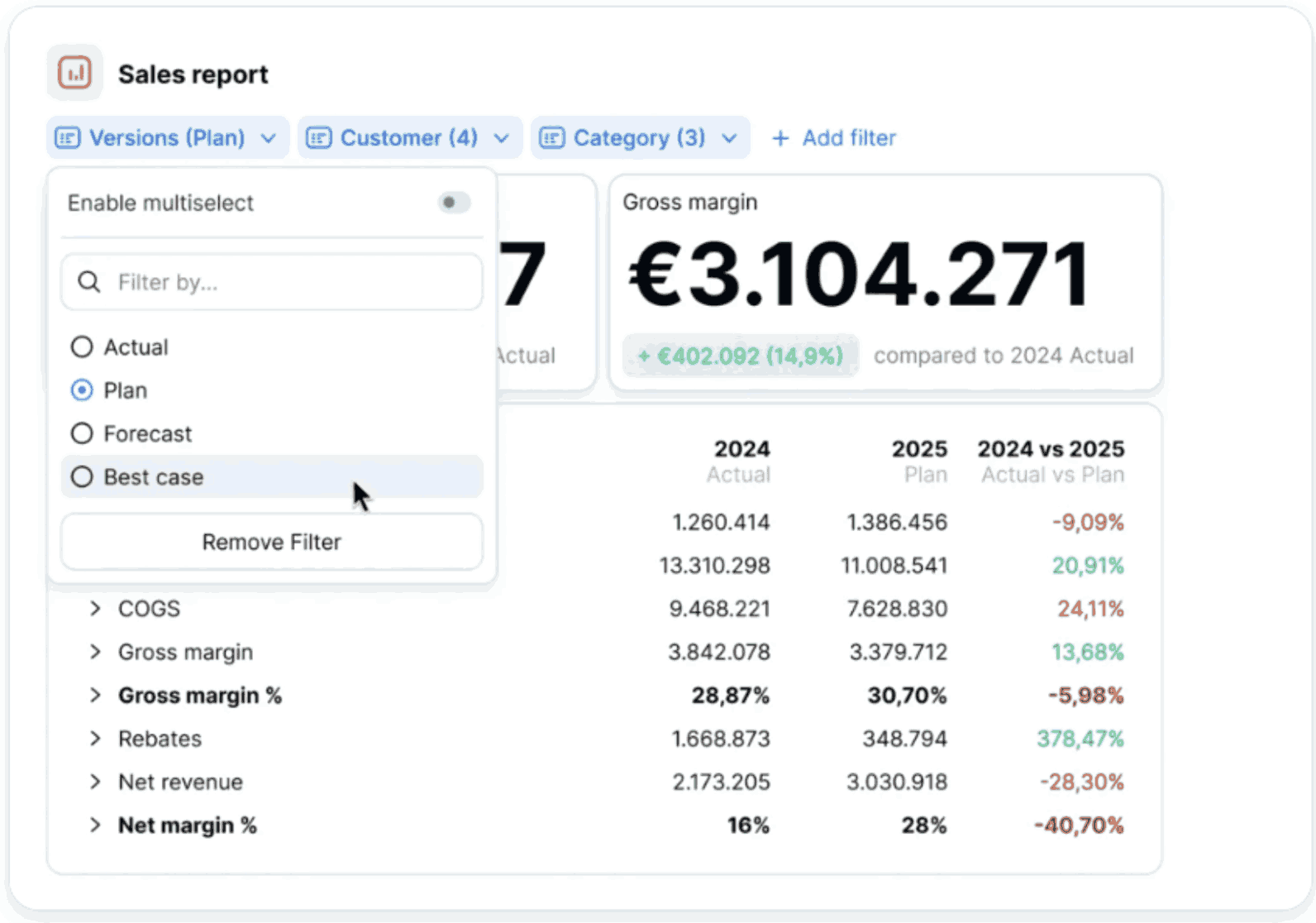
Scenario planning appears most frequently in strategic planning cycles, long-range financial plans covering three to five years, capital allocation discussions, market expansion evaluations, board and investor presentations, and responses to macroeconomic disruptions such as pandemics, trade conflicts, or inflationary environments.
It is worth noting that scenario planning is not a one-off exercise. The best FP&A teams revisit and refresh their scenarios regularly. Quarterly in fast-moving industries, semi-annually in more stable sectors. As new information arrives, scenarios should evolve. The recession scenario built in January may need to be updated by June if interest rate expectations have shifted. Scenarios that go stale lose their value as decision-support tools.
Understanding Sensitivity Analysis
What Sensitivity Analysis Is
Where scenario planning changes the entire picture, sensitivity analysis zooms in on a single variable.
It asks a simple but powerful question: How much do our results change if this one assumption moves?
The variables tested are typically the key drivers of financial performance. Sales volume, unit price, raw material cost, labour rates, exchange rates, or interest rates. FP&A teams adjust one variable at a time, holding everything else constant, and measure the impact on revenue, margin, EBITDA, net income, or whatever metric matters most for the decision at hand.
Read: Financial Statement Metrics: Which Ones Actually Improve Planning and Forecasting?
Sensitivity Analysis - The Purpose Behind It
Sensitivity analysis is a diagnostic tool. Its job is to tell you which assumptions carry the most weight in your model and where the business faces the greatest risk from a single-variable shift.
If a 5% increase in raw material costs wipes out half your operating margin, that is a finding leadership needs to see. If a 10% decline in volume barely moves the needle on profitability because of your fixed-cost structure, that too is a critical insight.
In other words, sensitivity analysis separates the variables that matter from the variables that do not. It ranks your assumptions by their financial impact and helps you focus management attention on the drivers that genuinely move results.
Sensitivity Analysis - A Practical Example
Consider a consumer goods company evaluating its pricing strategy. The FP&A team runs a sensitivity analysis on unit price. They test what happens if price increases by 5%, stays flat, or decreases by 5%. The model shows that a 5% price reduction cuts gross margin from 42% to 34% because of the company’s high fixed-cost manufacturing base, while a 5% price increase lifts margin to 49% with only a modest volume decline assumed.
That single analysis gives the pricing committee a clear picture of the financial stakes involved. It does not tell them what the competitive environment will look like—that would require scenario planning—but it tells them precisely how sensitive profitability is to the pricing lever.
Common Outputs and Visualisations
The outputs of sensitivity analysis are typically presented in one of three formats.
- Data tables show financial results across a range of values for the variable being tested.
- Sensitivity matrices extend this to two variables at once, showing how combinations of price and volume, for example, affect margin.
- Tornado charts rank multiple variables by their impact on a chosen outcome, making it visually obvious which drivers dominate. Tornado charts deserve special mention because they are one of the most effective communication tools in the FP&A arsenal. A well-built tornado chart can convey in a single visual what would take pages of tables to explain. It shows leadership, at a glance, which assumptions carry the most financial weight and by implication, which risks deserve the most management attention. If you are presenting sensitivity results to a non-finance audience, a tornado chart should almost always be part of your deliverable.
💡 Farseer AI in Action: Sensitivity Analysis
Farseer AI makes sensitivity analysis considerably more accessible by allowing FP&A teams to define variable ranges and generate visualisations directly within their planning models. No manual data tables or spreadsheet gymnastics required. When sensitivity testing is built into the platform rather than layered on top, it becomes something teams actually do regularly rather than saving for special occasions.
Where FP&A Uses Sensitivity Analysis Most
Sensitivity analysis is a staple of pricing analysis, margin analysis, investment decision modelling, driver-based forecasting, budget risk assessment, and financial model validation. It is also the first tool most analysts reach for when building or auditing a new model, because it reveals whether the model’s outputs respond logically to changes in its inputs.

Key Differences Between Scenario Planning and Sensitivity Analysis
Although both methods deal with uncertainty, they differ in scope, objective, complexity, and output. The table below summarises the distinctions.
| Dimension | Scenario Planning | Sensitivity Analysis |
| Scope of Change | Multiple variables change together | One variable changes at a time |
| Objective | Explore possible futures | Measure risk from key drivers |
| Level of Analysis | Strategic and directional | Analytical and diagnostic |
| Complexity | Complete alternative models | Focused and narrow |
| Typical Output | Multiple forecasts and projections | Impact tables, tornado charts, driver rankings |
| Time Horizon | Long-term (3–5 years) | Short to medium-term |
The simplest way to remember the difference is this:
Scenario planning changes the world around the model, while sensitivity analysis changes a dial inside it.
A recession scenario bundles together lower demand, tighter credit, pricing pressure, and cost inflation all shifting simultaneously.
A sensitivity test on price keeps everything else frozen and asks what happens if price alone moves up or down by a defined increment.
This difference in scope drives a difference in use. Scenario planning is the right tool when you need to explore what could happen in the broader environment. Sensitivity analysis is the right tool when you need to understand what matters most inside your existing model.
There is also a practical difference in how each method is built. Scenario planning typically requires cross-functional input. You need sales leaders to validate demand assumptions, operations teams to assess supply chain risks, and economists or market analysts to frame macro conditions. It is inherently a collaborative exercise. Sensitivity analysis, by contrast, can often be run by a single analyst within the financial model itself. That makes it faster to execute and easier to update. But it also means it captures less of the organisational knowledge that scenario planning draws on.
When FP&A Should Use Scenario Planning
1. Strategic, High-Stakes Decisions
Scenario planning earns its keep when leadership faces decisions that are large, consequential, and difficult to reverse.
Entering a new market, acquiring a competitor, launching a product line, committing to a multi-year capital programme. These are the decisions where the cost of being wrong is measured in years and millions. Scenario planning lets the team model the financial consequences of different futures before capital is committed.
2. High-Uncertainty Environments
When the external environment is volatile or genuinely unpredictable, scenario planning becomes indispensable.
Consider the planning challenges that emerged during the pandemic, or the current environment of geopolitical tension and shifting trade policy. In these moments, a single-point forecast is almost guaranteed to be wrong. Building three scenario-driven forecasts is not a luxury—it is a necessity.
Read: Top 7 Forecasting Techniques: Every FP&A Professional Should Know
3. Long-Range Planning Horizons
The further out you forecast, the wider the cone of uncertainty.
A one-year budget may be reasonably anchored to current run rates. A five-year strategic plan is essentially a set of assumptions about the future. And those assumptions could diverge in many directions. Scenario planning is the natural framework for three-to-five-year plans, investor presentations, and board-level strategic reviews because it acknowledges uncertainty rather than pretending it does not exist.
Read: FP&A Monthly Calendar
The Benefits for FP&A Teams
Beyond its direct analytical value, scenario planning trains the organisation to think strategically about risk. It encourages cross-functional dialogue—sales, operations, and finance have to agree on what each scenario assumes. It forces leadership to confront uncomfortable possibilities before they materialise. And it provides pre-built contingency playbooks: if we see early signals of the downturn scenario, here is what we do.
When FP&A Should Use Sensitivity Analysis
1. Identifying Key Value Drivers
Every financial model is built on dozens of assumptions, but only a handful truly drive the result. Sensitivity analysis is the fastest way to separate the critical few from the trivial many. By testing each input variable and measuring its impact on the output, FP&A can identify the three or four drivers that leadership should monitor most closely.
Read: A Step-by-Step Guide to Building a 3-Statement Financial Model
2. Assessing Risk Exposure
Sensitivity analysis is the go-to method for understanding how vulnerable results are to a specific assumption shift.
- How exposed are we to a 10% depreciation in the local currency?
- What happens to cash flow if interest rates rise by 100 basis points?
- How much volume decline can we absorb before we breach a covenant threshold?
These are precision questions that require a precision tool.
3. Financial Model Building and Validation
During model construction, sensitivity analysis serves as both a design tool and a quality check. It helps the analyst decide which inputs deserve the most modelling granularity and which can be simplified. It also acts as a sanity test: if the model shows no sensitivity to a variable that should matter, something is likely mis-specified.
4. Budgeting and Operational Planning
In the annual budgeting cycle, sensitivity analysis helps the team understand the risk embedded in the plan.
- What is the downside to revenue if the sales pipeline converts at 80% instead of 90%?
- How much does a 3% wage increase move total compensation expense?
These are the operational questions sensitivity analysis was built to answer.
The Benefits for FP&A Teams
Sensitivity analysis builds decision confidence by quantifying the stakes.
It helps finance professionals communicate risk in concrete terms—not “we might miss budget” but “a 5% volume shortfall reduces EBITDA by $2.4 million.” It supports faster decision-making because it highlights the variables that warrant attention and deprioritises the ones that do not.
There is also a communication benefit that is often overlooked. When FP&A presents a budget or forecast to leadership, one of the first questions is usually some variation of “how confident are we in these numbers?” Sensitivity analysis provides a structured, quantitative answer to that question. Instead of offering vague reassurance, FP&A can show exactly how much the result would move under different assumptions, and then frame the discussion around the specific risks that deserve attention.

Integrating Both Methods in FP&A
Why FP&A Should Use Both
The strongest FP&A teams do not choose between scenario planning and sensitivity analysis. They use them together, in sequence, as complementary steps in the same planning process. Each method answers a question the other cannot. Sensitivity analysis tells you what matters most. Scenario planning tells you what could happen if the world shifts. Together, they produce financial models that are both analytically rigorous and strategically robust.
The Practical Workflow
Step 1: Build the base financial model. Start with a well-structured model that captures your key revenue, cost, and cash flow drivers. This model serves as the foundation for both analyses.
Step 2: Run sensitivity analysis. Test each key input variable and identify the drivers with the greatest impact on financial results. Rank them by magnitude and note any variables where even a small change produces a disproportionate swing in outcomes.
Step 3: Build scenarios using those drivers. Take the high-impact variables identified in step two and construct complete scenarios around them. A demand slowdown scenario, a rapid growth scenario, a cost inflation scenario—each one grounded in realistic combinations of the variables that your sensitivity analysis proved actually matter.
This sequenced approach is powerful because it ensures your scenarios are built on the right variables.
- Without sensitivity analysis, FP&A teams sometimes build scenarios around assumptions that have little financial impact (waste of effort).
- Without scenario planning, sensitivity analysis stays isolated and fails to capture how variables interact in the real world.
💡 Farseer AI in Action: Integrated Planning
This is exactly the workflow that Farseer is designed to support. The platform lets FP&A teams run sensitivity analysis on their base model, identify the high-impact drivers, and then build full scenarios around those drivers. All within one environment. Because everything is connected, updating a single assumption automatically flows through to every scenario, eliminating the reconciliation headaches that plague spreadsheet-based planning.
An Integrated Example
Consider a mid-market consumer goods company preparing its annual strategic plan.
The FP&A team builds a base model and runs sensitivity analysis on twelve input variables. The results reveal that profitability is most sensitive to three factors: raw material costs, sales volume in the company’s largest channel, and foreign exchange rates on imported inputs.
Armed with that insight, the team constructs three scenarios.
- A stable environment scenario holds all three variables near current levels.
- A cost inflation scenario models a 15% increase in raw material costs alongside modest currency depreciation and flat volume.
- A growth acceleration scenario models a 20% volume increase in the key channel with stable costs and favourable exchange rates.
Leadership now has a sensitivity-informed set of scenarios that focus on the variables proven to drive results. The board discussion becomes sharper, the contingency plans become more targeted, and the entire planning exercise delivers more value in less time.
💡 Farseer AI in Action: Run Scenarios Through Chat
With Farseer AI, you can run scenarios directly from a chat interface. Simply type a question like “What happens to our margin if raw material costs increase 15%?” and Farseer AI pulls the numbers, runs the logic, and gives you the answer in plain language. No need to set filters or design dashboards—just ask and get your scenario analysis instantly.
The Combined Benefits
When used together, these two methods strengthen every dimension of the planning process.
Risk management improves because the team understands both which variables pose the greatest threat and what happens when those threats materialise simultaneously. Strategic planning improves because scenarios are built on analytically validated drivers rather than intuition alone.
Financial models become more robust because they have been tested at the component level and the system level.
The FP&A Playbook: Putting It All Together
Scenario planning and sensitivity analysis are two of the most powerful techniques available to FP&A professionals. But they are not interchangeable. Each solves a different planning problem, and understanding when to deploy each one—and how to combine them—is what separates competent financial planning from exceptional financial planning.
The rule of thumb is straightforward. Reach for sensitivity analysis when you want to answer the question: Which variable matters most? Reach for scenario planning when you want to answer the question: What if the world changes?
The most effective FP&A teams do not treat these as competing methodologies or occasional add-ons. They embed both into their standard planning workflow—sensitivity analysis to identify the critical drivers, scenario planning to explore the range of possible futures built around those drivers. The result is a planning process that is grounded in analytical rigour and expansive enough to handle genuine uncertainty.
In a world where the only certainty is that conditions will change, FP&A teams that master both tools do not just forecast better. They help their organisations think better, plan better, and ultimately decide better. And that is what great FP&A is all about.
So the next time you sit down to build a forecast, ask yourself both questions. What matters most in this model? And what happens if the world around it changes? Answer both, and you will deliver the kind of insight that turns finance from a reporting function into a genuine strategic partner.

FAQ
What is the difference between scenario planning and sensitivity analysis?
The difference between scenario planning and sensitivity analysis lies in scope and purpose. Scenario planning evaluates multiple variables changing together to model different future outcomes, while sensitivity analysis tests the impact of changing one variable at a time. Scenario planning is strategic, whereas sensitivity analysis is diagnostic.
When should FP&A teams use scenario planning?
FP&A teams should use scenario planning when making strategic decisions under uncertainty. It is most useful for long-term planning, market expansion, capital investments, and situations where multiple external factors such as demand, pricing, and costs may change simultaneously.
When should FP&A teams use sensitivity analysis?
FP&A teams should use sensitivity analysis when evaluating the impact of a single variable on financial outcomes. It is ideal for testing assumptions, identifying key drivers, and understanding how changes in factors like price, volume, or costs affect profitability.
Why is scenario planning important in financial planning?
Scenario planning is important because it helps organisations prepare for uncertainty by modelling different possible futures. It enables leadership to evaluate risks, test strategic decisions, and develop contingency plans before changes in the business environment occur.
What is the purpose of sensitivity analysis in FP&A?
The purpose of sensitivity analysis is to identify which variables have the greatest impact on financial results. It helps FP&A teams quantify risk, prioritise key drivers, and understand how changes in assumptions influence metrics such as revenue, margin, and cash flow.
Can scenario planning and sensitivity analysis be used together?
Scenario planning and sensitivity analysis can be used together to improve financial planning. Sensitivity analysis identifies the most important drivers, while scenario planning builds complete future scenarios around those drivers, making forecasts both analytically rigorous and strategically useful.
What are common outputs of sensitivity analysis?
Common outputs of sensitivity analysis include data tables, sensitivity matrices, and tornado charts. These tools show how changes in variables affect financial outcomes and help identify which assumptions have the greatest financial impact.
What are typical scenarios used in FP&A?
Typical scenarios in FP&A include a base case, an upside or best-case scenario, and a downside or worst-case scenario. These scenarios represent different possible business conditions and help organisations prepare for both opportunities and risks.
How does scenario planning improve decision-making?
Scenario planning improves decision-making by providing a structured view of multiple possible outcomes. It allows leaders to compare strategic options, assess risks, and make informed decisions based on a range of future scenarios instead of relying on a single forecast.
Is sensitivity analysis enough for financial planning?
Sensitivity analysis alone is not enough for financial planning because it only evaluates one variable at a time. While it identifies key drivers, it does not capture how multiple factors interact, which is why scenario planning is needed alongside it.

How Finance Teams Break Out Of Digital Planning Purgatory With Small, Stackable AI Moves
Read more
Farseer raises $7.2M Series A to build the Enterprise Operating System for Finance
Read more