How to Improve Your Cash Flow Forecast

You can have a rock-solid finance team and strong leadership – cash flow forecasts still find a way to go off track. It’s more common than you’d think – and it’s not just about getting a number or two wrong. A bad forecast can mean:
- missed growth opportunities
- late payments
- or betting on the wrong priorities because the data wasn’t there when you needed it.
When your forecast is off, the whole business feels it.
Read: Rolling Forecast – 101 Guide For Smarter Planning
In this post, we’ll look at why this keeps happening, and what you can do right now to start getting it right – without going back to square one and starting from scratch.
Step-by-Step: How to Do a Cash Flow Forecast (the Modern Way)
In mid-sized and large organizations, taking a different approach is necessary if you want to build a reliable cash flow forecast. This means going more than just dragging formulas across Excel tabs. The process needs to combine inputs from finance, treasury, sales, procurement, and operations, all in one place.
Here’s a practical, 8-step process that works in complex environments:
1. Define the period and frequency of your CFF
Decide how far ahead you want to see, and how often you’ll update the forecast. Separate everything in three most common time spans:
- Short-term (up to 2 months) forecasts are ideal for liquidity management and working capital planning.
- Mid-term (1 to 3 months) helps with investment and operational planning.
- Long-term (6 to 12 months) forecasts support strategy, budgeting, and board-level reporting.
For most finance teams, choosing one does not provide a complete image, but layering them does. For example, a manufacturing company might track weekly liquidity to manage raw material purchases, while also updating a quarterly cash forecast for CAPEX and debt planning. A rolling forecast keeps everything current as actuals come in.

2. Pull actuals directly from the source
Pulling actuals, cash in and cash out, directly from your ERP, bank feeds, or data warehouse ensures you building forecasts on clean data.
Too many teams still rely on manual consolidation: local controllers emailing Excel files, using different formats, or submitting late. If it takes days to collect data before you even start forecasting, you’re already behind. Automating this step is one of the fastest ways to improve the quality of your forecast.
Read CFO Budget Planning: Is Your Current Process Slowing You Down
3. Estimate inflows
Your biggest source of cash is usually customer payments. But AR rarely behaves the way the payment terms say it should. Forecast inflows based on real collection patterns, not just contract terms. Use AR aging reports and historical behavior by customer segment or region.
Also include other inflows like intercompany transfers, tax refunds, grants, asset sales, or financing. For example, pharma distributors often receive large, irregular payments from institutional clients, if those aren’t timed correctly in your forecast, it throws everything off.
4. Estimate outflows
Don’t underestimate variability! Payroll or rent are fixed, predictable costs, but costs such as supplier payments, logistics, energy, or bonuses, can swing widely based on operational needs.
Map out your typical outflows:
- Operating expenses (payroll, rent, utilities)
- AP (supplier payments, freight, outsourced services)
- Taxes, leases, interest, and CAPEX
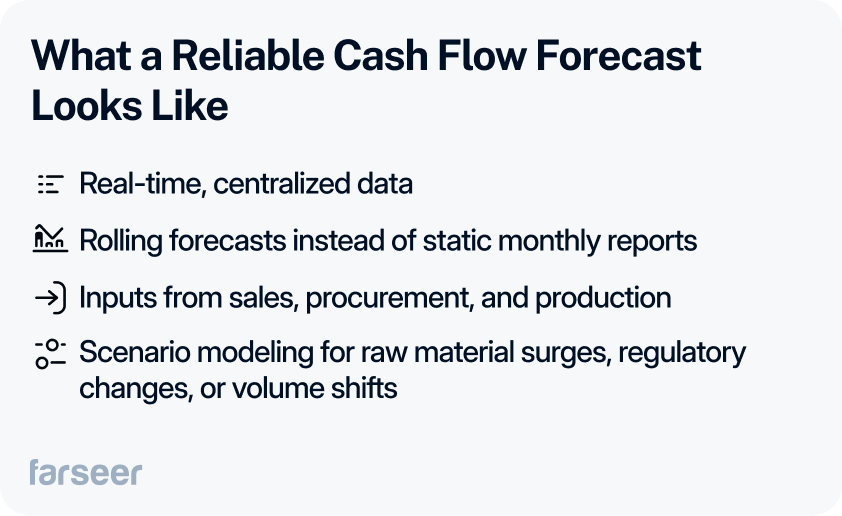
5. Include CAPEX and financing activity
CAPEX is often tracked outside of the standard cash flow forecast, and that comes with great risk. One postponed investment or early payment can significantly impact cash visibility over several months.
Include all large projects, financing plans, loan repayments, and dividend payouts. A logistics company expanding its warehouse or fleet may have multi-million-euro outflows planned across quarters that should be clearly visible in the forecast.
6. Account for seasonality, one-offs, and FX
Most ICP companies have some form of seasonality, whether its sales spikes, bulk orders from key customers, or procurement cycles. Your forecast should reflect that. If you know Q4 is bonus season or when annual supplier contracts renew, include that into the timing.
One-off events like tax settlements, large prepayments, or restructuring costs must also be included. And if you’re working across currencies, be clear about how FX will be handled, either by forecasting in local currency and converting, or planning in group currency with buffers.
7. Validate the output
This is where you catch errors before they become problems. Use historical comparisons to test if the forecast makes sense. Are your projected inflows in line with prior periods? Does a cash surplus next month match what actually happens year after year?
If something looks off, dig into it. Often, it’s an outdated assumption or a missing cost. Controlling teams should be able to trace forecast drivers and explain any big swings, this builds trust in the numbers across the organization.
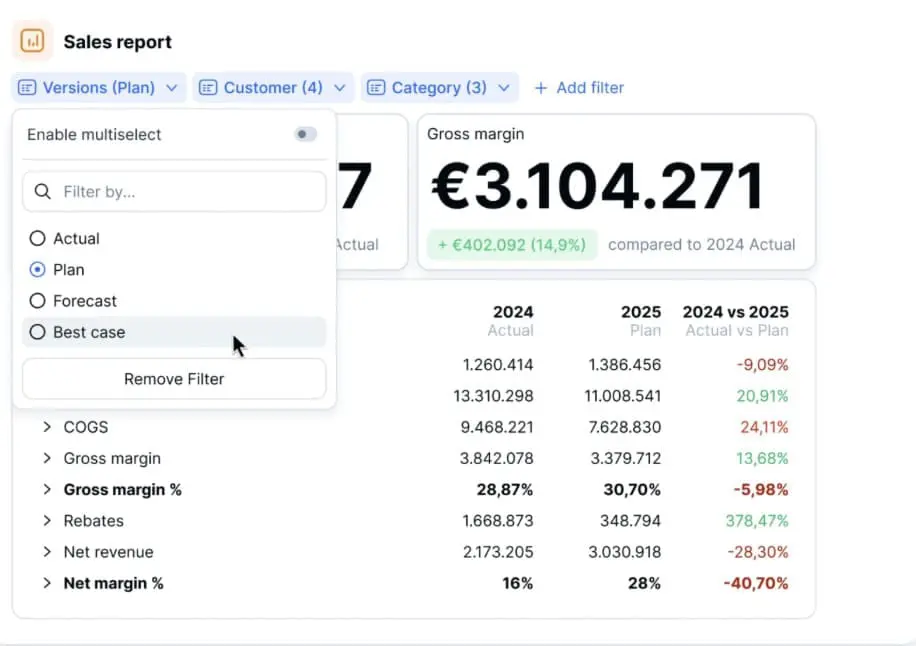
8. Share a single, centralized version
A common source of truth is critical. If sales is working from one forecast, procurement from another, and finance from a spreadsheet last updated two weeks ago, the process is already broken.
Use a shared system or central file where everyone works off the same version. This reduces errors, speeds up consolidation, and makes it easier for senior management to get a real-time view of cash flow without waiting for month-end reports.
Cash flow forecasting is not just about numbers, it’s about coordination. Sales, procurement, treasury, and finance all impact the outcome. Building a structured process with clear roles, clean data, and regular updates will do more to improve accuracy than any formula tweak.
Read more: How to Improve Your Cash Flow Forecast in 4 Easy Steps
Where Does Cash Flow Forecast Usually Break
Even with the right structure and accurate data sources, many cash flow forecasts fall apart in execution. Not because the finance team lacks skills, but because the process depends on inputs and assumptions that shift constantly.
According to CFO Selections, nearly 90% of corporate treasury teams say their current forecasting accuracy is unsatisfactory, highlighting just how difficult it is to get right in practice.
Here are the three biggest reasons forecasts fail:
1. Incomplete or Over-Optimistic Inputs
Sales and AR may assume best-case payment timing, procurement may miss upcoming outflows, and teams often confuse profit with cash. The result: projections that look good but don’t materialize.
2. Disconnected Process and Ownership
Forecasts spread across Excel, email, and ERP systems lead to delays and inconsistencies. When forecasting is treated as “finance’s job” instead of a shared responsibility, reliability drops.
3. Poor Timing
Some forecasts are updated too rarely, others take too long to build. Either way, they fail to support timely decision-making.
When these issues stack up, trust in the forecast erodes—and it stops being a decision-making tool.
Forecasting Time Reduced by 30% and Time for Consolidation of Planning Scenarios reduced by 80% with Farseer in HT
Read case studyIt’s Not About Precision, It’s About Control
Cash flow forecasts are rarely 100% accurate, and that’s not the point. The goal isn’t to predict the future perfectly. It’s to create enough visibility so your team can take action before it’s too late.
According to Gartner, even short-term cash forecasts help identify upcoming cash shortages or surpluses in time to act, turning cash forecasting into a proactive decision-making tool. Even a 70–90% accurate forecast gives finance leaders the chance to adjust payment timing, prepare for tight months, or plan investment windows with confidence.
If your cash flow forecasting still relies on disconnected spreadsheets and inconsistent assumptions, it limits your ability to make timely financial decisions. Improving the process doesn’t require an overnight full transformation.
Start by aligning on actuals, setting a clear update rhythm, and standardizing inputs across departments. Even small changes in structure and ownership can lead to more reliable forecasts and more confident decisions.