Budget Management Software for Business: How to Finally Leave Excel Behind

Budget management software for business is changing how finance teams plan and collaborate. Every finance team knows the pain of spreadsheet chaos – endless versions, broken formulas, and copy-paste marathons just to align numbers.
For years, Excel was the go-to tool for budgeting. It’s flexible and familiar, but as companies grow, it becomes a bottleneck: manual entry slows decisions, version control disappears, and collaboration turns into email chains.
Modern budgeting software fixes that – automating tasks, unifying data, and giving finance leaders real-time visibility across every cost center. It’s the shift from reactive reporting to confident, data-driven planning.
In this guide, we’ll explore how to choose the right tool for your business.
Read more: Strategic Financial Planning That Actually Drives Results
Why Budgeting Still Breaks in Excel
Excel was never built for collaboration, yet most finance teams still rely on it to run multi-million-euro budgets. What starts as a simple spreadsheet quickly turns into a maze of links, macros, and hidden sheets that only a few people truly understand.
According to Ventana Research, more than 60% of organizations still use spreadsheets as their primary budgeting tool, even though it limits accuracy, speed, and collaboration.
Here’s where things usually start to break down:
Version chaos and no single source of truth
Once files start circulating between departments, keeping track of “the right” version becomes impossible. Everyone’s editing locally, formulas get overwritten, and you end up reconciling 10 different sets of numbers.
Manual data entry and errors
Even small mistakes (an extra zero, a misplaced formula) can distort results across the model. Fixing them means hours of manual checks instead of actual planning.
No real-time collaboration or audit trail
Budget reviews happen over email. Comments, approvals, and changes are scattered everywhere, and there’s no clear record of who did what – or when.

Difficult to scale beyond one planner
Excel works when one person owns the file. Add multiple departments or regions, and performance drops. Suddenly, loading a single scenario takes minutes, not seconds.
Finance spends time fixing, not analyzing
Instead of driving performance, finance ends up in survival mode – fixing spreadsheets, reconciling data, and firefighting variances long after the close.
What to Look for in Modern Budgeting Software for Business
- Centralized data model: One governed source of truth for all plans, forecasts, and reports.
- Automation: Automatic data imports, budget vs. actuals, and approval workflows to cut manual work.
- Scenario & rolling forecasts: Easily test assumptions and adjust plans in real time.
- Collaboration & permissions: Finance, operations, and management can plan together securely.
- Integrations: Seamless connection with ERP, CRM, HRIS, and BI tools for consistent data flow.
- Ease of use & fast setup: Intuitive, no-code setup so finance teams can start quickly without IT.
Top Business Budget Management Software for Business in 2026
The budgeting landscape is shifting fast. Finance teams are no longer just reporting on what happened, they’re expected to plan the future in real time.
Modern FP&A tools are moving beyond spreadsheets and legacy systems. Instead of juggling separate platforms for budgeting, forecasting, and reporting, today’s best solutions bring everything together – data, workflows, and collaboration – in one governed model.
Prophix One
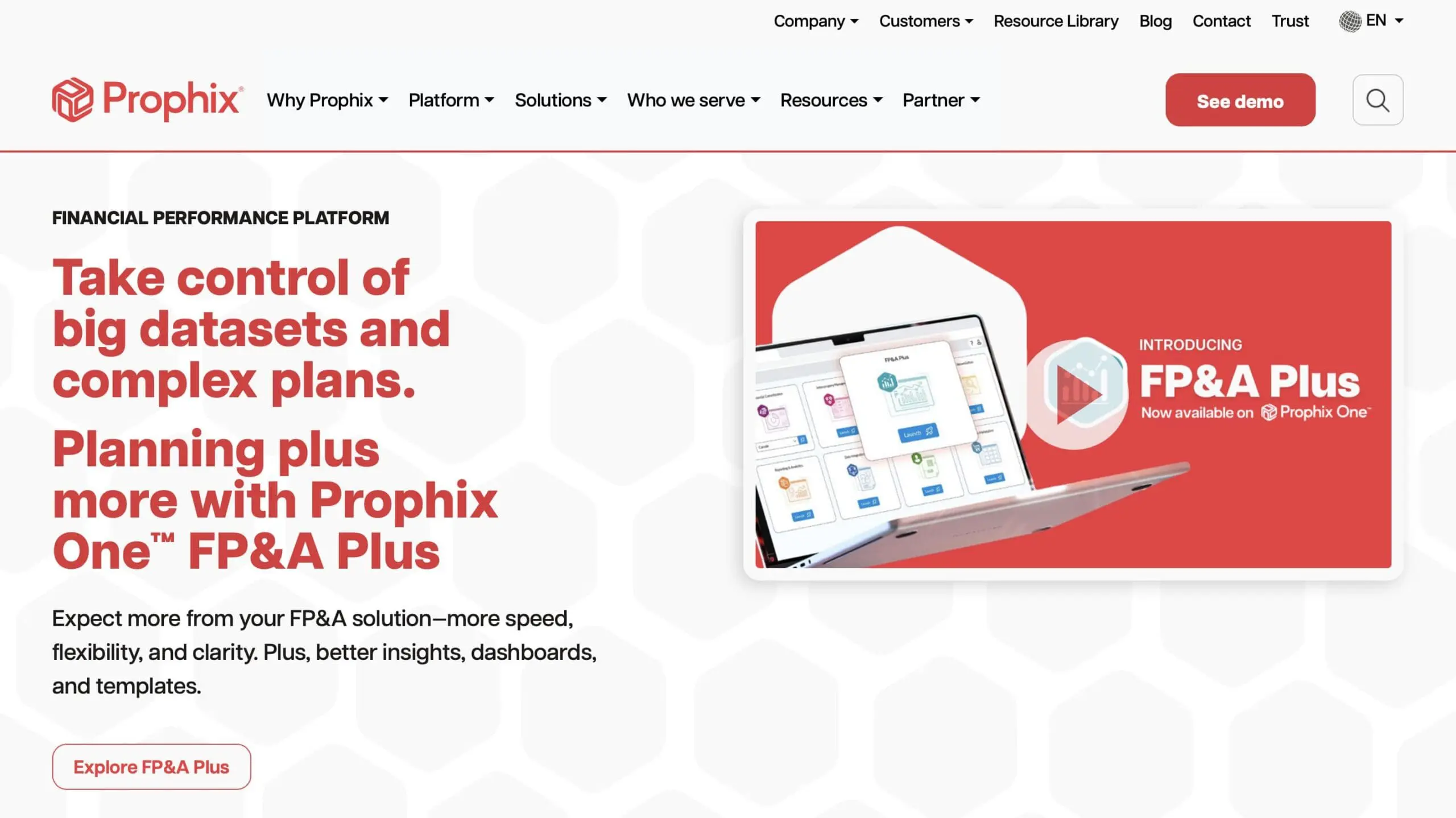
Prophix One is an end-to-end FP&A and financial consolidation platform designed for the Office of the CFO. It combines budgeting, forecasting, reporting, and close management into one system. The platform also includes built-in AI capabilities that surface insights, detect anomalies, and improve forecast accuracy.
Pros
- Covers the full FP&A cycle: planning, consolidation, reporting, and analytics
- AI-driven insights and predictive forecasting
- Comprehensive support, including onboarding and continuous success programs
Cons
- Implementation can be complex and time-consuming
- Higher cost compared to lighter mid-market tools
Best for
Large or enterprise finance teams that need end-to-end control, compliance, and high data governance standards.
Farseer
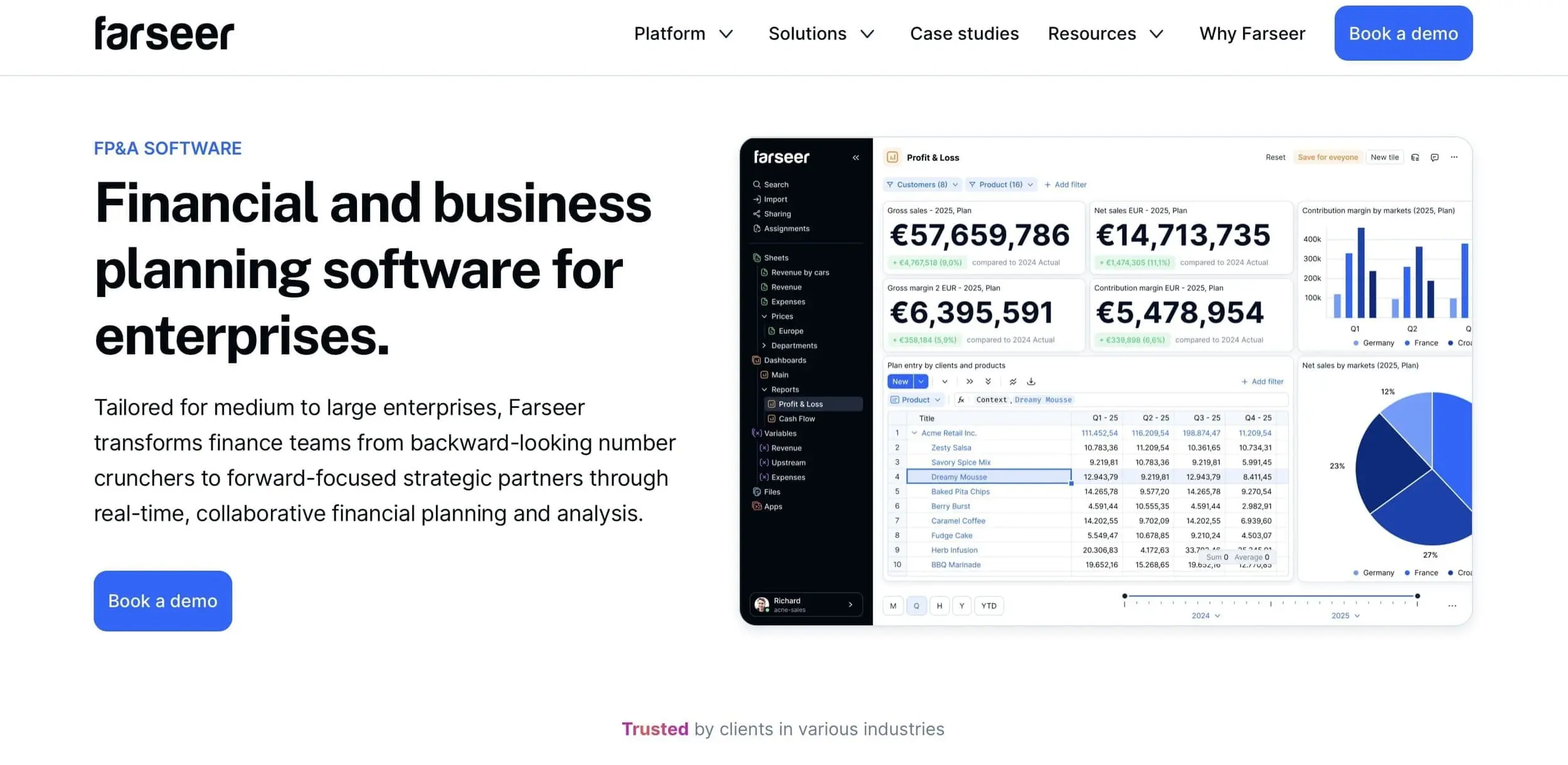
Farseer is a no-code FP&A platform built for modern finance teams that need to plan, budget, and forecast without relying on IT. It replaces scattered spreadsheets and disconnected models with one governed financial environment where everything – from budgeting and scenario planning to consolidation and reporting – runs on a single, centralized model that updates in real time.
Designed for agility and transparency, Farseer empowers finance teams to automate manual work, align all departments under one version of truth, and make faster, data-driven decisions. Its in-memory engine ensures instant calculations across thousands of variables, while its intuitive, spreadsheet-like interface keeps the learning curve minimal.
Layered on top of that governed model is Farseer AI, a suite of three finance-specific agents that work in plain natural language. During the budgeting cycle, the Analyst explains variances between actuals, budget, and forecast across entities or cost centers; the Strategist simulates how a cost increase, headcount change, or pricing shift reshapes the budget before it’s locked; and the Modeler builds new budget logic and dashboards from a simple description in minutes. Because every answer is a real calculation run on the governed model rather than a summary of an export, the numbers stay fully traceable to their assumptions and ready to stand up to audit, rather than the black-box estimates generic AI tools produce.
Pros
- Centralized data model with governed dimensions, version control, and a full audit trail
- Automation of repetitive tasks such as imports, allocations, eliminations, and variance analysis
- Real-time updates and scenario simulations across entities, markets, or cost centers
- AI agents that analyze, simulate, and build budgets in natural language — with traceable, model-grounded answers, not black-box estimates
- No-code modeling; finance teams can build, adjust, and maintain models without IT support
- Fast implementation and scalability for multi-entity environments
- Built-in dashboards and IBCS-certified reporting for immediate insights and consistent, standardized KPI tracking
- Seamless integrations with ERP, CRM, and HR systems for a true single source of truth
- Designed specifically for finance – not adapted from project or BI tools.
Cons
- Not designed for micro-businesses or early-stage startups with very simple structures
Best for
Mid-market and enterprise FP&A teams looking for speed, accuracy, and visibility across complex, multi-entity organizations.
Anaplan
Anaplan, budget management software for business, is an enterprise-level planning and modeling platform known for its scalability and flexibility. It allows global organizations to model complex financial and operational scenarios across multiple business units. With its in-memory Hyperblock™ engine, users can simulate “what-if” scenarios, align financial and operational plans, and collaborate across departments in real time.
Pros
- Highly scalable architecture suited for large global organizations
- Flexible modeling across finance, supply chain, and operations
- Strong collaboration features for cross-functional planning
- Real-time calculations and scenario comparisons
Cons
- Heavy implementation process that often requires specialized consultants
- High maintenance and licensing costs
- Steep learning curve for non-technical users
- Limited visibility for smaller teams without dedicated IT support
Best for
Global enterprises with large, distributed FP&A operations that require extensive customization and cross-department planning.
Read more: Anaplan Competitors – The 6 Best Alternatives for Enterprise FP&A
Planful
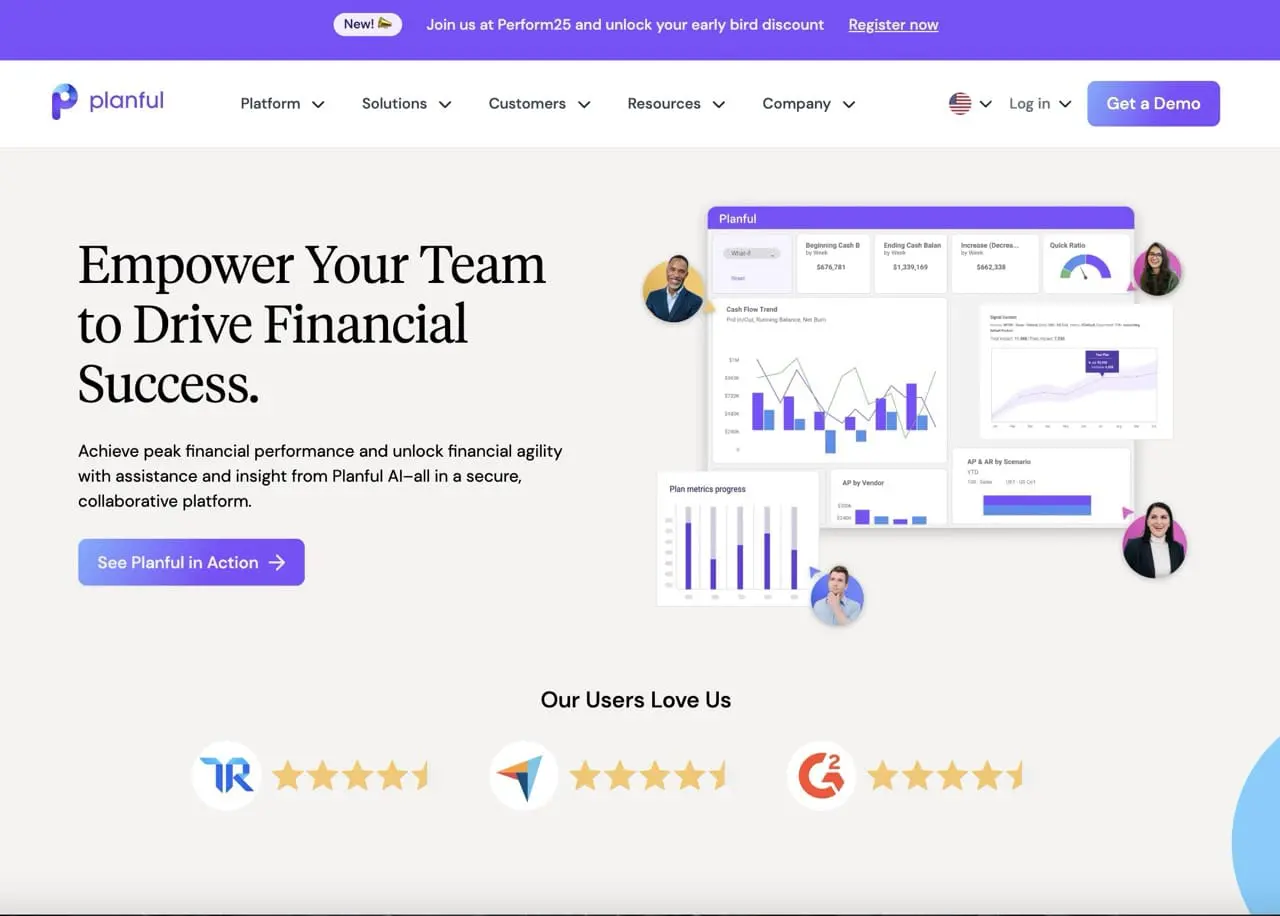
Planful is a cloud-based FP&A platform designed to connect finance and business users across the organization. It centralizes budgeting, forecasting, consolidation, and reporting in one system, allowing teams to collaborate more efficiently and close faster. The platform focuses on usability and automation, helping mid-sized organizations modernize their planning without overhauling existing processes.
Pros
- Intuitive, user-friendly interface with minimal onboarding time
- Automated workflows for faster budgeting and forecasting cycles
- Wide range of integrations with ERPs, CRMs, and BI tools
- Strong collaboration and version control features
Cons
- Limited flexibility for complex or highly customized financial models
- Dynamic planning runs on a separate database layer
- Some advanced analytics require additional licensing
Best for
Mid-sized organizations moving away from Excel-based planning toward a connected, automated FP&A process.
Read more: 6 Planful Competitors Finance Teams Should Consider in 2026
Pigment
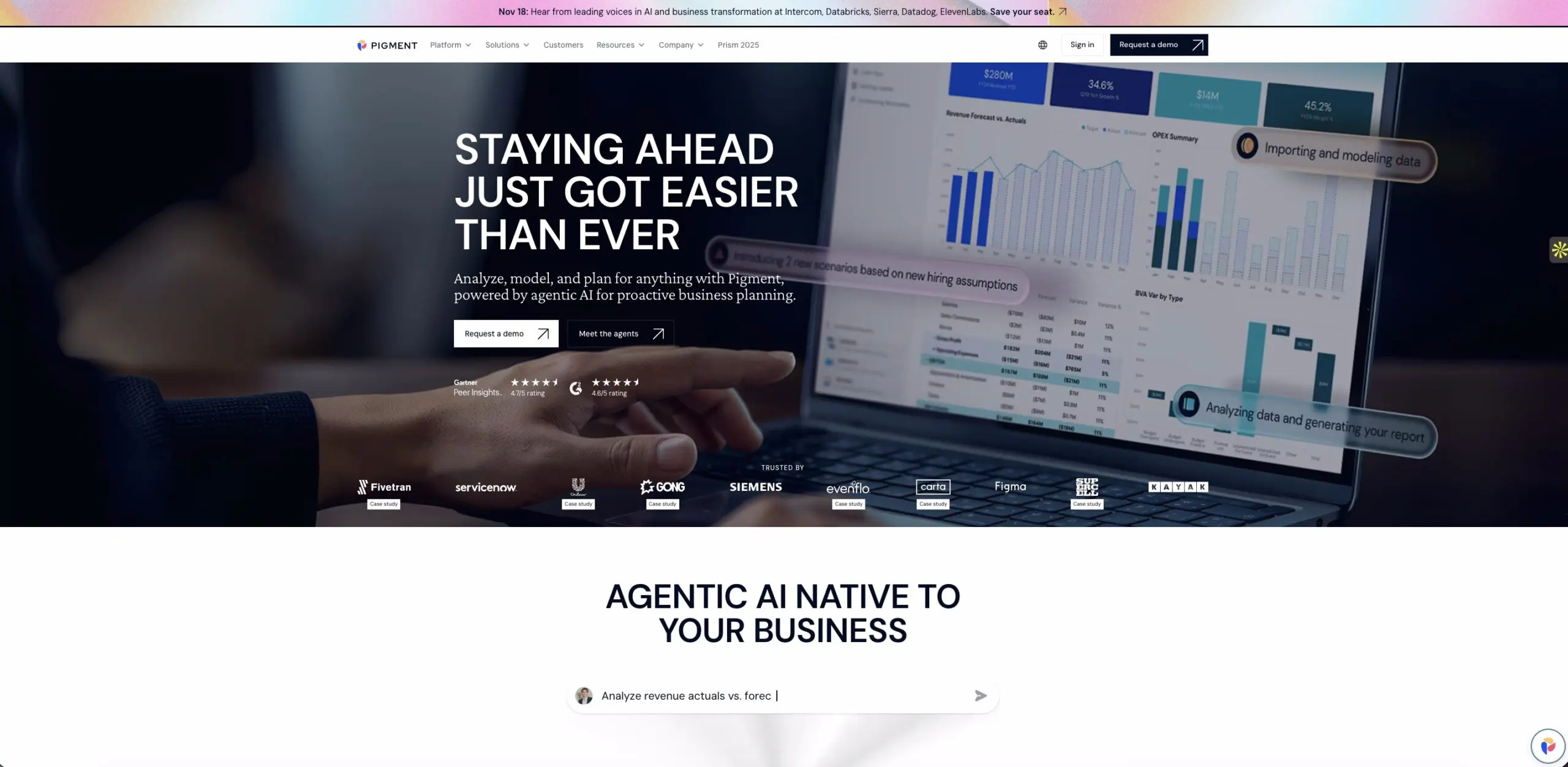
Pigment is a modern business planning platform built for collaboration and agility. It helps finance, sales, and HR teams model data, build scenarios, and analyze performance in real time – all through an intuitive, visual interface. Designed with speed and usability in mind, Pigment enables organizations to create dynamic plans that adapt quickly to change.
Pros
- Highly visual and intuitive interface that encourages cross-team adoption
- Strong integrations with systems like Salesforce, NetSuite, and Workday
- Fast setup and modern UX suited for non-technical users
Cons
- Limited depth for complex consolidations or compliance-heavy environments
- Premium pricing compared to mid-market tools
- Still developing advanced governance and audit-trail features
Best for
Scale-ups and tech-savvy finance teams that value speed, collaboration, and flexible scenario planning.
Workday Adaptive Planning
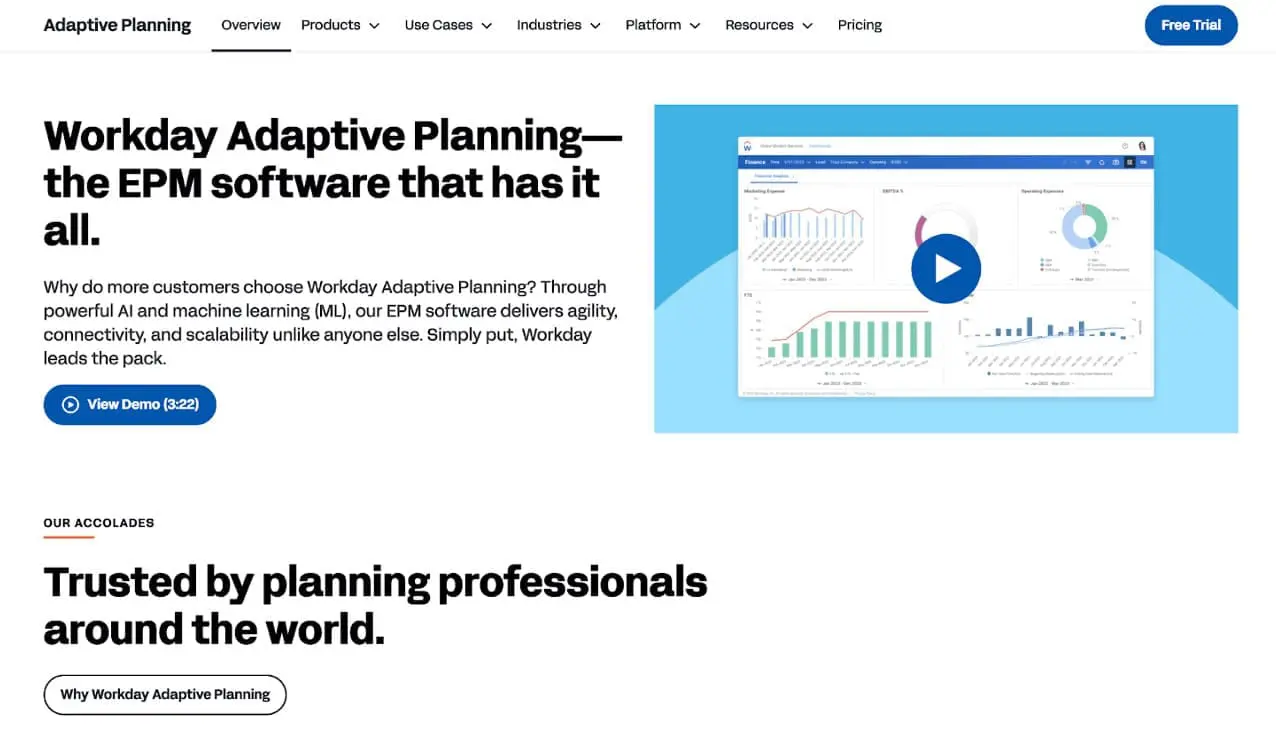
Workday Adaptive Planning, budget management software for business, is an enterprise-grade FP&A platform offering a full suite of financial, workforce, and operational planning modules. Built within the Workday ecosystem, it provides seamless integration for organizations already using Workday ERP. Adaptive Planning enables large teams to model complex scenarios, align departments, and forecast performance across multiple entities.
Pros
- Deep integration with the broader Workday ERP and HR suite
- Scalable and suitable for complex, multi-entity environments
- Prebuilt industry-specific templates for faster deployment
- Strong reporting and workflow capabilities
Cons
- Expensive renewals and rising subscription costs over time
- Complex configuration requiring dedicated admin resources
- Limited flexibility outside the Workday ecosystem
Best for
Large enterprises already using Workday ERP that need a unified planning platform across finance, HR, and operations.
Read more: 4 Workday Adaptive Planning Competitors Worth Considering in 2026
How to Choose the Right Software
Choosing the right budgeting platform isn’t about chasing the longest feature list – it’s about solving the right problems.
Here’s how finance leaders can make that decision with confidence:
- Start from pain points, not features – Identify where your current process breaks – version chaos, manual consolidation, or disconnected data. The right tool should fix your biggest friction first.
- Match complexity to company size and data maturity – A startup doesn’t need enterprise-grade governance, and a global manufacturer can’t scale on spreadsheets. Choose a tool that fits your current stage and can evolve with you.
- Evaluate integrations and onboarding time – Smooth integration with your ERP, CRM, or HR systems saves months of frustration later. If your budgeting process depends on accurate expense data, consider how it connects with travel and expense tools – this overview of types of expense management solutions shows which options fit different business complexities.
- Prioritize scalability and collaboration – Modern planning is a team sport. Look for real-time collaboration, governed access, and the ability to expand to new entities or departments without rebuilding models.
- Consider total cost of ownership – Licenses are just one part of the equation. Add setup, maintenance, and admin costs – then weigh them against the value of speed, automation, and visibility.
Real-Life Case - Delta DMD: From Spreadsheet Chaos to Connected Planning
Delta DMD, one of Serbia’s leading FMCG distributors, faced the same challenges many mid-sized companies do; too many spreadsheets, fragmented data, and long planning cycles that slowed decision-making.
Finance teams were spending more time collecting numbers than analyzing them.
Before
- Dozens of disconnected Excel files across departments
- Long monthly and annual consolidation cycles
- Limited visibility into profitability by brand or market
- Manual reconciliations that introduced risk and delay
After implementing Farseer
- Consolidation and reporting time cut by 50%
- Forecasting automated across business units
- One governed model connecting finance, commercial, and supply teams
- Real-time insight into margins and cash flow
Delta DMD turned budgeting from a reactive process into a strategic one – proof that even established companies can modernize without losing control.
Conclusion
Excel was never built for the kind of finance we do today. What used to be enough for tracking numbers is now slowing teams down; endless versions, broken links, and late-night reconciliations that steal time from actual thinking.
Modern budgeting software changes that. It gives finance a single place where data, people, and plans finally come together. No more chasing inputs or waiting for reports; numbers update in real time, forecasts roll automatically, and everyone works from the same page.
This isn’t just about saving hours. It’s about giving finance the visibility and confidence to steer the business forward.
The shift has already started; from reporting what happened to shaping what happens next. And the teams who make that move first will be the ones everyone else is catching up to.
FAQ
What is business budgeting software?
Business budgeting software helps finance teams plan, forecast, and manage budgets in one centralized platform. It replaces manual spreadsheets with automated workflows, real-time collaboration, and connected data models that improve accuracy and speed.
Why should companies move away from Excel?
Excel works for small-scale planning, but it breaks when complexity increases. Version chaos, manual errors, and slow updates make it nearly impossible for growing teams to maintain accuracy or respond quickly to change. Modern budgeting tools solve these issues with automation and real-time visibility.
How is budgeting software different from ERP systems?
ERPs record financial transactions; budgeting software plans for the future. It pulls data from the ERP and other systems to create forecasts, run scenarios, and align financial targets across departments.
What features matter most when choosing a budgeting tool?
Look for a platform that offers centralized data, strong integrations (ERP, CRM, HRIS), real-time collaboration, scenario planning, and ease of use. Fast implementation and scalability are key for long-term success.
Is budgeting software only for large enterprises?
Not anymore. Modern FP&A tools like Farseer are designed for mid-sized companies too, offering enterprise-grade capabilities without the heavy setup or maintenance cost.