What It Takes to Make a Consolidated Report Work

Every finance team knows the pain behind creating a consolidated report – getting numbers from different departments, aligning inconsistent templates, and merging files never built to fit together. It takes time. And even when it works, the final result often feels more like a patchwork than a clear picture.
That’s exactly what consolidated reporting is supposed to fix.
A consolidated report combines financial and operational data from across the business, different teams, regions, or entities, into a single, structured view. It should answer the question: How are we really performing as a whole?
So, whether it’s tracking group-wide revenue, comparing margins across product lines, or rolling up forecasts from multiple countries, the goal is the same, one version of the truth that supports better decisions.
The challenge? In many companies, consolidation still happens manually. Spreadsheets are emailed back and forth. Data is copied from different systems. Structures don’t align. And by the time the report is ready, the opportunity to act on it may already be gone.
This article looks at why consolidated reporting still breaks in 2025, where it adds the most value, and how to make it a tool for real decision-making, not just another reporting task.
Read more: Financial Consolidation: Definition, Challenges & Solutions
Why Consolidated Reporting Still Fails
Most finance teams know the value of consolidated reporting, but very few have a process that actually works at scale. In theory, it should be simple: bring together financials from across the business, align them, and create a single view of performance. In practice, it rarely looks like that.
The problem often starts with structure. Different entities may use different charts of accounts, planning timelines, or reporting formats. Without consistency, consolidation becomes more about fixing mismatches than producing insight.
Then there’s the manual workload. Many companies still rely on spreadsheets, email templates, and disconnected systems to pull everything together. According to KPMG, this is still the norm, with finance teams spending valuable time stitching together reports instead of analyzing results.

Even where the data is available, the process itself lacks the control and alignment finance needs. A recent Gartner report found that only 3% of companies have fully integrated their strategic, operational, and financial planning processes, making it difficult to build a report that actually reflects the full business. And when actuals, budgets, and forecasts are all managed in different tools or formats, reporting becomes fragmented and outdated the moment it’s published.
Gartner also notes that consolidation has become a domain of its own, with specialized tools and workflows required to manage close processes, intercompany eliminations, and real-time reporting across entities, In other words, what used to be a finance spreadsheet task now requires infrastructure.
These challenges don’t just slow down reporting. They reduce trust in the numbers, disconnect finance from operations, and delay decision-making, especially in businesses that are growing, expanding, or managing multiple markets.
What Needs to Change for Consolidated Reporting to Work
To make consolidated reporting work as a decision-making tool, a few core elements need to be in place. It’s about building a process that’s structured, reliable, and fast enough to support the business. Here’s what needs to change:
Align Structures Across the Business
If business units use different account mappings, reporting calendars, or levels of detail, consolidation will always be messy. Standardizing the chart of accounts and data structures across the business isn’t a nice-to-have, it’s the only way to create reports that hold up at group level.
Read more: Consolidation Entries 101 – A Modern Guide for Finance Teams
Stop Relying on Manual Data Collection
When actuals, forecasts, and plans are pulled manually from ERPs, spreadsheets, or BI tools, the process slows down and introduces risk. Automating data flow into a single model, with proper controls and ownership, gives finance the ability to focus on interpretation, not data wrangling.
Read more: 10 AI Use Cases in Finance & FP&A: You Can Implement Today

Use One System for Planning and Reporting
Consolidation works best when planning and reporting happen in the same environment. If actuals, budgets, and forecasts live in separate tools, it becomes difficult to align logic, timelines, or decision points. Modern FP&A tools like Farseer are built to support this, enabling one system, one structure, and one version of the truth.
Move Beyond the Month-End Cycle
A consolidated report shouldn’t be treated as a static, month-end output. To support real decision-making, it needs to reflect current conditions and respond to changes. That’s only possible when the process is built for speed and continuous updates, not locked into a fixed calendar.
The Basics You Can’t Skip for Successful Consolidated Reporting
A consolidated report should do more than summarize numbers. It should give a clear, reliable view of business performance across entities, departments, or regions. Here are three fundamentals that make the biggest difference:
1. One model, not multiple files
All actuals, forecasts, and budgets should live in a single system with the same structure, logic, and version control. When reports are built from disconnected spreadsheets or systems, consolidation becomes slow and unreliable.
2. Aligned structures across the business
Consolidated reporting only works when everyone uses the same rules. That means a unified chart of accounts, shared cost center definitions, and consistent reporting timelines across all business units. Without that, group-level reporting loses reliability.
3. Reporting tied to planning, not separate from it
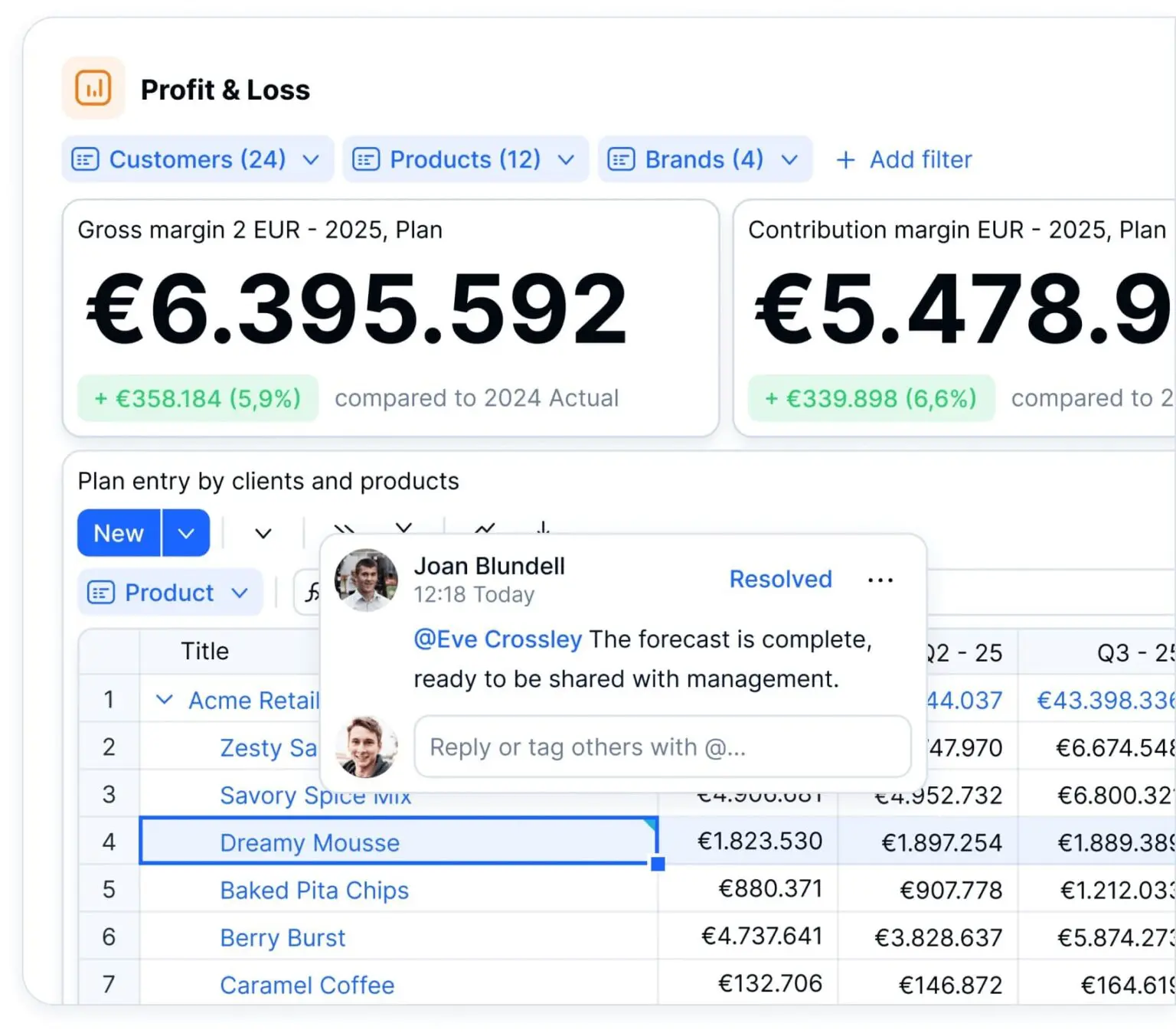
The most useful consolidated reports are connected to the financial model. That means finance can explain variances, reforecast quickly, and give leadership a forward-looking view, not just a historical one. This only works when reporting and planning run in the same environment.
Read more: Best Consolidation Software in 2025: Top Tools, Key Features, and How to Choose
Making It Work Long-Term
Consolidated reporting shouldn’t be something the finance team dreads every month, or something leadership waits on. When done right, it becomes a reliable, repeatable process that supports faster decisions and stronger accountability across the business.
However, it only works long-term if the foundation is solid: standardized structures, consistent data flows, and a shared environment where planning and reporting use the same logic. Without that, teams spend more time aligning spreadsheets than actually understanding performance.
The real value comes when reports move from static outputs to dynamic layers of insight, showing not just where the business stands but where it’s heading. For companies operating across multiple markets, teams, or product lines, that visibility is essential.


Financial Consolidation: Definition, Challenges & Solutions
Read more
Consolidation Entries 101 – A Modern Guide for Finance Teams
Read more