
Most finance teams think Artificial intelligence (AI) adoption requires a massive technology overhaul.
It doesn’t.
Many of the most powerful AI applications in finance can be implemented with tools teams already use: Excel, Python, and modern AI assistants.
The question is no longer whether AI will enter finance. The real question is which teams will learn to use it first.
AI is no longer a futuristic concept for finance teams. It is here, it is accessible, and it is fundamentally changing the way FP&A professionals work. From cleaning messy data to generating variance commentaries, AI is reshaping every layer of the finance function.
Yet many finance leaders remain unsure of where to start. The technology landscape is overwhelming, and the gap between proof-of-concept and production-ready implementation can feel enormous.
This article is designed to close that gap.
Below, you will find ten specific, practical AI use cases that FP&A teams and finance departments can implement. Many of them can be implemented today with tools that are already available.
Whether you are a CFO looking to streamline operations, an FP&A analyst tired of manual data wrangling, or a finance manager seeking better reporting, these use cases offer a clear roadmap.
Let us dive in.
1. Data Cleaning and Analysis
Most finance teams are overloaded with data. They lack time. Analysts spend most of their time cleaning spreadsheets instead of analysing data.
Finance teams spend an estimated 60–80% of their time on data preparation. Inconsistent formats, duplicate entries, missing values, and mismatched account codes are the daily reality for anyone working with financial data sourced from ERPs, spreadsheets, and third-party systems. Poor data quality directly undermines every downstream activity from budgeting to board reporting.
AI-powered tools can automate the identification and resolution of data quality issues at scale. Large language models such as Claude AI, when paired with Excel or Python, can parse unstructured data, standardise naming conventions, flag outliers, and reconcile figures across datasets.
Read: What Great Financial Reporting and Analytics Actually Look Like
Examples:
- You can upload a messy trial balance into Claude and instruct it to clean, categorise, and restructure the data into a consistent chart of accounts format —a task that might take an analyst several hours can now be completed in minutes.
- A mid-market company receives monthly sales data from 12 regional subsidiaries in different formats. An AI-powered cleaning pipeline standardises all submissions into a unified template, flags discrepancies, and generates a reconciliation summary reducing month-end close time by two days.
The benefits are substantial: reduced manual effort, improved accuracy, faster turnaround, and a consistent data foundation for analysis. The primary challenge is trust. Finance professionals must validate AI outputs, especially in the early stages. Building a review-and-approve workflow is essential.
2. Financial Modelling
Financial modelling is the backbone of FP&A. AI enhances modelling across four critical dimensions.
Read: The 7 Core Components of a Financial Model Every FP&A Professional Should Master
2A. Scenario Planning
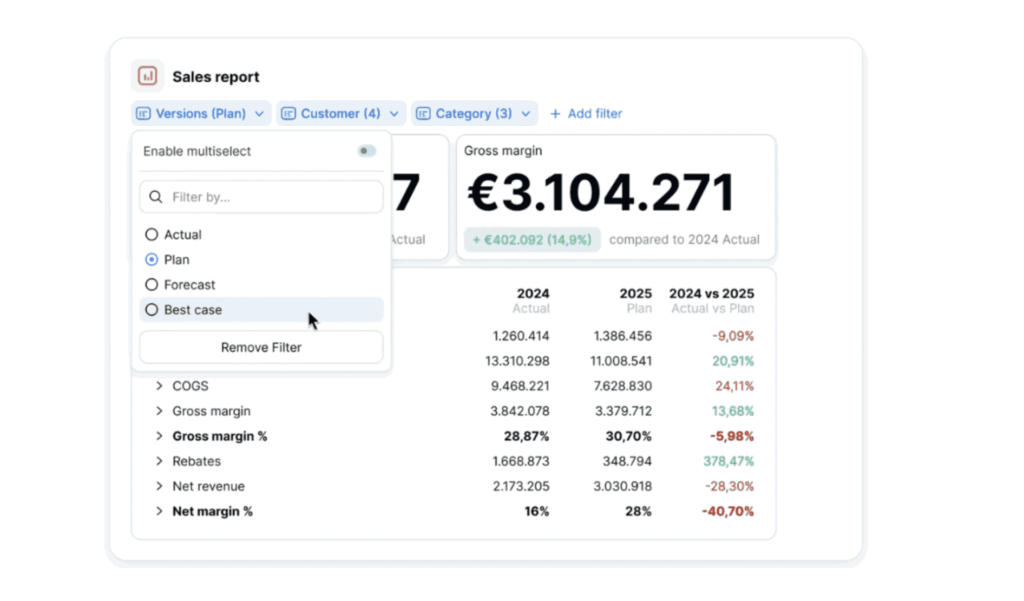
Traditional scenario planning involves manually building best-case, base-case, and worst-case projections. AI transforms this by enabling dynamic, multi-variable scenario generation. Instead of three static scenarios, AI can generate hundreds of simulations based on probability distributions of key assumptions—revenue growth rates, cost inflation, currency movements, and interest rates.
AI tools can also analyse historical patterns to suggest which scenarios are most probable. For instance, Claude AI can review five years of revenue data alongside macroeconomic indicators and generate a set of plausible scenarios ranked by likelihood. This shifts scenario planning from an art to a data-driven discipline.
Example: A retail company uses AI to model the impact of a potential tariff increase on imported goods. The AI analyses supplier data, historical margin data, and competitor pricing to generate five distinct scenarios with P&L implications for each.
2B. Three-Statement Financial Model
Building a fully integrated three-statement model of the income statement, balance sheet, and cash flow statement is one of the most complex tasks in FP&A. AI can accelerate this process significantly. By providing historical financial data and key assumptions, an AI assistant can generate the initial model structure, populate formulas, and ensure the statements are correctly linked.
AI is particularly powerful for error-checking in three-statement models. It can audit formula logic, verify that the balance sheet balances, confirm that cash flow reconciles to changes in balance sheet items, and flag circular references. This reduces the risk of model errors that can lead to flawed strategic decisions.
Example: An FP&A analyst uploads three years of financials into Claude AI and asks it to build a five-year projection model in Excel. The AI generates the model with linked statements, assumption tables, and sensitivity toggles ready for review and refinement.
2C. Cash Flow Forecasting
Cash is king, and accurate cash flow forecasting is critical for liquidity management, investment planning, and covenant compliance. AI improves cash flow forecasting by analysing historical cash patterns, identifying seasonality, and incorporating predictive signals that traditional methods miss.
Read: Choosing Enterprise Cash Flow Forecasting Software: Top Platforms for 2026
Machine learning models can learn from patterns in accounts receivable ageing, payment behaviour of key customers, and vendor payment cycles to produce more granular and accurate 13-week cash flow forecasts. AI can also flag early warning signs such as a deteriorating days-sales-outstanding trend before they become critical.
Example: A manufacturing company uses an AI-enhanced cash flow model that incorporates customer payment history, seasonal demand patterns, and raw material price forecasts to produce a rolling 13-week cash flow projection updated weekly.
2D. Sensitivity Analysis
Sensitivity analysis examines how changes in key assumptions impact financial outcomes. AI supercharges this process by automating the generation of tornado charts, data tables, and what-if matrices. Rather than manually adjusting one variable at a time, AI can run multi-dimensional sensitivity analyses that show the combined effect of simultaneous changes in revenue growth, COGS, and operating expenses.
AI can also identify which variables have the highest sensitivity, helping leadership focus their attention on the assumptions that matter most. This is particularly valuable during budgeting cycles and capital allocation decisions.
Example: A SaaS company uses AI to determine that customer churn rate and average contract value are the two variables with the highest sensitivity in their DCF model, leading the CFO to prioritise retention initiatives in the annual plan.
3. Budgeting – Consolidation
Budget consolidation is one of the most painful processes in finance. It involves collecting budget submissions from multiple departments, business units, or entities, reconciling them, eliminating intercompany transactions, and producing a consolidated budget. The process is error-prone, time-consuming, and often involves dozens of spreadsheet versions.
Read: Budgeting vs Forecasting: When to Use Each
AI streamlines consolidation by automating data collection, validation, and aggregation. AI tools can parse budget submissions regardless of format differences, map line items to a standardized chart of accounts, and flag submissions that fall outside expected ranges. AI-powered consolidation can also automate intercompany elimination entries and currency translation for multinational organisations.
Moreover, AI can learn from prior-year consolidation adjustments to suggest recurring entries, reducing the manual effort required by the consolidation team. The combination of AI with cloud-based FP&A tools such as Farseer creates a powerful end-to-end budgeting workflow.
4. Forecasting
Forecasting is the forward-looking engine of FP&A. AI enhances forecasting across three methodologies.
4A. Statistical Forecasting
Statistical forecasting uses mathematical models like time series analysis, regression, exponential smoothing, ARIMA to project future values based on historical data.
AI makes these techniques accessible to finance professionals who are not statisticians. Tools like Claude AI can analyse historical revenue or expense data and recommend the most appropriate statistical model, run the analysis, and generate a forecast with confidence intervals.
AI can also automatically detect structural breaks in data such as the impact of COVID-19 on revenue trends and adjust models accordingly, something that requires manual intervention in traditional approaches.
4B. Driver-Based Forecasting
Driver-based forecasting links financial outcomes to operational drivers such as headcount, pipeline conversion rates, customer acquisition costs, or production volumes. AI excels at identifying which drivers have the strongest correlation with financial outcomes and quantifying those relationships.
By analysing historical data, AI can reveal non-obvious driver relationships. For example, it might discover that employee engagement scores from quarterly surveys are a leading indicator of sales productivity three months later. AI can then incorporate these drivers into the forecasting model, creating a more nuanced and accurate projection.
Example: A subscription business uses AI to build a driver-based revenue forecast that links new customer signups, churn rate, average revenue per user, and upsell conversion rates into a cohesive model that is updated monthly with actuals.
4C. Rolling Forecasting
Unlike static annual forecasts, rolling forecasts continuously extend the forecast horizon. Typically 12 to 18 months and are updated monthly or quarterly. AI is a natural fit for rolling forecasts because it can automatically ingest new data, recalibrate models, and generate updated projections without manual intervention.
Read: FP&A Monthly Calendar
AI-enabled rolling forecasts adapt to changing conditions in near real-time, providing leadership with an always-current view of the future. This is particularly valuable in volatile industries where annual budgets quickly become outdated.
Example: An energy company maintains a rolling 18-month forecast that is automatically updated every month. AI recalibrates the forecast based on actual production data, commodity price movements, and regulatory changes, giving the CFO a continuously refreshed outlook.
5. Management Reporting – Variance Analysis Commentaries
Variance analysis is explaining the difference between actual results and budget or forecast is a core FP&A deliverable. Yet writing variance commentaries is one of the most time-consuming and repetitive tasks. Every month, analysts must review dozens or hundreds of line items, calculate variances, determine root causes, and write narrative explanations.
AI can automate the generation of variance commentaries by analysing actual-versus-budget data, identifying material variances, classifying them by type (volume, price, mix, timing), and generating plain-English explanations.
Claude AI, for instance, can process a P&L comparison and produce commentary such as: “Revenue was favourable by $2.1M (8%) versus budget, primarily driven by higher-than-expected volumes in the North American segment, partially offset by unfavourable pricing in EMEA.”
The AI can be trained on an organisation’s preferred reporting style, terminology, and materiality thresholds, ensuring consistency across reporting periods and business units.
6. Data Visualisation – Charts and Dashboards
A well-designed chart can communicate a financial story in seconds that a spreadsheet table cannot convey in minutes. Data visualisation is critical for stakeholder communication, board reporting, and operational decision-making. Yet many finance teams still rely on static Excel charts that lack interactivity, context, and design quality.
AI enhances data visualisation in two key ways.
First, it can recommend the most appropriate chart type for a given dataset and audience. For example, suggesting a waterfall chart for a bridge analysis or a sparkline dashboard for trend monitoring.
Second, AI can generate the charts and dashboards themselves, either in Excel, Power BI, or web-based tools.
Claude AI, for instance, can take a dataset and generate interactive dashboards with charts, KPI cards, and drill-down capability all from a single prompt. AI can also apply International Business Communication Standards (IBCS) formatting principles automatically, ensuring that charts follow best practices for financial reporting.
Example: An FP&A analyst provides Claude with monthly revenue and expense data and asks for an executive dashboard. The AI generates a responsive dashboard with revenue trend charts, expense breakdown by category, margin analysis, and year-over-year comparison ready for presentation to the leadership team.
7. Accounts Receivable and Collections Optimisation
Managing accounts receivable effectively is crucial for maintaining healthy cash flow. AI can analyse customer payment behaviour, credit histories, and external signals to predict which invoices are likely to be paid late or become delinquent. This allows finance teams to prioritise collection efforts on high-risk accounts.
AI-powered AR tools can also automate dunning (payment reminder) communications, personalising the tone and timing of payment reminders based on customer segment and payment history. Machine learning models continuously improve their predictions as new payment data becomes available, creating a virtuous cycle of better collections performance.
Example: A distribution company implements an AI-based AR scoring system that ranks outstanding invoices by probability of late payment. The collections team focuses on the top 20% highest-risk invoices first, reducing DSO by 8 days within two quarters.
8. Fraud Detection and Anomaly Identification
Financial fraud and data anomalies can cause significant losses and compliance failures. Traditional rule-based systems catch known patterns but miss novel fraud schemes. AI and machine learning models can identify subtle anomalies in transaction data, journal entries, and expense reports that would be invisible to rule-based systems.
AI-powered anomaly detection analyses patterns across millions of transactions to identify outliers like unusual vendor payments, duplicate invoices, round-number journal entries at period-end, or expense claims that deviate from an employee’s historical pattern. These systems can flag suspicious transactions for review in real-time, enabling proactive fraud prevention rather than reactive detection.
Example: An internal audit team deploys an AI anomaly detection model on the general ledger. The system identifies a series of journal entries that were consistently posted just below the approval threshold, leading to the discovery of a $400K procurement fraud.
9. Natural Language Querying of Financial Data
One of the most transformative AI capabilities for finance is the ability to query financial data using plain English. Instead of writing complex SQL queries, building pivot tables, or navigating BI tool interfaces, users can simply ask questions: “What was our gross margin by product line last quarter?” or “Show me the top 10 customers by revenue growth year-over-year.”
AI-powered natural language interfaces sit on top of existing data warehouses, ERP systems, or even Excel workbooks and translate questions into data queries, execute them, and return results in a conversational format. This democratises data access across the finance organisation, empowering business partners and non-technical stakeholders to self-serve insights without waiting for analyst support.
Example: A regional finance director types into the company’s AI-powered dashboard: “Compare Q3 operating expenses across all business units, highlight any that exceeded budget by more than 15%.” The system returns a formatted comparison table with flagged variances and a brief AI-generated explanation of the key drivers.

10. Automated Financial Document Processing
Finance teams process vast volumes of documents including invoices, contracts, purchase orders, bank statements, tax forms, and audit confirmations. Manually extracting data from these documents is tedious, error-prone, and a significant bottleneck in many finance operations.
AI-powered document processing uses optical character recognition (OCR), natural language processing, and machine learning to automatically extract, classify, and validate data from financial documents. Modern AI models can handle unstructured documents with varying layouts, extract key fields (amounts, dates, counterparties, payment terms), and feed the data directly into accounting systems or ERP platforms.
This technology is particularly powerful for invoice processing, where AI can match invoices to purchase orders, flag discrepancies, and route exceptions for approval—dramatically reducing accounts payable processing time.
Example: A shared services centre processes 5,000 invoices per month. After implementing AI-powered document processing, 80% of invoices are matched and posted automatically without human intervention. Exception handling time drops by 60%, and the team is redeployed to higher-value activities.
Conclusion: From Experimentation to Implementation
The use cases outlined above represent a practical roadmap for finance teams ready to embrace AI. They span the full FP&A lifecycle. Right from data preparation and modelling to reporting and process automation. Importantly, none of these use cases require a massive technology overhaul. Many can be implemented incrementally, starting with tools like Claude AI, Excel, Power BI, Python and FarseerAI.
The key to successful AI adoption in finance is not the technology itself but the mindset shift it requires. AI does not replace the judgement and expertise of finance professionals. It amplifies their capabilities, automates the repetitive, and frees them to focus on what matters most: providing strategic insight, challenging assumptions, and guiding better decisions.
Finance leaders who invest in building AI literacy within their teams, establish clear governance frameworks for AI outputs, and create a culture of experimentation will be the ones who unlock the full potential of this technology.
The question is no longer whether AI will transform finance and FP&A. It is whether your team will lead that transformation or be left behind.
FAQ
No. Many AI use cases can be implemented using tools finance teams already use, such as Excel, Python, Power BI, and AI assistants like Claude. The biggest shift is not technology, but mindset—starting small and integrating AI into existing workflows.
The fastest wins typically come from:
- Data cleaning and preparation
- Variance analysis commentary generation
- Scenario planning and forecasting
These are high-effort, repetitive tasks where AI can deliver immediate time savings and accuracy improvements.
AI can be highly accurate, but it should not be used without validation. Finance teams should implement review and approval workflows, especially in early adoption stages. Over time, as models are refined and trained on company-specific data, trust and reliability increase significantly.
No. AI does not replace finance professionals—it augments them. It automates repetitive, manual tasks and allows analysts to focus on higher-value work such as strategic planning, decision support, and business partnering.
The biggest barrier is not technology—it is uncertainty about where to start and lack of internal confidence. Many teams are overwhelmed by the landscape. The most effective approach is to begin with small, practical use cases and scale from there.